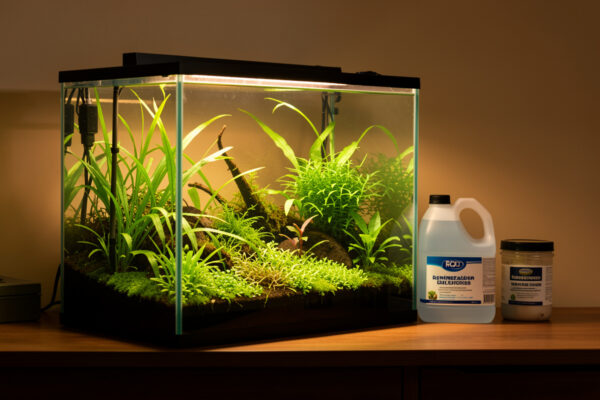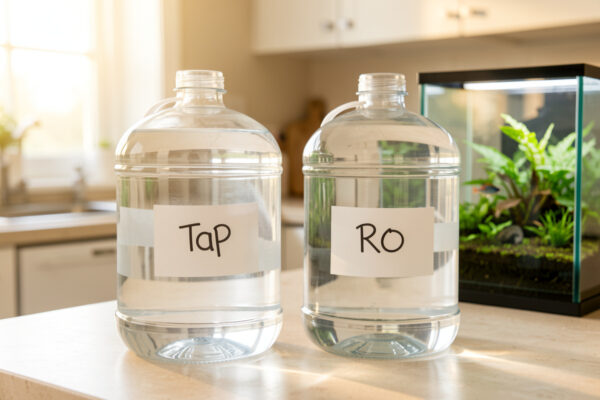
A TDS meter measures your aquarium water’s electrical conductivity and converts it to an estimate of total dissolved solids in parts per million. It’s the cheapest serious instrument in the hobby — under $20 — and the one that ties your whole water system together. But it only tells the truth if you calibrate it, because an uncalibrated pen reading 12 ppm on pure RO is lying to your face. Here’s the routine I actually run.
I came to aquariums through years of hydroponics, where I metered conductivity on nutrient reservoirs every single day, and the pen in my aquarium drawer is the same instrument discipline transplanted. Most aquarium content treats the TDS meter as a gadget you dip and forget. I treat it as a calibrated instrument, because a number you can’t trust is worse than no number at all — it hands you false confidence, which is exactly how a drifting pen cost me shrimp before I ever suspected the meter itself. This is the calibration and usage routine that turns a cheap pen into a tool you’d stake a colony on.
This lives inside the broader RO and water-source system, and the meter is what makes every other part of that system measurable — from checking your RO/DI output to confirming a remineralization batch hit target.
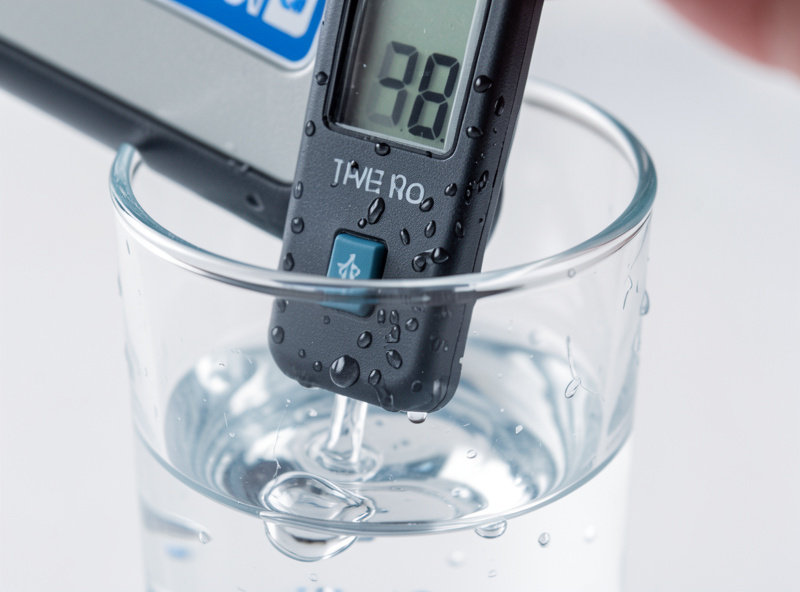
What Does a TDS Meter Actually Measure?
Here’s the thing that surprises people: a TDS meter doesn’t count solids at all. It measures the water’s electrical conductivity — how easily current passes between two electrodes — and dissolved ions (minerals, salts) carry that current, so more dissolved solids means higher conductivity. The meter then multiplies conductivity by a conversion factor to display a ppm estimate. That word “estimate” is doing real work.
The conversion factor is why two meters can read the same water differently. Conductivity is measured in microsiemens (µS/cm), and to convert to ppm the meter assumes a factor — commonly 0.5 (the NaCl scale) or 0.7 (the 442 or “natural water” scale). A meter using 0.5 will read lower than one using 0.7 on the exact same water. Neither is wrong; they’re using different assumptions. This is why comparing your ppm number to someone else’s online is shaky unless you both know your conversion factors. What matters is internal consistency — your meter, reading your water, the same way every time.
For aquarium work, the absolute ppm value matters less than tracking change. I don’t obsess over whether my remineralized water is “really” 180 or 195 ppm on some universal scale. I care that it reads the same number every time I mix to my recipe, that my RO reads near zero, and that my tank water’s number moves in ways I understand. Consistency beats accuracy for husbandry — but you only get consistency from a calibrated meter. The USGS has a clear primer on water science and conductivity if you want the physics under the hood.
Why an Uncalibrated Meter Lies
TDS meters drift. The electrodes foul, the internal reference ages, and the temperature compensation isn’t perfect, so a meter that was dead-on out of the box will slowly wander. A pen that reads 8 or 12 ppm when dipped in pure RO water — which you know should be near zero — isn’t detecting mystery solids; it’s telling you the pen itself is off. I’ve seen cheap meters drift 10 to 15 ppm within months of casual use.
That drift is dangerous precisely because the number looks authoritative. A digital readout feels like truth. So a keeper mixing shrimp water to “180 ppm” on a meter that actually reads 30 high is really mixing to 150, and if that gap sits in the wrong place, the shrimp pay for it. The meter didn’t fail loudly — it failed quietly, handing over a confident wrong answer. That’s the whole case for calibration: not perfectionism, but catching the silent lie before your livestock does.
My Calibration Routine, Step by Step
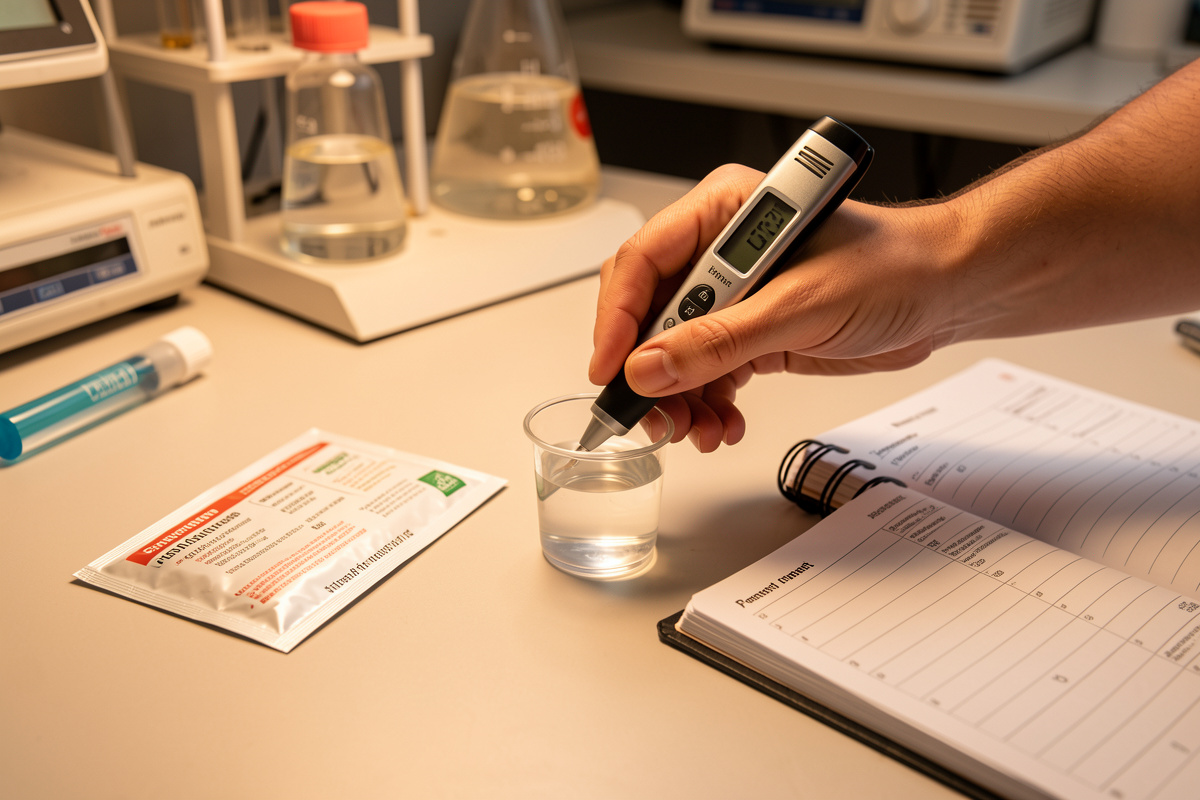
Calibration means dipping the meter in a solution of known conductivity and adjusting the meter to read the correct value. Here’s exactly what I do. I keep a bottle of calibration standard — a 342 ppm NaCl solution (equivalently 1413 µS/cm at 25°C), which is the common reference. I pour a small amount into a clean cup — never dip directly into the stock bottle, because that contaminates your standard — and let it come to room temperature, because conductivity changes with temperature and a cold standard throws the reading.
I dip the meter, wait for the number to stabilize (a few seconds), and if it doesn’t read the standard’s value, I adjust it — most pens have a small trimmer screw or a calibration button. Then I rinse the probe in a little RO water, dip it in fresh standard again, and confirm. Two consistent reads and I trust it. The whole thing takes under three minutes and I log the date. If the pen needed a big adjustment, I note that too, because a meter that drifts fast is a meter on its way out.
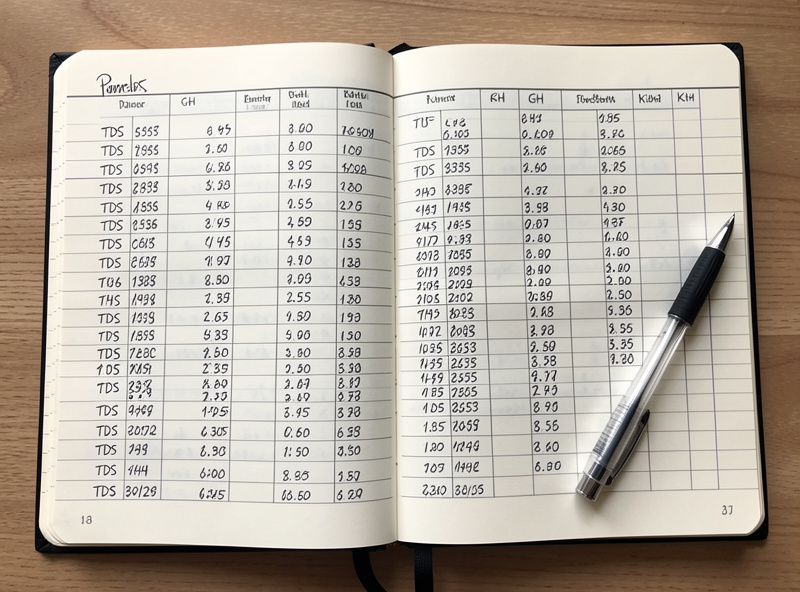
A few details that matter. Temperature is the big one — calibrate and measure at similar temperatures, because most cheap pens compensate imperfectly. Keep the probe clean; mineral scale on the electrodes skews readings, and a wipe with RO water after each use extends the pen’s honest life. And store the standard sealed and out of heat, because an evaporated or contaminated standard calibrates your meter to the wrong value, which is worse than not calibrating at all.
What My Readings Actually Tell Me
Once calibrated, the pen runs my whole water bench. My RO/DI output should read near zero — 0 to 2 ppm. The morning it climbs to 5 or 8, I know the membrane or DI resin is tiring, and that number is my maintenance alarm long before anything visible goes wrong. My remineralized mixing water reads my recipe target — about 180 ppm for the Neocaridina colony — and confirming that before I use it means I never dose shrimp with mismatched water again.
Tank water is the interesting one. It reads a bit higher than my mixing water because of accumulated waste and evaporation concentrating the minerals, and watching that number creep upward between water changes tells me the bioload story before nitrate does. A sudden jump means something died and is decomposing, or I overfed; a slow steady climb is normal concentration I reset with the next water change. On my shrimp tank especially, a stable TDS is a stable colony — the pen catches drift I’d otherwise only notice when the shrimp stopped molting well.
The number I care about most on the shrimp tank is stability, not any specific value. Neocaridina tolerate a range, but they hate swings, and a nano’s small volume swings fast. The pen lets me catch a 40 ppm drift and correct it with a small water change before it becomes a stress event. That’s the parameter-log method in action: measure, log, spot the trend, act early.
How Often Should You Calibrate, and When Do You Replace?
My rule is calibrate monthly for a pen in regular use, and always before any critical measurement — like mixing a fresh shrimp batch or diagnosing a problem. If a pen is new and holding calibration well, I stretch to every six weeks; if it’s drifting, I check more often. The check itself is so quick that erring toward more frequent costs nothing but three minutes.
Replace the meter when it won’t hold calibration, when the adjustment range runs out, or when readings become erratic and jumpy even in fresh standard. Cheap pens are consumables — the electrodes wear, and at under $20 there’s no sense nursing a dying one when it’s guarding a colony. I keep a spare in the drawer for exactly this, so a failing pen never leaves me flying blind on a mixing day. A backup pen also lets me cross-check: when two calibrated pens agree, I trust the number completely.
As an Amazon Associate I earn from qualifying purchases.
The two things worth buying together are a digital TDS meter and a bottle of 342 ppm calibration solution — a meter without a standard to check it against is only half a tool, and the solution costs a few dollars and lasts a long time.
The Reading That Fooled Me
Here’s my confession, and it’s the reason I preach calibration. For the first several months I owned my pen, I never once checked it against a standard — it came out of the box, it lit up a number, and a number felt like proof. I used it week after week to wave through my RO/DI top-off water for the shrimp tank, trusting a reading that sat near zero. What I didn’t know was that a hairline film of scale had built up on the electrode, and the pen had drifted to under-read by close to 15 ppm — the “clean” water I was topping off with wasn’t nearly as clean as the display claimed.
The tell wasn’t dramatic at first. Over about three weeks my colony’s molts got slower and patchier, a few animals stalling half out of their old shell, and I chased the wrong causes — flow rate, feeding, even the substrate — for most of that stretch. It was only when I finally dunked the pen in a calibration standard, more out of habit than suspicion, and watched it read 15 ppm low that the story clicked: every top-off had been quietly pushing the tank’s mineral load past where I thought it sat. I lost three shrimp before I connected the two. The instrument wasn’t broken; it was ignored. Since that week I calibrate before any batch that touches the colony, no exceptions, and I haven’t had an unexplained molt problem since. It’s the oldest lesson I own, the one hydroponics beat into me before aquariums confirmed it: the meter is only worth what you spend keeping it true.
So if you take one thing from this: buy the calibration solution when you buy the pen, calibrate before it matters, and log the number. The EPA’s secondary standards give you context for what TDS values even mean, but the value that saves livestock is the one you can trust — and trust is a three-minute ritual, not a hope. Test, don’t guess. Then calibrate the thing you’re testing with.