For the question of all in one fertilizer vs separate dry salts, my answer for almost any nano is blunt: run all-in-one. On small water the daily doses are so tiny that weighing dry salts to a tenth of a gram is impractical, and a weighing error that would vanish in a 200L tank swings your numbers hard in 18L. Separate salts earn their place only on a larger, high-demand tank.
I run four tanks and I have landed on a split that reflects exactly that logic: all-in-one liquid on three of them, dry salts on one. Below is how I decided, the real trade-offs I weigh, and how to make either approach work without guessing.
What each approach actually is
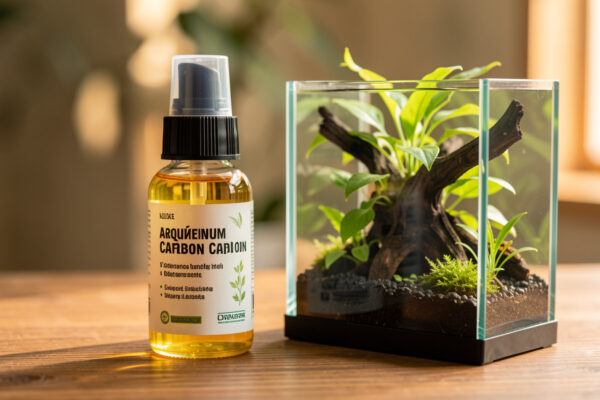
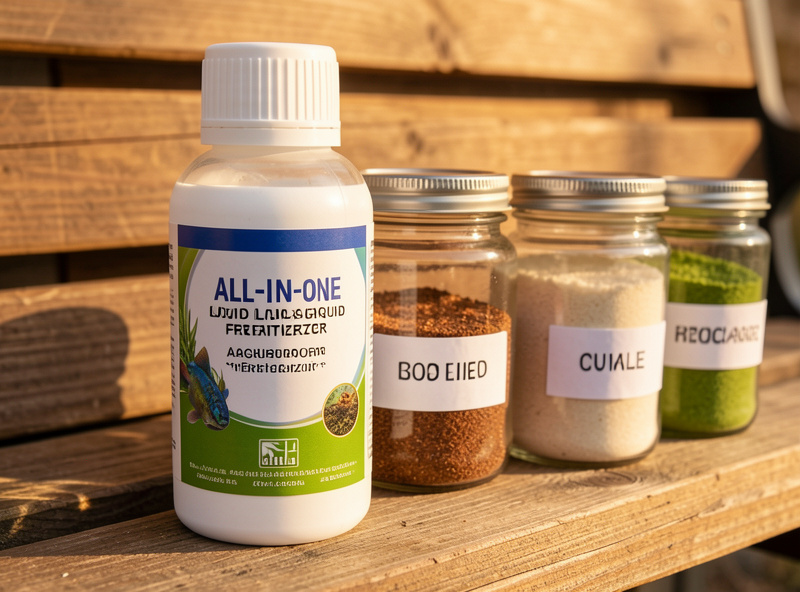
An all-in-one liquid is a single bottle that carries your macronutrients (nitrogen, phosphorus, potassium) and your micronutrients (iron and the trace metals) together, already dissolved and pre-proportioned. You dose it by milliliters against tank volume. That is the whole workflow.
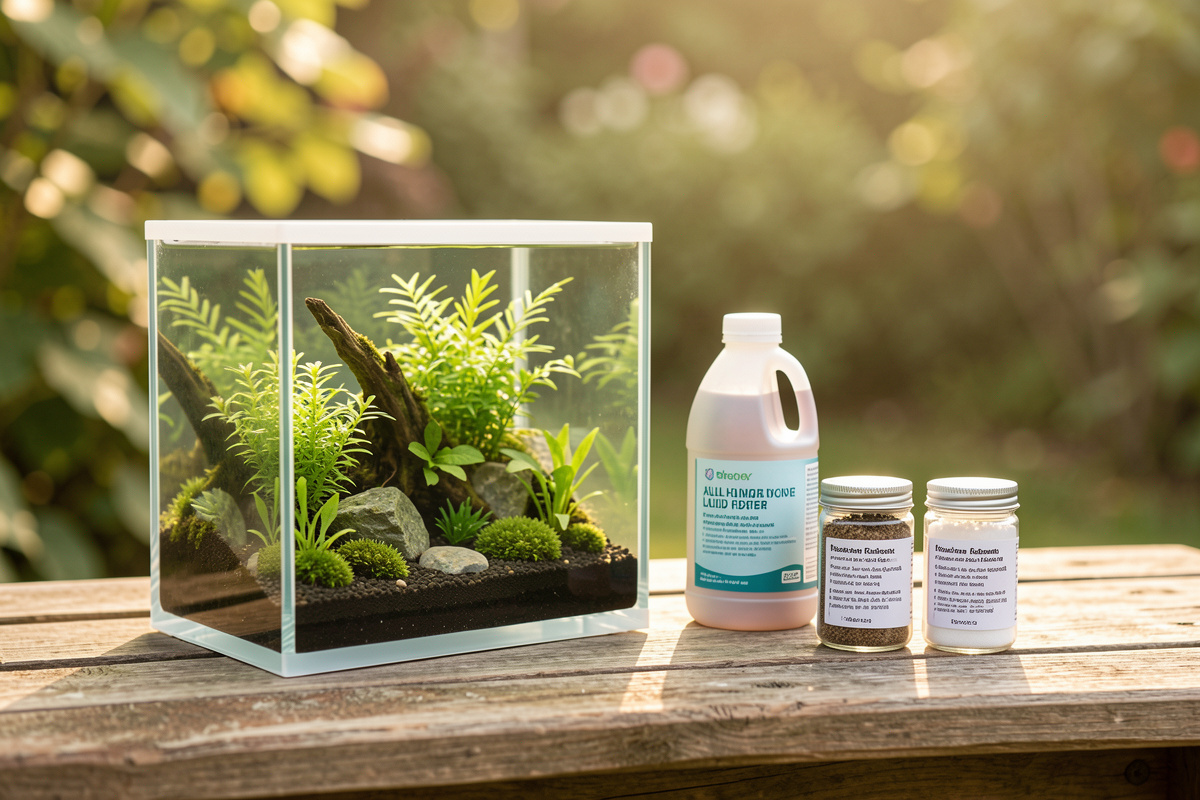
Separate dosing means you buy dry salts and mix them yourself. The usual kit is potassium nitrate (KNO3) for your nitrate and part of your potassium, monopotassium phosphate (KH2PO4) for phosphate and more potassium, and a chelated trace mix (a CSM+B style blend) for iron and micros. You weigh each one out, either straight into the tank or, more sensibly, into stock solutions. This is the same family of chemistry I lived in during my hydroponics years, so dry salts feel familiar to me — but familiar is not the same as correct for a given tank.
The reason people reach for separates is control. With three components in your hand you can push nitrate independently of phosphate, or lean the potassium up, or dial iron for a demanding red plant, without touching the others. All-in-one locks that ratio for you. For a wider view of how dosing decisions hang together, my nano tank fertilizer dosing guide maps the whole system.
Why all-in-one wins on nearly every nano
The short answer: at nano scale the doses are microscopic, and a liquid meters cleanly where a scale cannot. On my 18L shrimp tank a maintenance dose is a fraction of a milliliter of concentrate or a couple of milliliters of a ready-to-use liquid. There is no consumer kitchen scale that resolves the dry-salt equivalent of that dose to a useful precision. You would be estimating fractions of a gram, and estimation is exactly what I refuse to do in small water.
Small water is harder, not easier — I keep saying it because the numbers keep proving it. In 18L a modest overdose is a large concentration change, and my parameter log shows how quickly a nano moves when I feed it too much of anything. A pre-mixed liquid removes one whole error source: the ratio is fixed and correct, so the only variable left is how many milliliters, which a syringe handles perfectly. That is why my low-tech nano and my cherry shrimp tank both run all-in-one. On a shrimp colony especially I want the calmest possible routine, and I keep an eye on the numbers that actually matter for the animals in my cherry shrimp water parameters notes.
Convenience and safety are the honest headline here. One bottle, one syringe, one number to remember. Nothing to weigh, nothing to store as a hygroscopic powder that cakes in a humid fish room, no chance of grabbing the wrong jar half-asleep. If you want a straight product-selection walkthrough, I cover what I look for in a bottle in best all-in-one aquarium fertilizer.
When separate dry salts genuinely pay off
Dry salts earn their keep on larger, high-demand tanks where the doses are big enough to weigh accurately and where you actually want independent control. My high-tech 60L rimless with pressurised CO2 is the one tank where I run them, because in a growth phase I want to push nitrate up without dragging phosphate along for the ride, and the doses are large enough that my scale resolves them honestly.
The second real driver is cost at scale. Dry salts are dramatically cheaper per dose than a bottle of liquid once your consumption is high. On a single nano you will never dose enough to notice; a bag of KNO3 outlives the tank. But across a heavily dosed high-tech tank over a year, the difference is real money, and that is a legitimate reason to mix your own. Estimated dry EI dosing is a method built around this, and I break down the calculations in EI dosing for a nano tank.
Control is the third reason, and it is where separates shine on a demanding scape. If my planted nano stems start showing a specific deficiency pattern, I can respond to that one nutrient. With all-in-one I would have to lift everything to lift one thing. On a stable low-tech tank that flexibility is wasted; on a CO2-driven jungle it is the point.
All-in-one vs separate: the honest comparison
Here is how the two stack up on the factors I actually weigh when deciding for a given tank. Read it as “which tank am I standing in front of,” not “which is better in the abstract.”
| Factor | All-in-one liquid | Separate dry salts |
|---|---|---|
| Cost at scale | Higher per dose; irrelevant on a nano | Much cheaper per dose; matters on high-demand tanks |
| Dosing accuracy at nano scale | Excellent — meter with a syringe | Poor — sub-gram weighing is error-prone |
| Control over individual nutrients | Fixed ratio, no independent tuning | Full — push N, P, K, or trace separately |
| Effort | Minimal — one bottle, one number | Higher — weigh, mix, store, label |
| Best for | Nanos, shrimp tanks, low-tech, anyone who wants safety | Larger high-tech tanks, high consumption, tuners |
The stock-solution workaround if you go dry
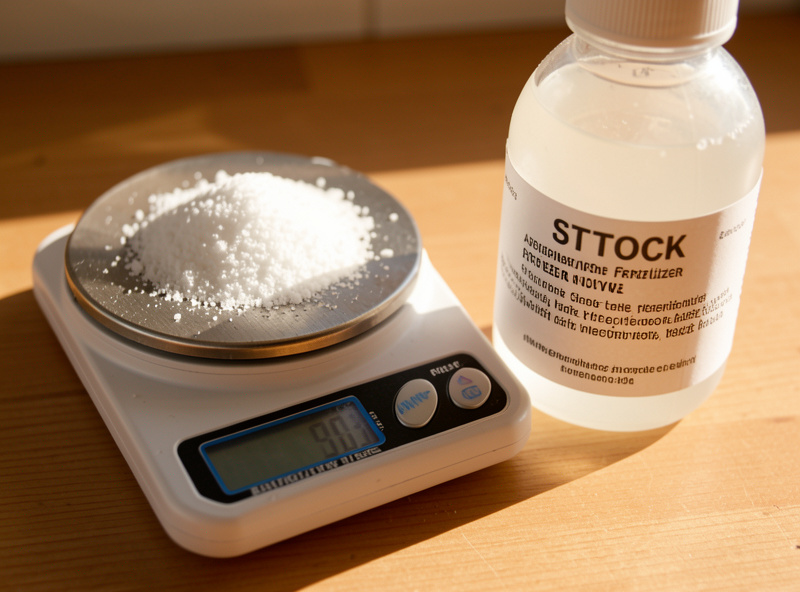
If you decide dry salts are right for you but you still keep smaller tanks in the mix, do not dose powders straight into the water. Make stock solutions instead. You weigh a known mass of each salt once, dissolve it into a fixed volume of RO or distilled water in a labelled bottle, and from then on you dose milliliters of liquid — which is exactly the precision advantage that made all-in-one so appealing in the first place.
This is how I handle the 60L when the doses are small enough to be fiddly. One careful weighing session turns the dry-salt method into a liquid-dosing routine, so you keep the cost and control benefits without the sub-gram weighing at the tank each day. Stock solutions do have a shelf life, especially the trace mix, so mix batches you will use up in a few weeks and store them cool and dark. I keep the same discipline here I keep everywhere: log what went in, and change one variable at a time.
Whichever route you run, remember that fertilizer is only one lever. Nutrients accumulate or deplete against your water-change rhythm, and getting that cadence right matters as much as the bottle you dose — I keep that logic in my water change cadence for a nano tank notes. And if you lean on the substrate for root feeders, liquids and salts both sit alongside, not instead of, root tabs.
How I actually split it across four tanks
To make this concrete: three of my four tanks run all-in-one and one runs dry salts. The 18L low-tech nano, the dedicated cherry shrimp tank, and the quarantine bench all get a simple liquid because their demand is low, their volumes are small, and I value the calm routine over any tuning I could theoretically do. The 60L high-tech rimless runs dry salts — mixed into stock solutions — because its consumption is high enough to make cost and control worth the extra effort.
Notice there is no algae argument in any of that. People will tell you one method or the other prevents algae; my parameter log does not support it. Algae in a nano tracks light, CO2, and stability far more than which brand of nitrogen you dosed. I choose the fertilizer method for accuracy, cost, and control — not as an algae cure. Match the method to the tank in front of you and both approaches work fine.
The bottom line
For a nano, all-in-one is the safer, easier, and — because your consumption is tiny — barely-more-expensive choice, and it removes an entire class of weighing errors that small water punishes hard. Separate dry salts pay off when the tank is big and hungry enough to weigh accurately, when bulk cost genuinely bites, or when you need to steer one nutrient independently. Pick by the tank, not by dogma, and keep logging your numbers either way.
If you do buy in, I run a general all-in-one liquid on the small tanks and keep a bag of dry aquarium fertilizer salts for the 60L; a ready-made all-in-one aquarium plant fertilizer covers everything else.
As an Amazon Associate I earn from qualifying purchases.
Frequently Asked Questions
Is all-in-one or separate fertilizer better for a nano tank?
For nearly every nano, all-in-one wins. The daily doses are so small that weighing dry salts to a fraction of a gram is impractical and error-prone, while a liquid meters cleanly with a syringe. Separate salts only pay off on larger, high-demand tanks.
Are dry salts cheaper than all-in-one liquid?
Per dose, yes, dry salts are dramatically cheaper. But on a single nano you dose so little that the saving is invisible; a bag of KNO3 outlasts the tank. Bulk cost only becomes a real factor on a heavily dosed high-tech tank over time.
What dry salts do I need for separate dosing?
The usual kit is potassium nitrate (KNO3) for nitrogen, monopotassium phosphate (KH2PO4) for phosphate, and a chelated trace mix for iron and micronutrients. Both KNO3 and KH2PO4 also contribute potassium, so you rarely need a separate potassium salt.
How do I dose dry salts accurately on a small tank?
Do not dose powders straight into the water. Weigh each salt once into a labelled bottle of RO water to make a stock solution, then dose milliliters of that liquid. This gives you syringe-level precision while keeping the cost and control of dry salts.
Does all-in-one or separate fertilizer affect algae?
Not meaningfully. Algae in a nano tracks light, CO2, and stability far more than which fertilizer format you chose. My parameter log does not support any algae difference between the two methods. Pick your dosing method for accuracy, cost, and control instead.