Reading a nutrient deficiency means matching a symptom to a location on the plant, then confirming it with a number. Yellowing on old leaves points one direction; pale new growth points the opposite way. Get the location right and you fix the tank in one dose instead of six weeks of guessing.
I learned this the slow way. For years my hydroponic reservoirs taught me that a plant tells you exactly what it lacks — you just have to know whether to read the top of the plant or the bottom. The aquarium confirmed it. The mistake most nano keepers make is treating “yellow leaves” as a single problem and reaching for whatever bottle is closest. That is how you end up dosing iron into a tank that was actually starving for nitrogen, watching it get worse, and blaming the fertilizer.
The whole diagnostic collapses to one question, and this guide is built around it: is the damage on the old leaves or the new ones?
Why Are My Aquarium Plant Leaves Turning Yellow?
Because a plant moves nutrients around inside itself, and where it can’t move them is where the damage shows. Mobile nutrients (nitrogen, phosphorus, potassium, magnesium) get pulled out of old leaves and sent to new growth, so a shortage shows on the oldest leaves first. Immobile nutrients (iron, calcium, manganese, boron) can’t be relocated, so a shortage shows on the newest leaves.
That single rule — mobility decides location — is the backbone of every serious plant-nutrition reference, from university extension crop guides to the aquascaping community’s collective testing. The University of Minnesota Extension plant-nutrition material lays out the same mobile-versus-immobile split that governs a submerged stem plant. Water doesn’t change the botany; it just changes how fast the plant burns through the pantry, and a nano burns fast.
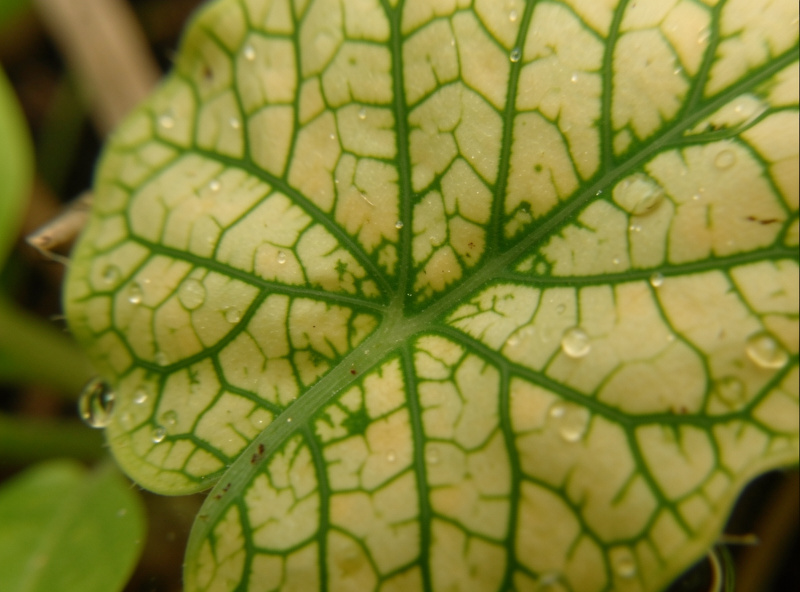
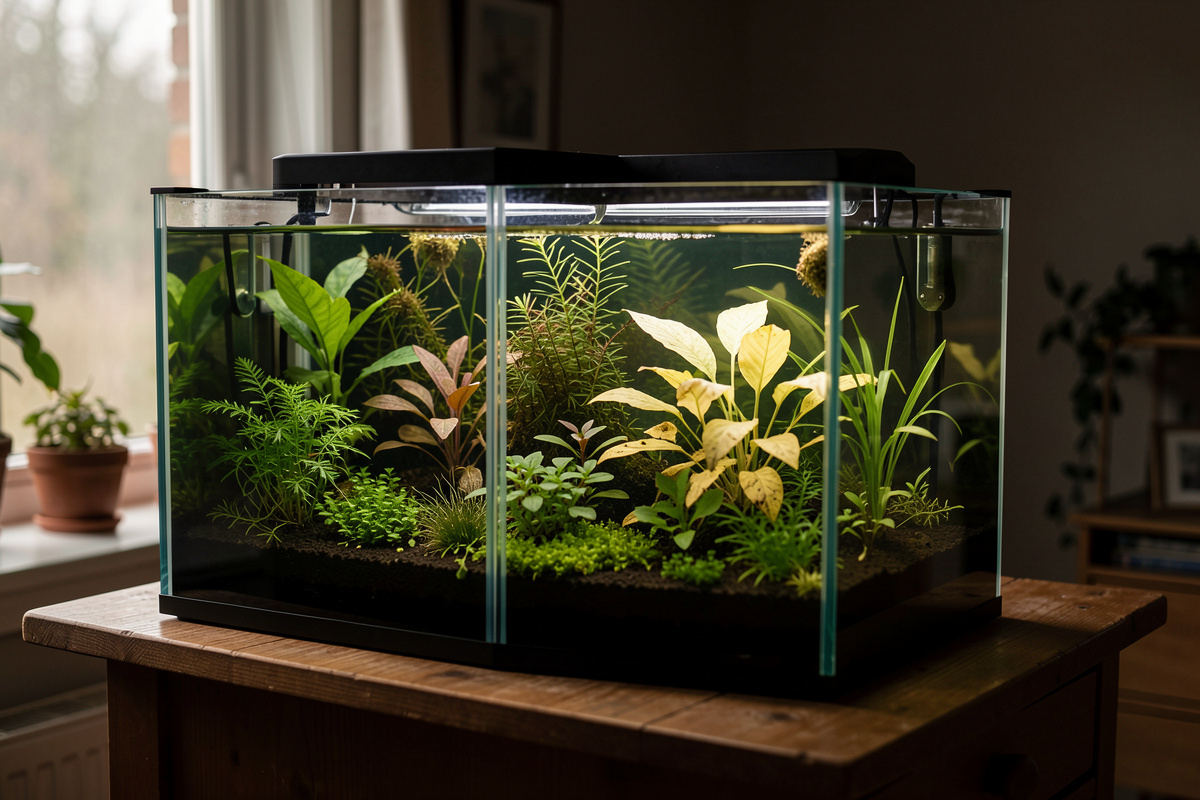
The photo above is the single most useful pattern to memorize: interveinal chlorosis. The veins stay green while the tissue between them goes pale. See it on the bottom of the plant and you’re looking at magnesium. See the same interveinal pattern on the top, on brand-new leaves that come in almost translucent, and it’s iron. Same symptom, opposite ends, completely different fix. That is the trap the chart below is designed to keep you out of.
The Nutrient Deficiency Chart: Symptom, Location, and Fix
Here is the working chart I keep taped inside my fertilizer cabinet. It is deliberately short — six deficiencies cover roughly 95% of what actually goes wrong in a planted nano. Read the “Where” column first, always.
| Nutrient | Mobility | Where it shows | What you see | First move |
|---|---|---|---|---|
| Nitrogen (N) | Mobile | Oldest leaves | Uniform yellowing, then die-back; stunted, slow overall growth | Test nitrate; raise toward 10–20 ppm |
| Potassium (K) | Mobile | Older/mid leaves | Pinholes, often with a yellow halo; brown leaf edges | Add potassium (most all-in-ones carry it) |
| Phosphorus (P) | Mobile | Older leaves | Dark, dull, sometimes purple-tinged; stunting | Test PO4; small macro dose |
| Magnesium (Mg) | Mobile | Older leaves | Interveinal yellowing, veins stay green | Raise GH with a Mg-bearing booster |
| Iron (Fe) | Immobile | Newest leaves | Pale, near-white new growth; green veins | Add a micro/trace mix, not just iron |
| Calcium (Ca) | Immobile | Growing tips | Twisted, deformed, stunted new tips | Check GH; remineralize if using RO |
Two things people get wrong with this chart. First, they skip the “Where” column and match on color alone, which is exactly how magnesium (bottom) gets treated as iron (top). Second, they treat iron chlorosis as a pure iron problem. Nine times out of ten in my tanks, pale new growth is a whole-trace shortage — iron is just the most visible casualty — so I dose a complete micro mix rather than hammering straight iron and skewing the ratio. If you want the mechanics of how a full macro-plus-micro schedule is built, that’s the EI dosing on a nano tank write-up; this article is only about reading the leaf.
Old Leaves or New Leaves? The First Question I Ask
Before I look at color, shape, or holes, I decide which end of the plant is failing. It takes ten seconds and it eliminates half the chart. On a stem plant that means comparing the growing tip to the leaves down near the substrate. On a rosette like a crypt or an Anubias, it means comparing this month’s leaf to last season’s.
Damage climbing up from the bottom is a mobile-nutrient story — the plant is cannibalizing old tissue to feed the tip, which is a shortage of N, P, K, or Mg. Damage starting at the top, on tissue that came in wrong from the start, is an immobile-nutrient story — Fe, Ca, or a trace element the plant simply never received. I have watched keepers dose iron for a month while the actual yellowing was on the oldest leaves, which iron never touches. The plant was screaming “nitrogen” and getting handed the wrong bottle.
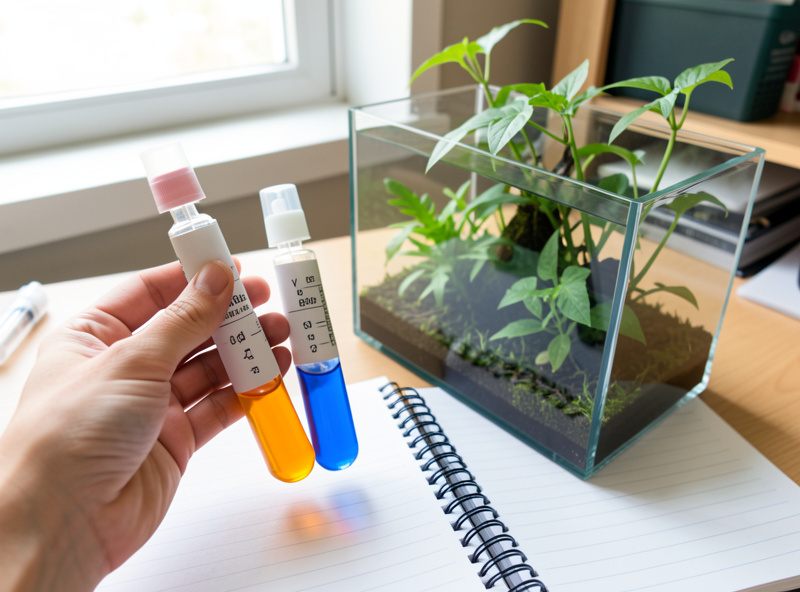
This is also where my old hydroponics reflex kicks in: test, don’t guess. The TDS pen in my aquarium drawer is the same one that ran my nutrient reservoirs for years. A leaf gives you a direction; a test kit gives you a number. I never dose off a symptom alone — the symptom tells me which test to run, and the test tells me whether to dose at all.
Is It Really a Deficiency, or Is It CO2?
The most expensive misdiagnosis in the hobby: dosing more fertilizer at a problem that was never about nutrients. Stunted tips, twisted new growth, and creeping algae look like a deficiency but are far more often a carbon or light imbalance. A plant lit hard with no matching CO2 will demand nutrients it can’t actually use, and the surplus feeds algae instead.
My rule of thumb, built from running both a low-tech 20-liter reference tank and a pressurized-CO2 60-liter showpiece side by side: if growth has flat-out stopped and the tips are curling, I check carbon and light before I touch the fertilizer. Green spot algae on the glass and slow-growing plants together almost always mean the light is outrunning the CO2, not that the tank is short on phosphate. I wrote the full comparison of what each setup actually demands in the low-tech vs high-tech CO2 guide, and the algae side lives in the nano tank algae guide. Diagnose the cause, not the bottle.
How Do I Confirm Nitrogen Deficiency Without Guessing?
Run a nitrate test. Uniform yellowing on the oldest leaves plus a nitrate reading near zero is nitrogen deficiency, full stop — no other single reading is that decisive. In a planted tank I want nitrate sitting somewhere in the 10–20 ppm band; when mine drifts toward zero, the oldest leaves on my fast stems pale out within a week.
This surprises new keepers because they spent their first months terrified of nitrate as a toxin. In a fish-only tank it is waste to be minimized. In a planted tank it is a macronutrient the plants eat, and a heavily planted nano with a light bioload can strip it to nothing. The reading is the same molecule; the meaning flips depending on what’s living in the water. If the number is genuinely on the floor, the fix is a controlled macro dose — and the deeper diagnostic for that specific case is the nitrate too low in a planted tank guide. If the number is fine and the leaves still yellow, nitrogen isn’t your problem and you move on down the chart.
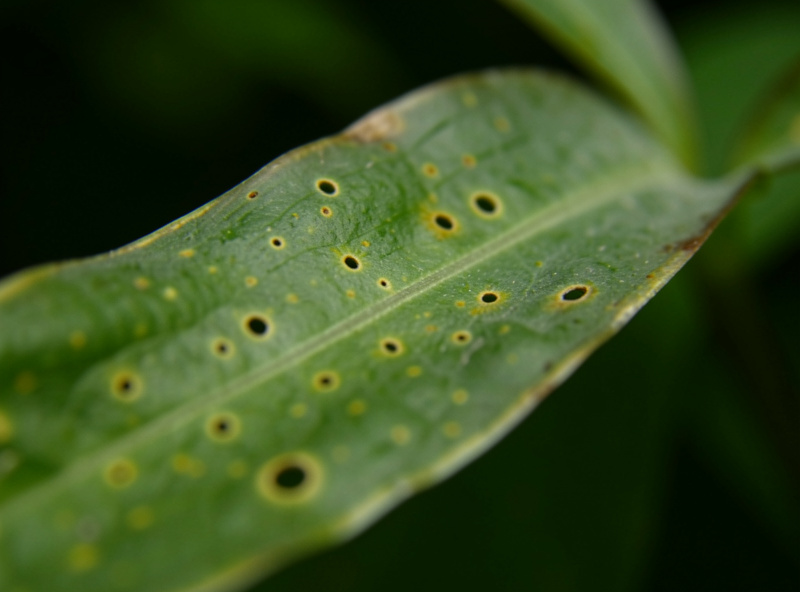
Potassium is the other reading you can’t easily test with a hobby kit, so you diagnose it by eye: the pinholes above, punched through mid-age leaves and often ringed with a faint yellow halo. I’ve seen a colony of these holes on my Ludwigia clear up within two weeks of adding potassium, with no other change. Because there’s no cheap K test, this is one of the rare places I dose to the symptom — but only after ruling out nitrogen first, because a starving plant makes holes for several reasons.
The Deficiency I Misdiagnosed for a Month
My worst call was on the shrimp tank. New crypt leaves were coming in pale and thin, and I was certain it was iron, so I dosed trace for four weeks with nothing to show for it. The tank runs on RO water that I remineralize for my Neocaridina colony, and what I’d actually done was set the general hardness too low — the plants were short on calcium, an immobile nutrient, which is why only the new growth suffered.
The tell I ignored: the new leaves weren’t just pale, they were slightly deformed at the tip, which is calcium, not iron. Iron gives you pale-but-normal-shaped leaves; calcium gives you twisted ones. I bumped the GH back into my colony’s 6–8 dGH working range with a proper remineralizer, and the next set of leaves came in clean and flat. The lesson I keep taped next to the chart: on an RO tank, suspect the mineral base before you suspect the fertilizer. My shrimp parameters and the remineralizing I run for them are in the cherry shrimp water parameters guide.
How I Read the Leaves Now — A Simple Weekly Routine
Once a week, before the water change, I spend two minutes on each tank doing the same three-step read. Old leaves or new? That narrows the chart to half. Color or shape? Yellow-but-flat versus twisted-and-deformed splits it again. Then one confirming test — usually nitrate — before I decide whether to dose or just wait a week and watch.
The routine matters more than any single symptom because a nano swings fast; a shortage that shows on Monday can be visible damage by Friday. Small water volume means small margins, which is the whole thesis of keeping these tanks well — the nano tank stability guide covers why the volume math works against you. Reading leaves is just early warning. The parameter log turns “the plants look a bit off” into “nitrate has fallen 5 ppm three weeks running,” and that’s the difference between fixing a trend and reacting to a crash. The reference I still reach for when a symptom doesn’t fit the common six is the Michigan State University Extension horticulture material — the underlying deficiency signatures are the same whether the roots have fins nearby or not.
What I’d do starting today if my plants looked off: don’t buy anything yet. Walk up to the tank, decide old-leaf or new-leaf, run one nitrate test, and only then open a bottle. Nine times out of ten the plant already told you the answer before you spent a cent.
How do I tell iron deficiency from magnesium deficiency?
Location. Both cause interveinal yellowing where the veins stay green and the tissue between them pales. Magnesium is mobile, so it shows on the oldest leaves at the bottom of the plant. Iron is immobile, so it shows on the newest leaves at the top. Same symptom, opposite ends of the plant, different fix.
Why are my plant leaves yellow if my nitrate is high?
High nitrate rules out nitrogen deficiency, so read the location of the yellowing. If it is on new growth it points to iron or another trace element. If old leaves yellow between the veins it is likely magnesium. Yellowing with holes on mid-age leaves points to potassium, which most hobby kits cannot test.
Can low CO2 look like a nutrient deficiency?
Yes, and it is one of the most common misdiagnoses. Stunted growth, twisted tips, and creeping algae often come from light outrunning the available carbon rather than a missing nutrient. If growth has stopped and tips curl, check carbon and light before adding more fertilizer.
What nitrate level should a planted nano tank sit at?
A commonly used target for planted tanks is roughly 10 to 20 ppm nitrate. Below that, heavy plant uptake in a lightly stocked nano can strip nitrate to near zero and the oldest leaves start to pale. Test before dosing rather than assuming.
Do I need a test kit or can I just read the leaves?
Both. The leaf tells you the direction by showing which nutrient class is short and whether the damage is old growth or new. A liquid test kit confirms the specific number, especially for nitrate. Reading leaves without a confirming test is guessing, and small tanks punish guesses fast.