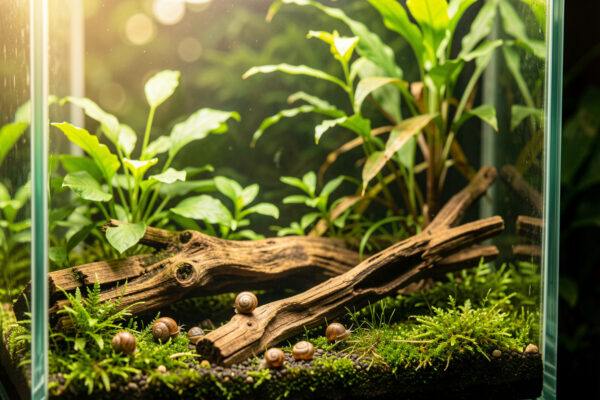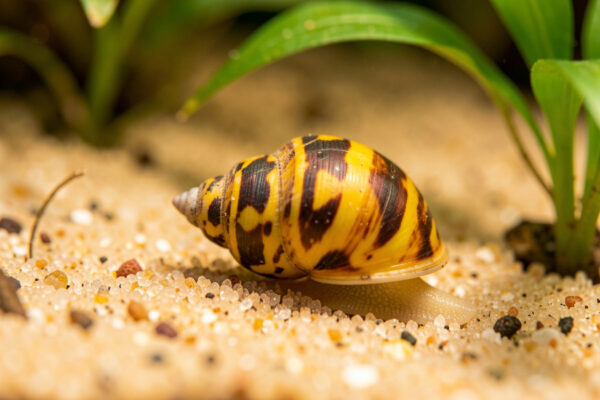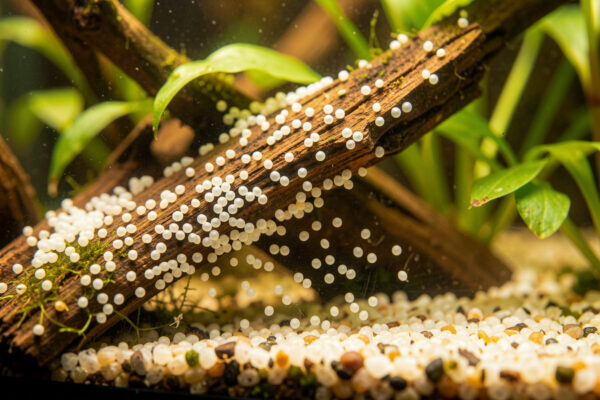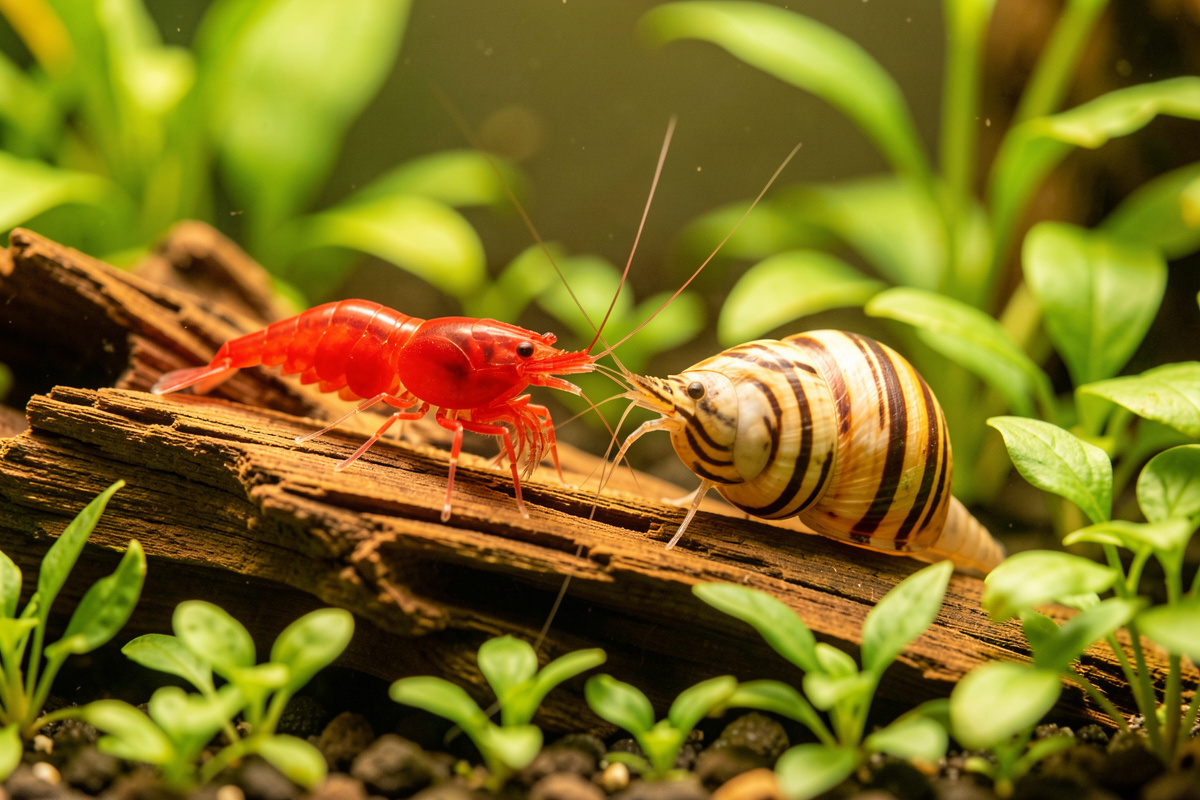
Yes, you can keep snails and shrimp together — they are the classic nano cleanup pairing and they do not meaningfully compete. They occupy slightly different feeding niches, their combined bioload stays trivial, and neither preys on the other. The one thing you actually have to reconcile is water hardness, because snails need enough KH and GH to build shell while soft-water shrimp set the lower limit. In my shrimp tank the two have coexisted for years.
The “do they compete?” worry is the most common question I get about this combination, and it comes from imagining a fixed pool of food both species fight over. That is not how it works. Shrimp and snails graze different things in different places, and a tank that feeds one comfortably feeds both. Here is the honest breakdown of diet overlap, the real hardness compromise, and how I stock the two so nobody loses.
Do snails and shrimp compete for food?
Not in any way that matters. Dwarf shrimp are opportunistic grazers that pick constantly at biofilm, soft algae and detritus across every surface, and they swarm any food you drop. Snails work more deliberately — nerites rasp hard films off glass and hardscape, ramshorns clear soft algae and dead leaves, trumpet snails process the substrate below. The overlap is real but partial, and in a tank with any biofilm at all there is more grazing surface than either species can strip.
The only genuine flashpoint is supplemental food. When you drop a snail pellet or an algae wafer, both will pile onto it, and a crowd of snails can occasionally muscle shrimp off a single wafer. The fix is trivial: feed small amounts in two or three spots rather than one, and both get their share. Day to day, my Neocaridina colony and my snails graze the same tank without me ever seeing a shrimp go hungry because of a snail.
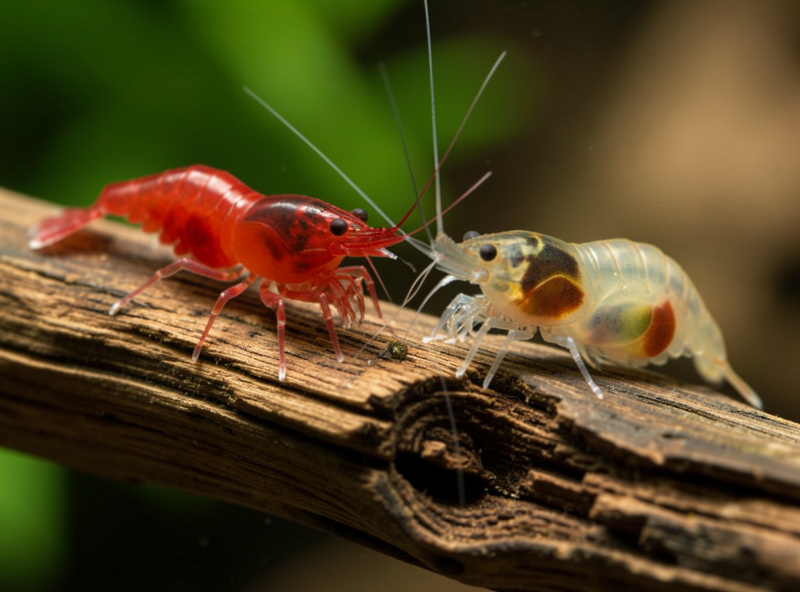
The real issue: matching the water
The genuine challenge in this pairing is not food — it is chemistry. Snails build shells from calcium (GH) and carbonates (KH), and they need KH at roughly 4 dKH or more to avoid shell erosion. Neocaridina shrimp are comfortable in exactly that harder range, so they pair with snails effortlessly. The friction appears only with soft-water Caridina shrimp — crystal reds and their kin — which are kept deliberately at KH 0–2, water soft enough to slowly dissolve a snail’s shell.
So the compatibility question is really a hardness question, and it splits cleanly. Neocaridina plus snails: no compromise, both thrive in GH 6–8 and KH 3–5. Caridina plus snails: a real conflict, because what keeps the shrimp happy erodes the snail. If you run a soft-water Caridina tank, either skip snails or accept that their shells will suffer — the mechanism is laid out in the shell erosion guide. Match the pairing to your target KH, GH and TDS and the rest takes care of itself.
Which snails pair best with shrimp
For a shrimp tank I reach for nerites first. They are the heaviest algae grazers, they cannot breed to overrun the tank, and they leave shrimplets completely alone — nerites are pure grazers with no interest in animals. A nerite and a Neocaridina colony is my single favourite low-maintenance nano combination, and I cover the grazer itself in the nerite snail guide. Ramshorn and trumpet snails also pair fine and add soft-algae and substrate cleanup, though they breed, so feeding discipline matters.
The one snail I would keep away from a shrimp tank you care about is the assassin snail. It is a carnivore, and while it targets other snails, there are scattered keeper reports of assassins taking weak or moulting shrimp. I would not risk a valued colony on it. If you have a pest-snail problem in a shrimp tank, lean on trapping and feeding control instead — the chemical-free methods in the pest snail removal guide — rather than introducing a predator into a tank full of vulnerable moulting shrimp.
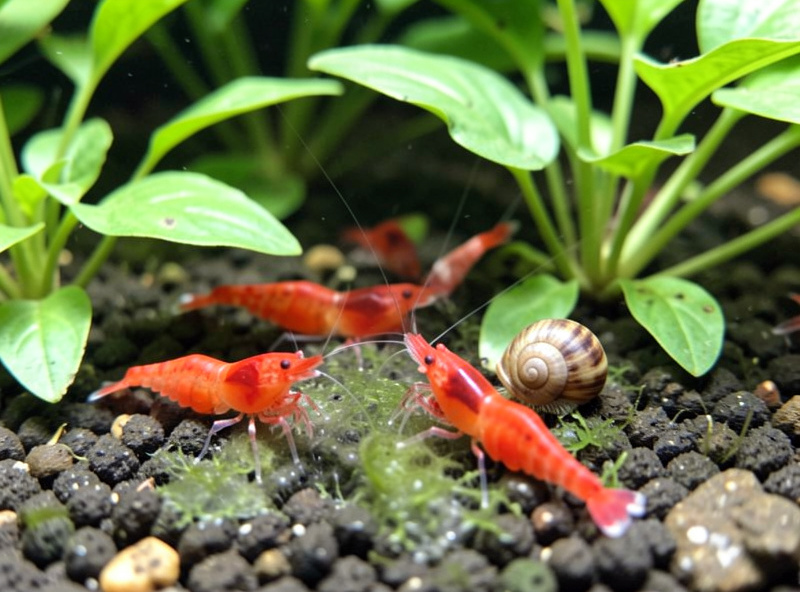
Stocking the two together
Order and restraint matter more than numbers. I establish the shrimp colony first in stable, cycled water, let it settle for a few weeks, then add snails a couple at a time — a soft acclimation for the snails and no sudden bioload jump for the shrimp. Both are sensitive to parameter swings and to copper, so nothing goes in the tank without a slow drip acclimation, and no snail-killing chemical ever touches a tank with shrimp in it. That single rule prevents the most common disaster in this hobby.
One caution about the word “self-sufficient”: it describes the cleanup, not the tank. A snail-and-shrimp crew grazes surfaces beautifully, but nothing in that crew removes nitrate or replaces trace minerals — only water changes do that, and shrimp in particular punish a neglected tank with failed molts. So I still run the same small, matched water changes I would on any nano, still test KH and TDS on a schedule, and still top off evaporation with the right water so hardness does not creep. The crew reduces the visible mess; it does not repeal the chemistry. Treat the cleanup as a bonus on top of good husbandry, never a substitute for it.
Combined, a nerite or two and a Neocaridina colony is about as self-sufficient as nano cleanup gets: the shrimp graze what the snails miss and vice versa, the bioload barely registers, and maintenance drops to matched water changes and honest feeding. It is the crew I recommend to anyone starting a planted shrimp nano. The full roster of snails worth adding sits in the nano tank snails guide, and if RO water is part of your shrimp setup, remineralizing it correctly — covered in the RO remineralization guide — is what keeps both shrimp and snail shells healthy.
Frequently Asked Questions
Can you keep snails and shrimp together?
Yes. Snails and dwarf shrimp are a classic nano cleanup pairing that graze different niches without meaningful competition, and neither preys on the other. The only thing to reconcile is water hardness, since snails need adequate KH and GH to build shell.
Do snails and shrimp compete for food?
Not in any way that matters. Shrimp pick biofilm and detritus across surfaces while snails rasp films, soft algae or process substrate. The only flashpoint is a single dropped wafer, solved by feeding in two or three spots so both get their share.
Will snails eat baby shrimp?
No. Nerite, ramshorn and trumpet snails are grazers with no interest in animals and leave shrimplets completely alone. The exception is the assassin snail, a carnivore that has occasionally taken weak or moulting shrimp, so keep it out of a shrimp tank you value.
What water parameters suit both snails and shrimp?
Neocaridina shrimp and snails both thrive around GH 6 to 8 and KH 3 to 5, so they pair with no compromise. Soft-water Caridina shrimp kept at KH 0 to 2 conflict with snails, because that softness slowly erodes shells.
Which snail is best for a shrimp tank?
The nerite. It is the heaviest algae grazer, cannot breed to overrun the tank, and ignores shrimp entirely. A nerite with a Neocaridina colony is one of the most self-sufficient low-maintenance nano combinations you can run.