Neocaridina shrimp care comes down to one honest truth: keep the water stable at GH 6-8, KH 2-4, TDS 150-250, and 70-76°F, and these animals nearly keep themselves. A starter group of ten becomes a hundred-plus in a year. The killer is never delicacy; it is swings.
That is the headline, and almost everyone gets it backwards — they buy “easy beginner shrimp,” treat the tank casually, and watch the colony dwindle while blaming bad luck or a phantom disease. I have run my dedicated Neocaridina tank as a parameter-logged experiment for years, the same way I ran nutrient reservoirs back in my hydroponics days. The meters are literally the same drawer — the TDS pen that reads my shrimp water once read my lettuce solution. That crossover is the whole point of this site: water chemistry does not care whether the thing living in it has roots or a tail. This guide is the spine of everything I have learned keeping cherries, written cycle-first and numbers-always, with the gear that actually earns its place called out by name.
What Water Parameters Do Neocaridina Shrimp Need?
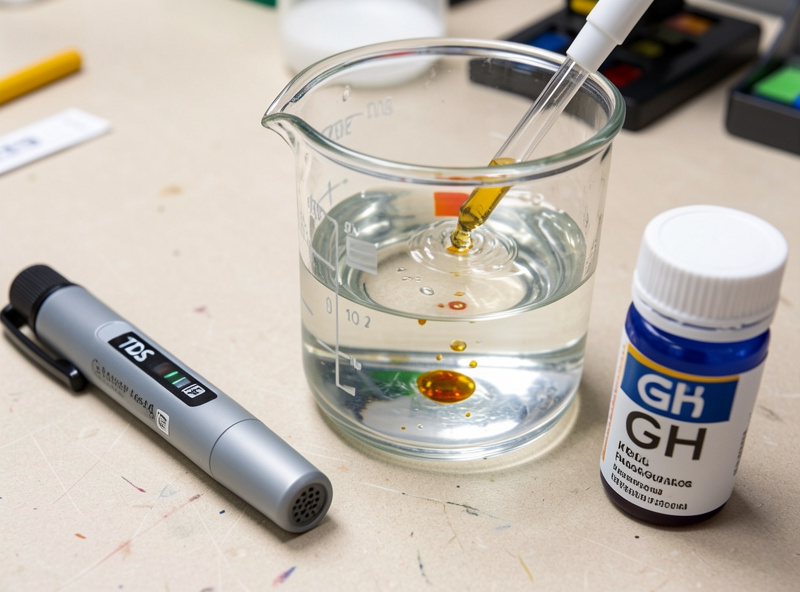
Neocaridina (cherry) shrimp thrive at GH 6-8, KH 2-4, TDS 150-250, pH 6.8-7.6, and 70-76°F. They are the hardy, tap-water-tolerant cousins of the fussy Caridina genus, which is exactly why they are the right first shrimp. The headline number is general hardness (GH) — that is the calcium and magnesium they pull from the water to build new shell at every molt.
What trips people up is that all five numbers move together. KH (carbonate hardness) is the buffer that stops your pH from crashing; if KH falls to zero, a sudden pH drop can wipe a colony overnight. TDS is the cheap, fast proxy I check daily — it does not tell you what is in the water, but a stable TDS reading across weeks tells you nothing dangerous is drifting. In my parameter log, the single best predictor of a thriving colony is not any one perfect value; it is a flat line. Aim your tap or remineralized water into the bands above, then guard the steadiness harder than the exact figure. Small volumes swing fast for the same physics every time, which is why I treat stability as the real skill in my guide to parameter swings in small tanks.
How Do You Cycle a Tank Before Adding Shrimp?
You must fully cycle the tank before a single shrimp goes in — Neocaridina tolerate hardness swings far better than they tolerate ammonia, and even 0.25 ppm ammonia is lethal pressure on an invert. A complete fishless cycle takes roughly 3-6 weeks and ends when the tank converts 2 ppm ammonia to zero ammonia and zero nitrite within 24 hours — I spell out exactly how to know when an aquarium is truly cycled rather than trusting the calendar.
Shrimp are slow-bioload animals, so people assume the cycle matters less. The opposite is true. A shrimp colony has no margin: there is no “I’ll do an emergency water change” rescue when the casualties are 8mm long and you cannot see the dead ones decomposing in the moss. I cycle every shrimp tank the boring, patient way and confirm it with the test kit, not the calendar. If you have not run a fishless cycle before, the foundation is non-negotiable physics — I walk through the full process in my aquarium nitrogen cycle guide and the exact week-by-week routine in the fishless cycle step by step breakdown. Do not skip it because the bioload looks small.
Cherry Shrimp Water Parameter Cheat Sheet
Here is the band I keep my Neocaridina colony inside, with the measurement that matters for each line. These are ranges, not single magic numbers — a shrimp keeper who quotes you one exact figure to four decimals is selling certainty that does not exist. I break down exactly what each line means and how the five numbers move together in my cherry shrimp water parameters guide.
| Parameter | Target range | Why it matters | How I measure it |
|---|---|---|---|
| General hardness (GH) | 6-8 dGH | Calcium/magnesium for shell building at every molt | Liquid GH drop test |
| Carbonate hardness (KH) | 2-4 dKH | pH buffer; near-zero KH risks a pH crash | Liquid KH drop test |
| TDS | 150-250 ppm | Daily stability proxy; flat line = nothing drifting | Calibrated TDS pen |
| pH | 6.8-7.6 | Wide tolerance; stability beats target value | Liquid pH or calibrated pen |
| Temperature | 70-76°F | Higher = faster breeding + shorter lifespan | External thermometer, never the heater dial |
| Ammonia / Nitrite | 0 ppm both | Lethal to inverts even at trace levels | Liquid ammonia + nitrite tests |
| Nitrate | under 20 ppm | Tolerated low; controlled by water changes | Liquid nitrate test |
If you only buy one thing before your first shrimp, buy a full liquid master liquid test kit plus a separate GH and KH test kit. The strip kits drift and lie; the liquid drops are the difference between guessing and knowing. I get into the parameter detail tank-by-tank in my dedicated cycle troubleshooting work, but for shrimp the numbers above are the law.
As an Amazon Associate I earn from qualifying purchases.
Do Cherry Shrimp Need RO Water?
Most cherry shrimp keepers do not need RO water — and that is the genus’s whole appeal. If your tap sits in the GH 6-8, KH 2-4 band after dechlorination, you can keep Neocaridina on conditioned tap and skip an entire layer of cost and labor. RO plus remineralization only becomes worth it when your tap is too hard, too soft, or too variable to trust.
My tap in Sweden runs harder and less predictable than I like, so my shrimp tank actually does run on RO water rebuilt to spec with a shrimp-specific GH/KH mineral. But I am clear about why: it is for consistency, not because cherries are secretly soft-water animals. The mistake I see constantly is beginners buying an RO unit in a panic, then mixing minerals badly and producing water less stable than the tap they replaced. If you do go the remineralized route — which is mandatory for the Caridina genus and optional-but-useful for Neocaridina in bad-tap areas — measure the rebuilt water to TDS and GH before it ever touches the tank. A reverse osmosis system paired with a proper GH/KH remineralizer is the tool; discipline is what makes it work. I walk through my full mixing-and-measuring routine in the RO water remineralization for shrimp guide.
If you do remineralize, target the same band you would aim for from tap: I rebuild my RO to roughly TDS 180-200, GH 6, and KH 3 with a shrimp-grade GH/KH mineral, added to the water and stirred until the TDS reading stops climbing rather than dosed by the scoop. The number that catches people out is KH — over-dosing carbonate to chase a stable pH quietly pushes hardness too high and stalls molting, the exact opposite of the goal. I add minerals to a mixing jug, not the tank, let it equilibrate overnight, and only then top off or change with it. That one-day buffer is the difference between a controlled parameter and a guess, and it is the same batch-and-measure discipline I used mixing nutrient stock for hydroponics — never trust a fresh mix until the meter has settled.
How Fast Does a Cherry Shrimp Colony Grow?
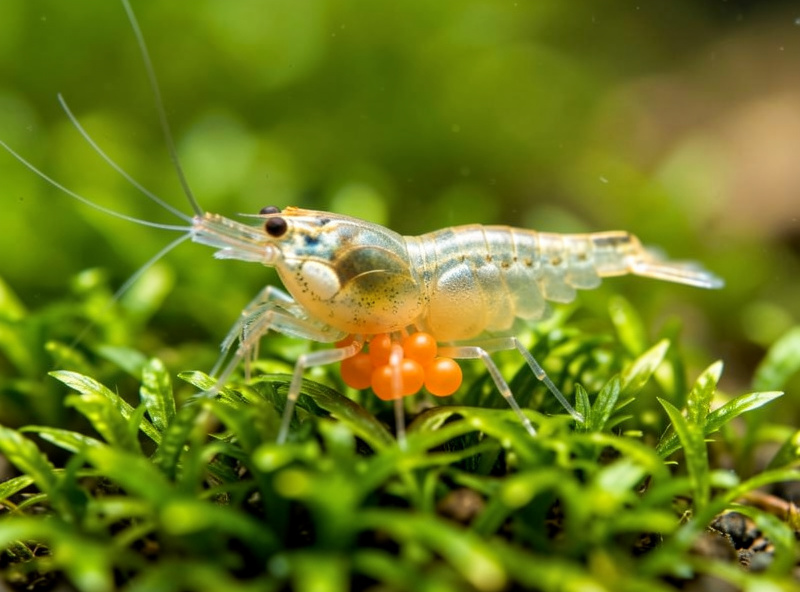
A stable cherry shrimp colony roughly doubles every 8-12 weeks once breeding starts. A starter group of ten healthy adults, given clean stable water and 72-76°F, can realistically reach 100+ shrimp inside a year. Females carry 20-30 eggs per clutch and can re-berry within days of releasing the last batch. I lay out the realistic month-by-month numbers in how fast cherry shrimp breed.
The accelerator is temperature: warmer water (toward 76-78°F) speeds metabolism, breeding, and growth — at the cost of shorter individual lifespans and lower dissolved oxygen. I run my colony tank cooler, around 72°F, because I would rather have a slower, longer-lived, more stable population than a fast burnout. The brake is, almost always, an unstable cycle or food management. Overfeeding is the number one colony killer I see: uneaten food spikes nitrates and feeds the wrong bacteria. I feed my colony a tiny amount every 2-3 days and let them graze biofilm the rest of the time. When the numbers hold and you stop overfeeding, the population curve takes care of itself.
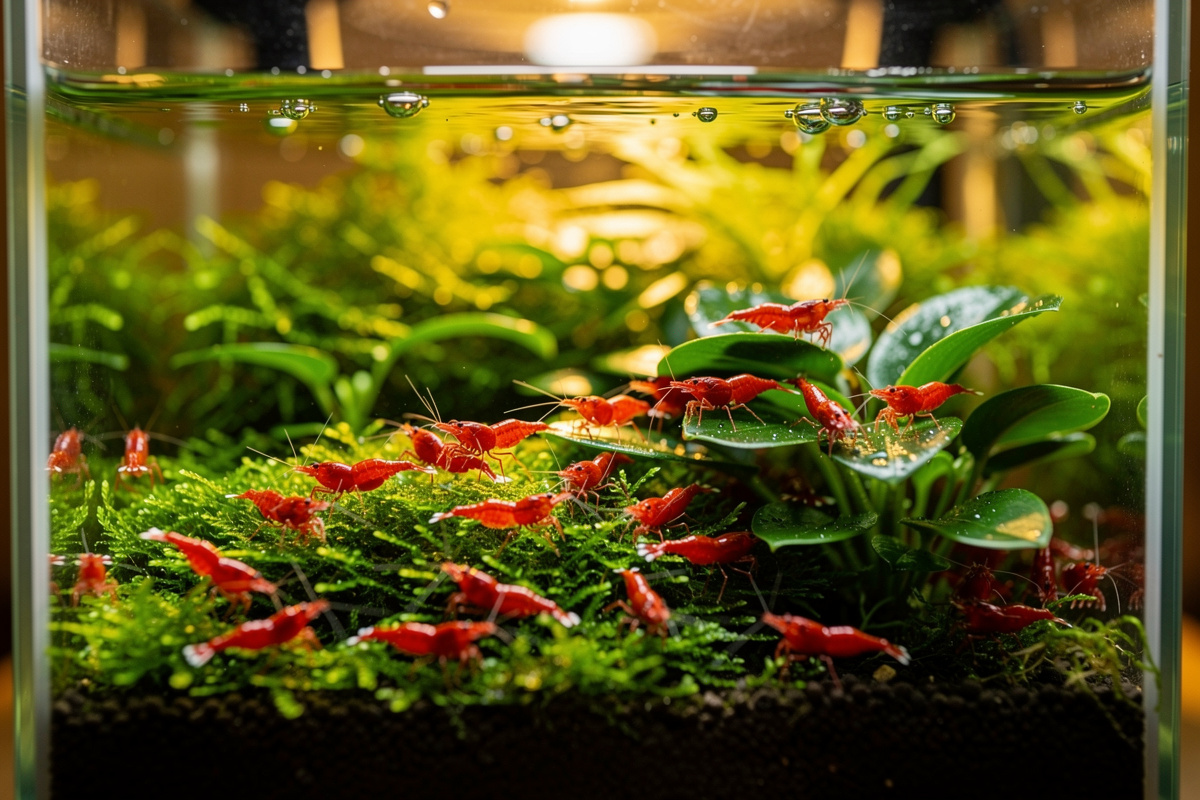
There is a population ceiling worth understanding too. A colony does not grow forever — it self-limits at whatever the tank’s bioload, food, and surface area can sustain. In my roughly 20-litre colony tank the population settles around 150-200 visible adults and then holds, with births and natural deaths roughly balancing. That is healthy, not a problem to fix. The moment people try to push past the natural ceiling — extra feeding to force faster breeding — is the moment nitrates climb and the colony’s health drops. If you want more shrimp than your tank holds, the answer is another tank, not harder feeding. This is the same reservoir-capacity logic from hydroponics: a system has a carrying capacity set by its volume and turnover, and fighting it just degrades water quality.
What Can Live With Cherry Shrimp?
The honest answer is: in a dedicated shrimp tank, nothing — and that is the build I recommend for breeding. Almost any fish that fits in its mouth will eat baby shrimp, and “shrimp-safe” fish are tolerated, not trusted. The genuinely low-risk tankmates are other inverts: snails (Nerite, ramshorn, bladder) and other Neocaridina color morphs of the same genus.
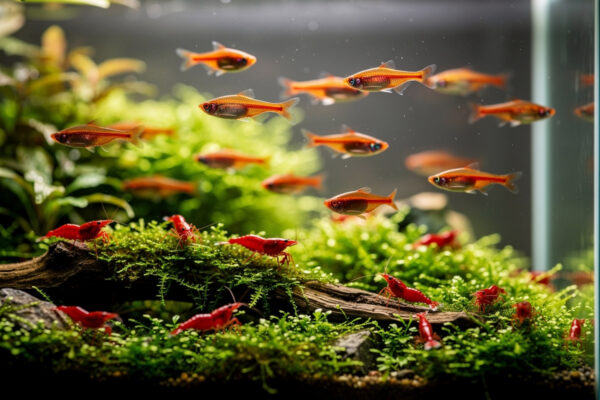
People want shrimp and a community tank, and you can have a surviving colony alongside small peaceful fish like chili rasboras or pygmy corydoras — but understand the trade. You will rarely see shrimplets, the population will plateau at whatever the predation ceiling allows, and you are choosing a display tank over a breeding project. I keep my colony tank shrimp-only specifically so the babies survive. If you want fish in the mix, stack the deck: heavy moss and plant cover gives shrimplets hiding spots, and you accept lower numbers honestly. What you should never do is add shrimp to an aggressive or large-mouthed setup and call it a colony — that is a feeding station. I go through the safe and the genuinely risky options in my honest guide to keeping shrimp with fish.
What Filter and Equipment Do Shrimp Tanks Need?
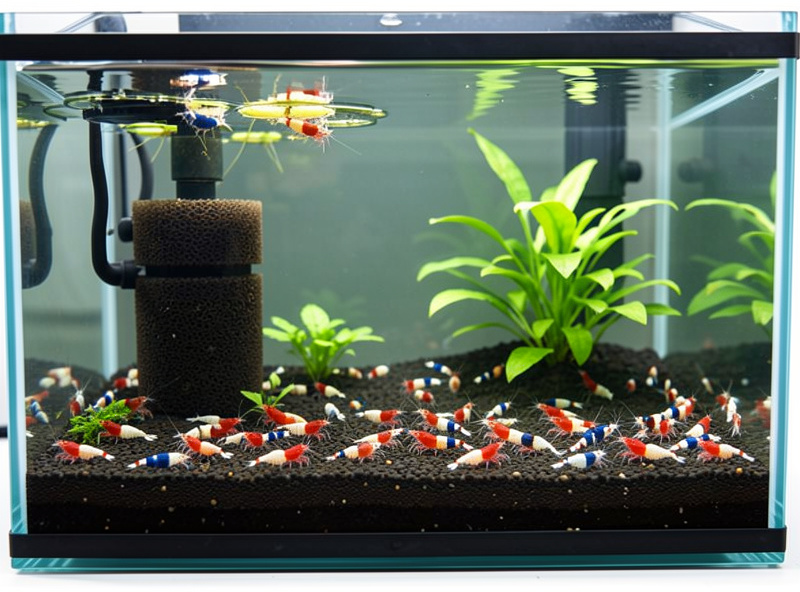
A shrimp tank’s filter has one rule above all others: it cannot suck in shrimplets. A sponge filter driven by an air pump is the near-universal answer — gentle, no impeller, and the sponge surface itself becomes a biofilm grazing buffet. For a nano colony tank, a single sponge filter rated above your volume is genuinely all the filtration you need.
Beyond filtration, the kit list is short and honest: a reliable nano heater (verified against an external thermometer, because heater dials lie — I go through which units actually hold temperature in my best heater for a nano tank picks), the test kits already covered, and a TDS pen for daily checks. You do not need a canister, a fancy light, or CO2 to keep cherries thriving — those are planted-tank ambitions, not shrimp requirements. Plants help enormously, though: a tank stuffed with moss, Anubias, and floating cover is not decoration, it is infrastructure. The moss grows the biofilm shrimplets eat, the floating plants soak up nitrate, and the dense cover gives the young somewhere to hide while they grow out of bite-size. My colony tank is deliberately overgrown, and it needs less intervention from me because of it — the plants are doing half the filtration and all the foraging. If you want a hang-on-back filter for aesthetics, fit a pre-filter sponge over the intake or you will vacuum babies into the chamber. I learned that the expensive way early on, finding shrimplets thriving inside the filter housing where they had been sucked. The stability routines that keep any small tank alive — top-off discipline, water-change cadence, evaporation management — apply double to shrimp; I cover the full system in my nano tank stability guide, and the water change cadence for nano tanks piece is the one shrimp keepers should read twice.
What Are the Cherry Shrimp Color Grades?
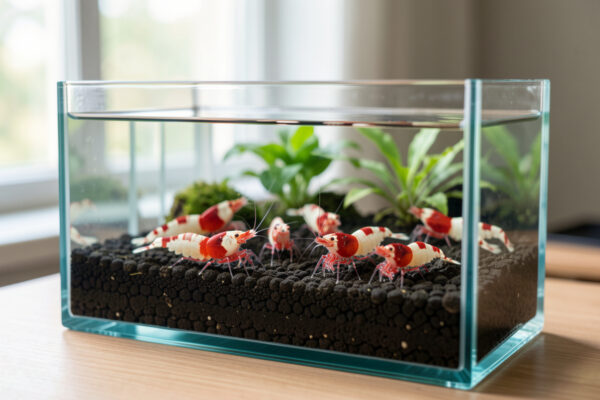
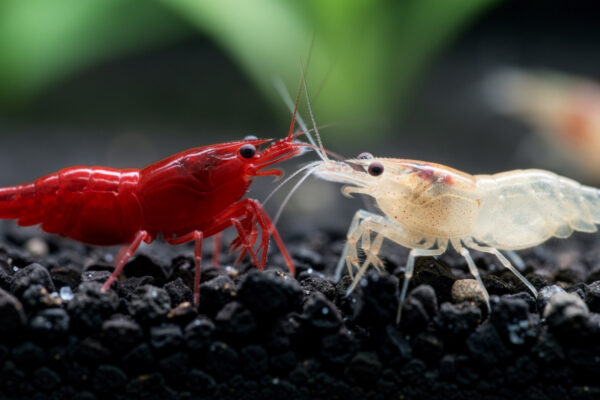
Cherry shrimp are graded by color saturation and coverage, climbing from basic Cherry through Sakura, Fire Red, and Painted Fire Red, where even the legs and face carry solid opaque red. The grade is purely cosmetic — a Painted Fire Red and a plain Cherry have identical care needs — but it matters for two practical reasons: price and breeding.
Higher grades cost more because someone did the selective-breeding work to fix the color, and that work is fragile. Color is partly genetic and partly environmental: a dark substrate, good diet, and stable water all deepen the red you actually see, while a bright bare-bottom tank and stress wash it out. If you want to hold a grade, you cull toward the deepest, most opaque individuals every generation; let the colony breed unselected and it drifts back toward wild brown-clear within a few generations because the wild type is genetically dominant. This is also why mixing different Neocaridina colors — reds with blues with yellows — is a trap: they all interbreed (same species), and the offspring revert to muddy wild-type. Pick one color line and keep it pure if appearance matters to you. I run a single Fire Red line in my colony tank and a separate Blue Dream line in another, never the two together, precisely so neither muddies. Holding a grade means selecting every generation — I cover the ethical, rehome-not-kill way to do it in culling a cherry shrimp colony.
Cherry Shrimp First 90 Days Timeline
The first 90 days decide whether you have a colony or an expensive disappointment, and almost all of the work happens before the shrimp arrive. Weeks 1-5 are the fishless cycle and hardscape — no livestock, just building bacteria and dialing parameters into the GH 6-8 band until the numbers hold flat for a week. This is the patience tax, and it is non-negotiable.
Around week 6, with ammonia and nitrite reading zero and TDS stable, the starter group goes in by slow drip acclimation over 1-2 hours. Then you do almost nothing for a month: feed lightly every 2-3 days, top off evaporation with the right water (RO-remineralized or dechlorinated tap matched to your tank’s TDS — getting evaporation top-off on a nano tank right is what keeps TDS from creeping up on a shrimp colony), and resist the urge to fiddle. Weeks 6-10 are when you will first spot a berried female — eggs visible under her tail — and that is your signal the water is genuinely right. By weeks 10-13 the first shrimplets appear, tiny clear versions of the adults grazing in the moss. The single biggest first-90-days mistake is impatience: adding shrimp before the cycle finishes, or panic-changing parameters when a single shrimp dies (a few losses in the first weeks are normal as the weakest acclimate). Log your numbers, change nothing without a reading to justify it, and let the timeline run.
What Are the Most Common Cherry Shrimp Mistakes?
The four colony-killers, in order of how often I see them: unstable water (the cause behind most “mystery deaths”), overfeeding, copper exposure, and impatience during acclimation. Cherry shrimp deaths are almost never a disease — they are a husbandry signal. When a shrimp keeper says “they just keep dying,” the parameter log almost always shows a swing. Failed molts are the clearest example — I trace them straight back to GH and stability in my shrimp molting problems checklist.
Copper deserves its own warning: shrimp are extremely sensitive to it, and it hides in some fish medications, certain plant fertilizers, and old plumbing. This is exactly why shrimp husbandry stays on the prevention side of the line — if your shrimp are sick, you do not reach for a copper-based fish treatment, you check water chemistry and remove the cause, and for any genuine disease concern you consult an aquatic specialist rather than dosing a colony. Acclimation is the other quiet killer: shrimp need slow drip acclimation over 1-2 hours to adjust to your TDS and GH, because the very hardness stability they love makes them intolerant of a sudden change. Float-and-dump works for fish; for shrimp it is a coin flip with their lives. Drip them in, log your numbers, feed lightly, and the colony does the rest.
Frequently Asked Questions
Are cherry shrimp good for beginners?
Yes. Neocaridina (cherry) shrimp are the hardiest dwarf shrimp, tolerating GH 6-8 and ordinary conditioned tap water in most areas. The only hard requirement is a fully cycled, stable tank. They are far more forgiving than the soft-water Caridina genus.
How many cherry shrimp should I start with?
Start with at least 10 to ensure both sexes and genetic diversity. A group of 10 healthy adults in stable water can grow past 100 within a year, since females carry 20-30 eggs per clutch and re-berry quickly once breeding begins.
Do cherry shrimp need a heater?
In most homes a heater keeps them in the ideal 70-76°F band and, more importantly, stable. Cooler water (around 72°F) slows breeding but extends lifespan; warmer water (76-78°F) speeds breeding but shortens it. Verify any heater against an external thermometer.
Why do my cherry shrimp keep dying?
Sudden shrimp deaths are almost always a water-chemistry swing, copper exposure, or too-fast acclimation, not disease. Check ammonia, nitrite, GH, KH and TDS for drift, rule out copper from medications or fertilizers, and drip acclimate over 1-2 hours.
Can cherry shrimp live with fish?
They can survive with small peaceful fish like chili rasboras, but shrimplets will mostly be eaten, so the colony plateaus. For breeding, keep them in a dedicated shrimp-only tank with heavy plant cover so the young survive.
How often should I feed cherry shrimp?
Feed a small amount every 2-3 days and let them graze biofilm the rest of the time. Overfeeding is a leading colony killer because uneaten food spikes nitrates. A thriving planted tank feeds shrimp passively between feedings.
Related Guides
- The Aquarium Nitrogen Cycle, Honestly — the non-negotiable foundation every shrimp tank needs first.
- Fishless Cycle Step by Step — the patient week-by-week routine before any livestock.
- Nano Tank Stability Guide — why small water swings fast and the routines that tame it.
- Water Change Cadence for Nano Tanks — the maintenance rhythm shrimp colonies depend on.
- Cherry Shrimp Water Parameters — the GH, KH and TDS bands explained line by line.