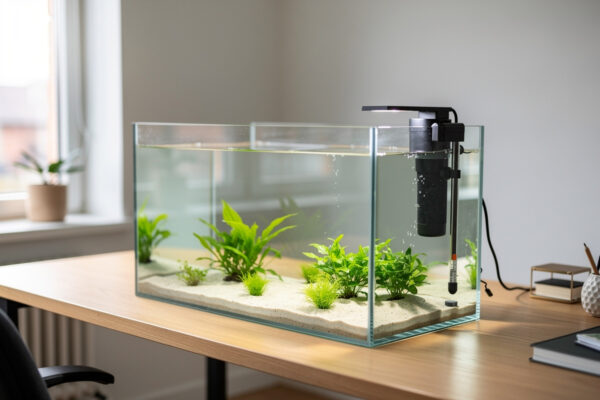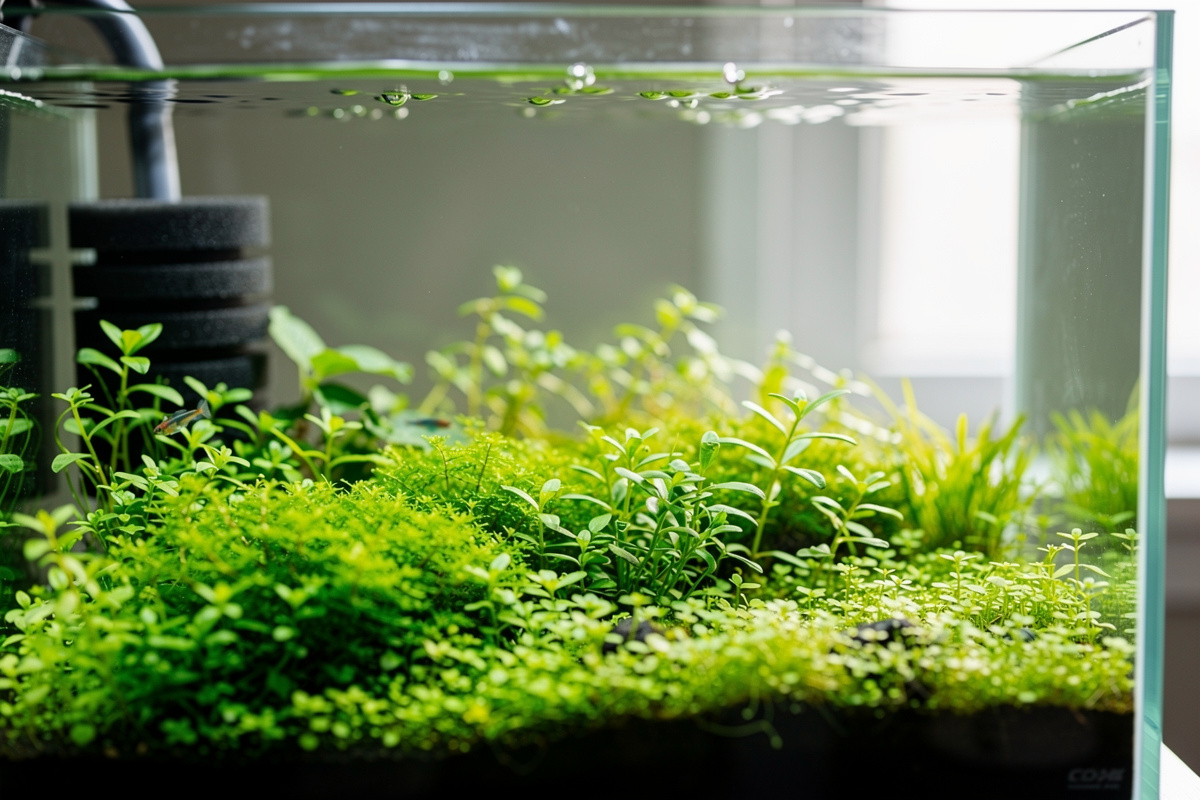
The aquarium nitrogen cycle is the single most important thing happening in your tank, and it is also the thing the pet store glosses over hardest. I came to aquariums sideways, through years of hydroponics, where I learned to never trust a reservoir I hadn’t measured. The same reflex saved me when I set up my first nano: I treated it as a water-chemistry bench with a heartbeat, ran a fishless cycle, and logged every number. The fish I added six weeks later barely noticed they’d moved house. That is the whole point of understanding the cycle honestly — it is not a patience tax, it is the difference between a stable tank and a fish-killing ammonia trap.
This guide is the map for the rest of the cluster. I’ll walk through what the cycle actually is at the level of the numbers your test kit reports, why nano tanks make it both faster and more brutal, and how to run one start to finish without guessing. Each section links out to a deeper article when you want the full bench notes.
What the nitrogen cycle actually is
Strip away the marketing and the cycle is just chemistry with a biological middleman. Your livestock — and any uneaten food or decaying plant matter — releases ammonia (the test kit calls it total ammonia nitrogen). Ammonia is acutely toxic to fish and shrimp even at fractions of a part per million. In a mature tank you never see it, because a bacterial colony eats it as fast as it appears.
That colony comes in two acts. First, ammonia-oxidizing bacteria (and archaea) convert ammonia into nitrite. Nitrite is also toxic — it wrecks a fish’s ability to carry oxygen in the blood — so you have traded one poison for another. Then a second group of bacteria converts nitrite into nitrate, which is far less toxic and which you remove with routine water changes. That is the entire cycle: ammonia in, nitrate out, two bacterial colonies doing the work in between.
The reason this takes weeks is that those bacteria are slow growers. They are not floating in the water; they live on surfaces — your filter media, the substrate, the hardscape. They double on the order of every day or two under good conditions, so building a colony big enough to keep pace with a stocked tank is a matter of weeks of patient feeding. There is no shortcut that beats the biology, only ways to make the biology comfortable.
Why nano tanks change the math
Most cycle guides are written for a 200-litre community tank, and they quietly mislead anyone running small water. I keep a rack of nanos — a low-tech planted ~20L as my daily reference, a high-tech 60L showpiece, and a dedicated Neocaridina shrimp tank — and the lesson the nano teaches over and over is that small volume amplifies everything.
In a big tank, a slug of ammonia gets diluted across hundreds of litres and the concentration barely moves. In a 20-litre nano, the same amount of waste produces a far higher reading. That cuts both ways during cycling: a nano can actually establish a colony quickly because the surface-area-to-volume ratio is generous, but it also swings hard if you overdose your ammonia source or skip a test. This is the standing thesis of the whole site — small water is the advanced class sold as the beginner one — and the cycle is where it bites first.
The practical upshot: on a nano you dose ammonia more conservatively, you test more often, and you respect that a reading that would be a rounding error in a big tank can be a genuine spike in yours. I go deeper into volume-driven swings in the nitrite spike article, because the nitrite phase is where nano keepers panic most.
Fishless vs. fish-in cycling — and why I only do one
There are two ways to grow that bacterial colony. The honest, humane one is a fishless cycle: you add a pure ammonia source to an empty tank and feed the bacteria directly, watching the numbers climb and fall over a few weeks, then stock once it’s done. The other is fish-in cycling, where you add hardy fish first and let their waste seed the colony — which means subjecting living animals to weeks of ammonia and nitrite exposure and constant water changes to keep them alive.
I run fishless cycles, full stop. It is faster (you can drive ammonia harder than fish safely could), it is kinder, and it lets you stock the tank fully on day one instead of dribbling fish in. Fish-in cycling is what the hobby did before we understood the chemistry, and it is still what happens by accident when someone buys a tank and fish in the same trip. If you are already in that situation the priority is damage control — small frequent water changes, heavy testing, no new livestock — but the planned route is always fishless. The full fishless cycle walkthrough is its own article.
The four numbers your test kit reports
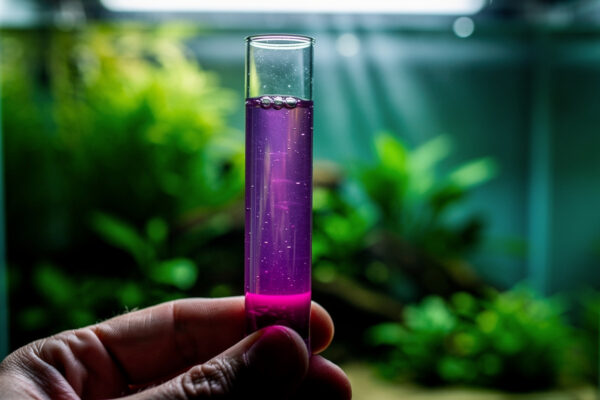
You cannot cycle a tank by looking at it. The water is clear the whole time; the drama is entirely in the chemistry. A liquid test kit is the first thing you should buy — before the heater you panic-bought, before the fancy light — and it is genuinely the cheapest insurance in the hobby. Here is what each reading means during a cycle.
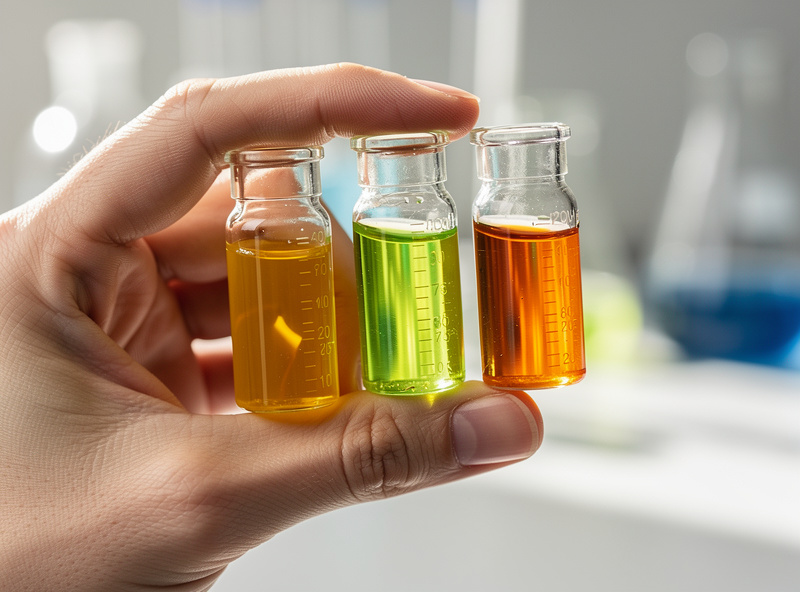
Comparison: what each parameter tells you
| Parameter | What it is | Toxicity | During a healthy cycle | In a cycled tank |
|---|---|---|---|---|
| Ammonia (NH3/NH4) | First waste product from fish, food, decay | Acutely toxic | Rises first, then falls to zero | Always 0 |
| Nitrite (NO2) | Made by bacteria from ammonia | Acutely toxic (blocks oxygen transport) | Rises after ammonia, often spikes high, then falls to zero | Always 0 |
| Nitrate (NO3) | Made by bacteria from nitrite; the end product | Low toxicity at normal levels | Climbs steadily as the cycle completes | Present; controlled by water changes |
| pH / KH | Acidity and carbonate buffer | Not toxic, but governs everything | Can crash if KH is low — stalls the cycle | Stable; check the buffer |
The pattern to memorize: ammonia rises, then nitrite rises as ammonia falls, then nitrate climbs as nitrite falls. When you can add ammonia and read zero ammonia and zero nitrite the next day, with nitrate present, the cycle is done. That “double-zero” test is the whole finish line, and I devote a full article to reading the cycled tank correctly so you don’t stock too early.
One number most beginners ignore is the buffer. KH (carbonate hardness) is the tank’s resistance to pH swings, and the cycle consumes it — the nitrification process is acidifying. If your KH is very low, the pH can crash mid-cycle, the bacteria stall out, and you sit there for weeks wondering why nothing is happening. I learned this the hard way on soft Swedish tap water, and it is the single most common hidden cause of a stalled cycle.
Choosing your ammonia source
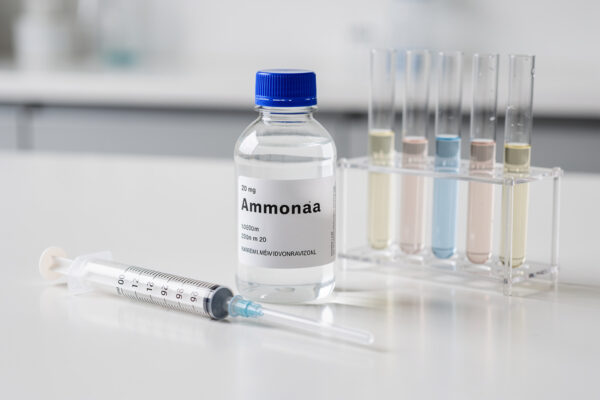
For a fishless cycle you need a clean, dosable source of ammonia. The cleanest is pure aqueous ammonia — ammonium hydroxide with no surfactants, no perfumes, no “lemon scent.” You dose a measured amount to hit a target ammonia reading and top it up as the bacteria consume it. The alternative is the “rotting food” method, where you let a pinch of fish food or a raw shrimp decay to release ammonia organically — it works, but it is messy, imprecise, and invites mold and bacterial blooms.
I default to dosed liquid ammonia because, true to the bench mindset, I want to control the variable. The food method is fine if you genuinely cannot get clean ammonia, but you give up the precision that makes the whole exercise readable. Picking and dosing the source correctly is fiddly enough that it gets its own deep-dive — including the exact target readings I aim for and why “more ammonia” actively slows the cycle down — see the ammonia source deep-dive.
The gear that actually matters for a cycle
- A liquid test kit — the non-negotiable first purchase. The drop-test kits read ammonia, nitrite, nitrate, pH and KH; the dip strips are convenient but I trust the liquid drops for the readings that matter most. Browse master liquid test kits on Amazon.
- Pure ammonia source — unscented, no surfactants, for dosed fishless cycling. Browse fishless-cycle ammonia on Amazon.
- A KH/GH test — to catch the buffer crash that stalls cycles on soft water. Browse KH/GH test kits on Amazon.
Seeding: the one real speed-up
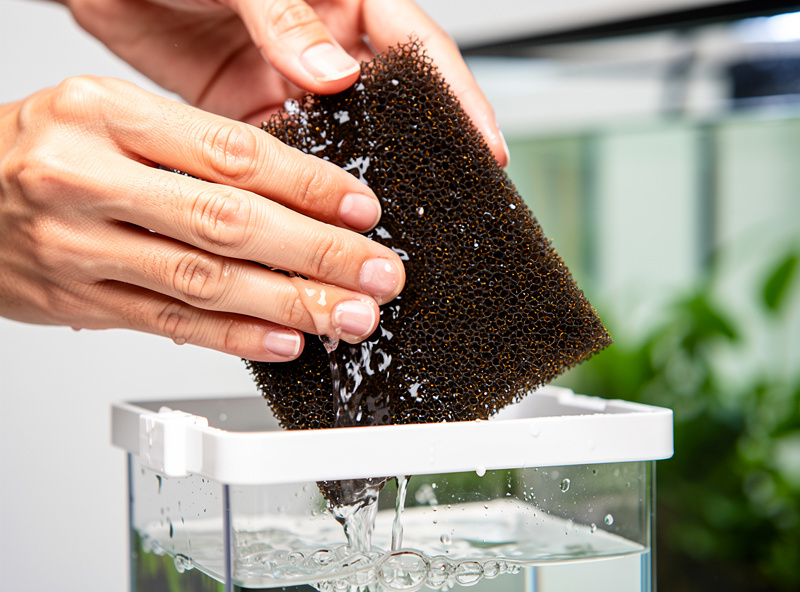
You cannot beat the biology, but you can import it. The single legitimate way to shorten a cycle is to transplant established bacteria from a mature, healthy tank — a handful of seasoned filter media, a squeeze of dirty sponge, some used substrate. Those surfaces already carry the colony, and dropping them into your new filter gives the bacteria a running start instead of waiting for them to arrive on their own.
This is also the honest framing for the bottled-bacteria products that promise an “instant cycle.” Some of them genuinely contain viable nitrifying bacteria and can give a real head start; others are shelf-stable wishful thinking. None of them let you skip testing. I treat them as a possible accelerant, never as a license to add fish on day three, and I unpack which claims hold up in the bacteria-in-a-bottle article. The reliable seed is always real media from a real tank.
When a cycle stalls
Sometimes the numbers just stop moving. Ammonia sits high and nitrite never appears, or nitrite parks itself off the top of the chart for weeks. A stall is almost never bad luck — it is a condition the bacteria don’t like. The usual culprits are a crashed pH from depleted KH, water that is too cold for the bacteria to grow, an ammonia overdose that has gone toxic even to the nitrifiers, or chlorine/chloramine from un-dechlorinated tap water quietly sterilizing the tank.
The fix is diagnostic, not a product: test the buffer, check the temperature, ease off the ammonia, confirm you’re dechlorinating. I keep my cycling tanks in the mid-to-upper twenties Celsius because warmth speeds bacterial growth, and on my soft tap water I add a little buffer to hold KH up. The full troubleshooting tree — every common stall and how to read your way out of it — is its own article, because “my cycle stalled” is one of the most common cries for help in the hobby.
The buffer chemistry nobody explains
This is the part where my hydroponics background pays for itself, because it is pure water chemistry and most aquarium content waves at it nervously. Nitrification — the bacterial conversion of ammonia through to nitrate — produces hydrogen ions. Hydrogen ions are acid. So the very process you are trying to establish is steadily acidifying your water, and the only thing standing between you and a pH crash is your carbonate buffer, the KH.
Think of KH as the tank’s bank account of pH stability. Every day the cycle runs, it makes a small withdrawal. If you start with a healthy balance — a KH that reads comfortably on the kit — the daily withdrawals barely move the pH and the bacteria stay in their happy range. If you start with near-zero KH, which is common on soft tap or pure RO water, the account empties, the pH drops into the low fives, and the nitrifying bacteria slow to a crawl or stop. The cycle looks “stalled,” but the real cause is a chemistry problem upstream.
On my soft Swedish tap water I keep a small dose of carbonate buffer on hand specifically for the cycling phase, and I test KH alongside ammonia and nitrite rather than treating it as an afterthought. For the shrimp tank, where I run remineralized RO water, getting the KH right is doubly important because the whole point of RO is to build the water back up to a known target. The crossover lesson is the same one the reservoir taught me years ago: a number you don’t measure is a number that will surprise you, and surprises in a closed system are rarely good.
Water changes during the cycle — and after
A fishless cycle does not need water changes while it runs. There are no animals to protect, so you can let ammonia and nitrite climb and fall on their own schedule — interrupting with water changes just removes the food and slows the bacteria. The one exception is if you have wildly overdosed ammonia into the genuinely toxic-to-bacteria range, in which case a partial change to bring it back down is sensible. Otherwise, leave it alone and let the numbers do their thing.
The moment the cycle finishes, though, the routine flips. Once you confirm the double-zero result, do one large water change before you stock — the nitrate has been climbing for weeks and you want to reset it to a low baseline so the fish move into clean water. From then on, water changes are forever: the cycled tank converts everything to nitrate, and water changes are how nitrate leaves. On a nano I run a small, frequent cadence rather than big infrequent dumps, because — again — small volume means big swings (the same reason a nitrite spike hits a nano so hard), and a gentle weekly habit keeps the parameters flat. I treat the water-change schedule as part of the tank’s life support, not a chore I’ll get to eventually.
If you already have fish in an uncycled tank
Plenty of people find this guide after the pet store sent them home with a tank and a bag of fish in the same afternoon. If that’s you, don’t panic and don’t add anything else — your job now is damage control while the tank cycles around the fish. Test daily. The instant ammonia or nitrite climbs into the danger zone, do a partial water change to dilute it back down; you are manually doing the job the bacteria can’t do yet. A dechlorinator is mandatory on every drop of replacement water, because chlorine kills the very bacteria you’re trying to grow.
Keep feeding light — less food means less ammonia — and resist every urge to “help” with more products. The colony is building whether you like it or not; your only role is to keep the concentrations survivable until it catches up, which on a fish-in cycle can take a month or more of daily vigilance. This is precisely why I cycle fishless and why I’m blunt about it: the fish-in route is weeks of work and stress that a few weeks of patience upfront would have avoided entirely. If you’re reading this before you’ve bought fish, take the easier road.
How long does it really take?
An honest fishless cycle runs roughly four to eight weeks. Seeded with mature media and kept warm, the fast end is realistic; cold, unseeded, on soft water that keeps crashing, the slow end is where you’ll sit. Anyone promising a cycled tank in 24 hours is selling something. The tank does not care about your schedule — it is running on bacterial doubling times, and those are fixed.
What I tell every new keeper is to start the cycle the same day the tank is set up, before you have even chosen your fish. By the time you have researched stocking, drip-acclimation, and the rest, the colony is well underway. Treat the wait as the design phase, not dead time. The numbers will tell you exactly when you’re allowed to stock — no guessing, no “it’s probably fine.”
The mistakes that wreck a cycle
After running cycles on every tank in my rack and helping a fair few friends rescue theirs, the failures cluster into a short list of avoidable mistakes. The first is impatience — adding fish because the water looks clear and a week feels like long enough. Clear water tells you nothing; only the test kit knows. The second is over-cleaning. New keepers scrub the filter and rinse the media under hot tap water, killing the exact colony they spent weeks building. Once a tank is cycled, the filter media is the most precious thing in it — you rinse it gently in old tank water, never under chlorinated tap, and you never replace all of it at once.
The third mistake is medicating or dosing the cycling tank with things that aren’t part of the plan. A lot of products marketed at new tanks are antibacterial in some way, and an antibacterial agent is exactly what you do not want when you are trying to culture beneficial bacteria. I keep cycling tanks boring on purpose: ammonia, dechlorinator if I’m topping up, a buffer if KH is low, and nothing else. The fourth is forgetting the dechlorinator entirely and wondering why the cycle never starts — municipal water with chloramine will keep sterilizing the tank indefinitely. Treat every drop that goes in.
The last one is misreading the finish line, which is common enough that it earned its own article. People see ammonia hit zero, get excited, and stock — forgetting that nitrite is the second act and is still climbing. Stocking into a nitrite spike is just as lethal as stocking into ammonia. The cycle is not done until both read zero on the day after a fresh ammonia dose, with nitrate present. Read the double-zero test carefully before you celebrate.
The full cluster — where to go next
This hub is the overview; each step has its own detailed bench notes. Start with the fishless walkthrough, then dip into whichever number is confusing you.
Read next
- Fishless cycle, step by step — the full week-by-week walkthrough with target readings.
- Choosing and dosing your ammonia source — pure ammonia vs. the food method, and the dose that actually works.
- When your cycle stalls — the diagnostic tree for a cycle that won’t progress.
- What a nitrite spike means — the scariest phase, explained calmly.
- The truth about bottled bacteria — what the products can and can’t do.
- Is my tank actually cycled? — the double-zero test and how to read it.
Frequently Asked Questions
How long does the aquarium nitrogen cycle take?
An honest fishless cycle runs about four to eight weeks. Seeded with mature filter media and kept warm, the fast end is realistic; cold, unseeded, or on soft water that keeps crashing, expect the slow end. Anything promising a cycled tank in 24 hours is marketing, not biology.
Can I add fish before the tank is cycled?
You can, but it means subjecting living animals to weeks of ammonia and nitrite while the bacteria catch up, plus daily testing and water changes to keep them alive. I always cycle fishless instead. If you already have fish in an uncycled tank, do small frequent water changes, test daily, and add nothing new.
What test kit do I need to cycle a tank?
A liquid drop-test kit that reads ammonia, nitrite and nitrate at minimum, plus a KH test to catch buffer crashes on soft water. The liquid kits are more trustworthy than dip strips for the readings that matter during a cycle. The kit is the first purchase, not the last.
How do I know when my tank is fully cycled?
Add your usual ammonia dose and test the next day. The tank is cycled when both ammonia and nitrite read zero and nitrate is present. Ammonia alone hitting zero is not enough, because nitrite is the second stage and is just as toxic.
Why is my cycle stalled?
The usual causes are a crashed pH from depleted KH, water that is too cold for the bacteria, an ammonia overdose that has gone toxic to the nitrifiers, or chlorine and chloramine from un-dechlorinated tap water. It is almost always a fixable condition, not bad luck. Test the buffer, check the temperature, ease off the ammonia, and confirm you are dechlorinating.
Does bottled bacteria really work?
Some products contain viable nitrifying bacteria and can give a genuine head start; others are shelf-stable wishful thinking. None of them let you skip testing or add fish on day three. The only reliable speed-up is seeding with real media from an established, healthy tank.