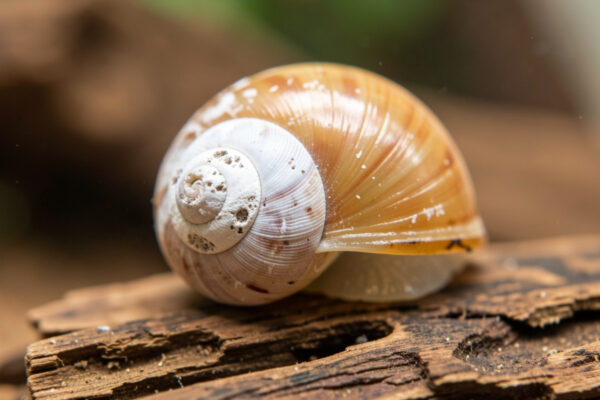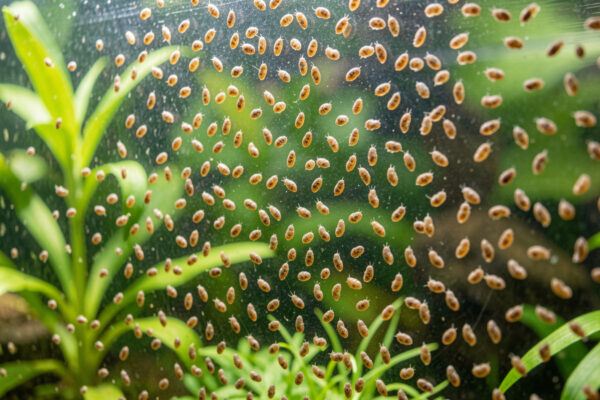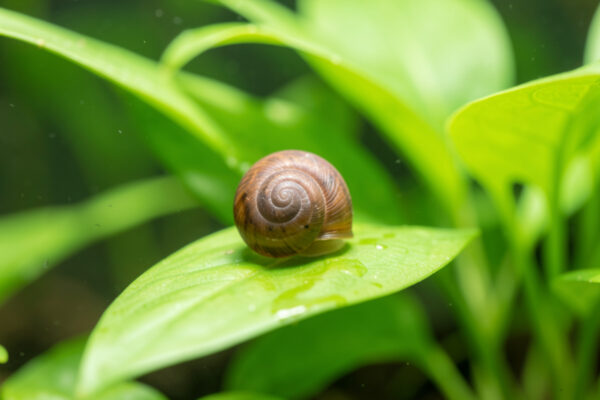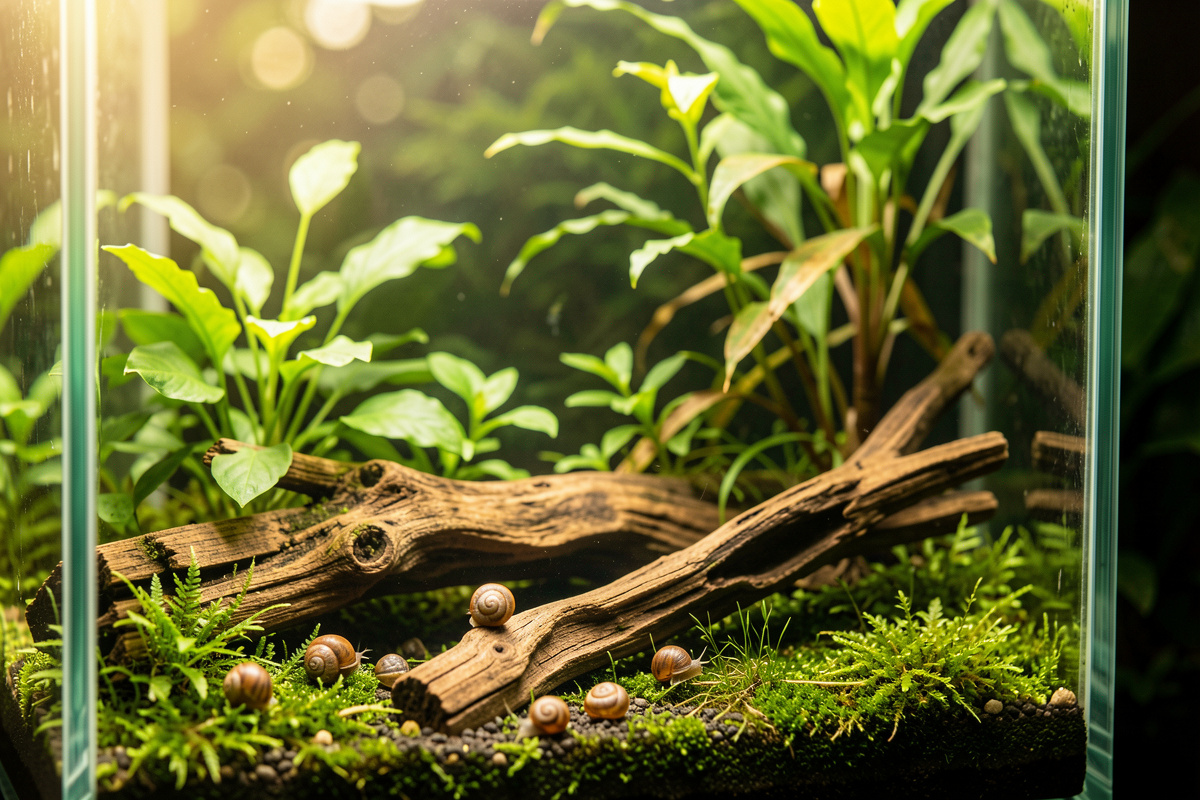
A nano tank snail is a working invertebrate, not decoration: nerites graze algae off glass and hardscape, Malaysian trumpet snails till the substrate, and even the “pest” species are just detritivores doing a job. In my parameter log a mixed cleanup crew barely moves nitrate — a dozen small snails add roughly the bioload of a single tetra, and unlike a fish they eat the film you were scrubbing by hand.
I keep four small tanks in Sweden and every one of them runs a cleanup crew, because I stopped treating snails as an accident and started treating them as livestock with a purpose. This guide is the map: what each species does, why the “snails cause an outbreak” panic is a feeding problem wearing a chemistry costume, and how to build a crew that balances your specific water instead of copying a stocking list off a forum. Test, don’t guess — whatever’s living in the water.
What a nano cleanup crew actually does
A cleanup crew is the invertebrate layer that processes what your fish and plants leave behind: algae on glass, biofilm on hardscape, uneaten food, decaying leaves, and — in the case of burrowing snails — the anaerobic pockets that build up in deep substrate. They do not “clean” the water in the chemical sense. Nothing eats nitrate except plants and water changes. What snails do is convert visible mess into a smaller, slower waste stream and keep surfaces grazed so algae never gets a foothold.
The honest limit matters as much as the benefit. A snail turns leftover food into ammonia faster than it would have rotted, which your established nitrogen cycle then processes. On a cycled tank that is a non-event. On an uncycled one it is fuel for a crash. This is why I never recommend snails as a fix for a dirty tank — they are a maintenance tool for a stable one, and the difference is the whole game.
The snail bioload myth — the chemistry reality
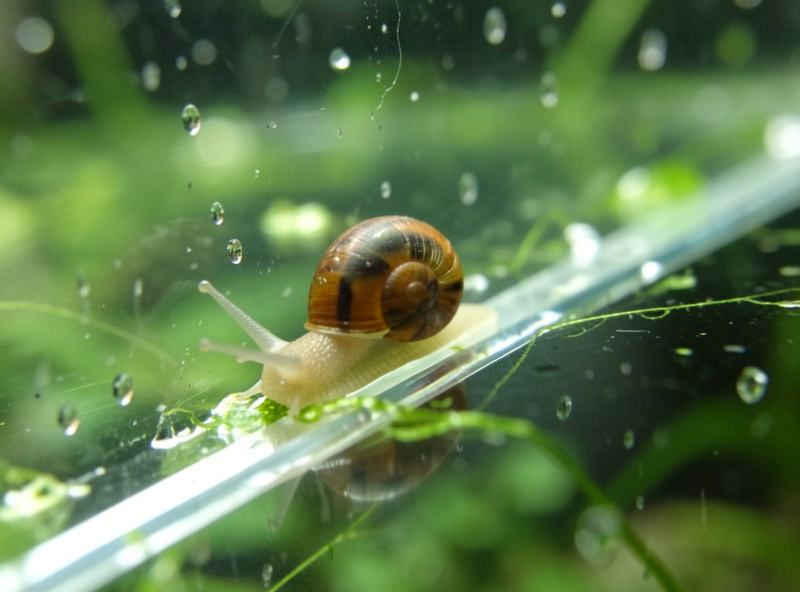
The most repeated warning in the hobby is that snails “overload” a small tank. In my parameter log they barely register. A grown nerite weighs a couple of grams and eats algae that was already in your tank; it does not import waste, it redistributes existing organic load into a form your filter handles. When I added eight nerites and a ramshorn colony to my 20-litre low-tech nano, the weekly nitrate reading did not shift outside its normal 5–10 ppm band.
Where bioload genuinely climbs is with overfeeding, not with snails. A snail population that suddenly explodes is a symptom of surplus food — the snails ate the excess you were putting in, then bred to match it. Fix the feeding and the population self-corrects within weeks. If you want the full argument with the numbers behind it, I made the case in the pest-snail bioload reality check, and the overstocking signs guide shows what an actual overload looks like in the test tube (spoiler: it is nitrite, and snails never cause it).
The nano cleanup-crew roster
There is no single “best” cleanup snail — there is the right tool for the job your tank needs done. The table below is how I sort them: by what they eat, whether they breed in your water, and the hardness they need to hold a shell. Read the shell column carefully, because a snail dissolving in soft water is the single most common failure I see, and it is pure chemistry.
| Snail | Main job | Breeds in freshwater? | Min KH for shell | Adult size |
|---|---|---|---|---|
| Nerite (zebra, tiger, horned) | Algae grazer — glass, hardscape, film | No (lays sterile eggs) | 4+ dKH | 1–2.5 cm |
| Malaysian trumpet | Substrate tiller, detritivore | Yes (livebearer, prolific) | 3+ dKH | 1–2 cm |
| Ramshorn | Detritus, soft algae, dead plant matter | Yes (egg clutches) | 4+ dKH | 1–2 cm |
| Bladder / pond | Detritus, leftover food, film | Yes (very prolific) | 3+ dKH | 0.7–1.5 cm |
| Assassin (Clea helena) | Predator — controls pest snails | Yes (slow, single eggs) | 4+ dKH | 1.5–3 cm |
| Mystery / apple | Leftover food, some algae | Yes (above-water clutches) | 5+ dKH | 4–6 cm (too big for pico) |
Two rules fall straight out of that table. First, only the nerite refuses to breed in freshwater, which is exactly why it is the workhorse for keepers who want algae control with zero population risk — I break the whole genus down in the nerite snail guide. Second, every snail here needs carbonate hardness to build shell, and if your KH sits below 4 dKH their shells pit and erode. That is not a disease; it is a KH and GH problem you fix in the remineralizing bucket.
Nerite snails: the algae workhorse
If I could only put one snail in a nano tank it would be a nerite, every time. They graze glass, silicone, driftwood and rock harder than anything else their size, they tolerate a wide parameter range, and — critically — they cannot reproduce in fresh water. Their larvae need brackish or full saltwater to develop, so the eggs they lay on your hardscape are biological dead ends. You get the cleanup with none of the population math.
The trade-off is those eggs. A well-fed female stipples little white sesame-seed capsules across dark hardscape, and they are stubborn to remove. That is the number-one nerite complaint I answer, and I cover exactly why they appear and what actually removes them in the nerite egg guide. For most tanks the fix is simply keeping fewer nerites, or accepting the eggs as the price of the best algae control in the hobby.
Pest snails: bladder, ramshorn and Malaysian trumpet
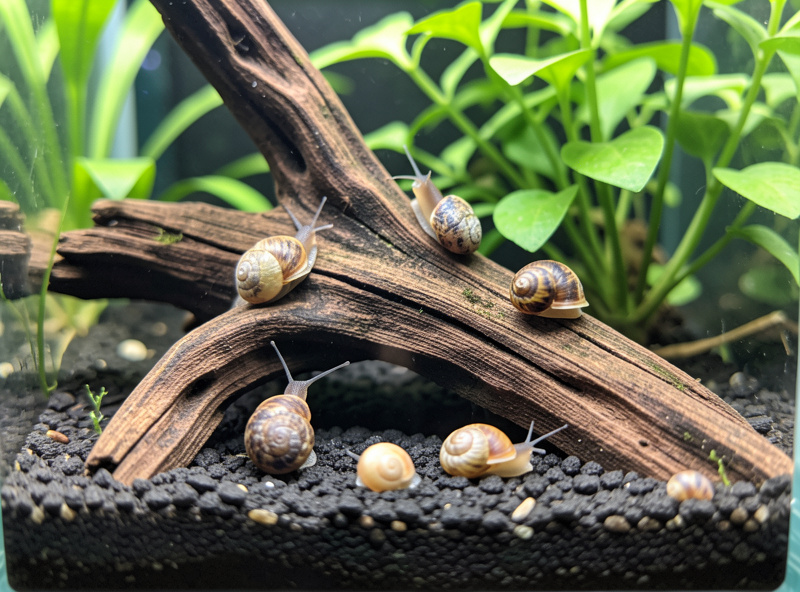
“Pest snail” is a label the hobby slaps on any snail that arrived uninvited on a plant and then bred. Bladder snails, ramshorns, and Malaysian trumpet snails all fall under it. The honest position — and the one my test tube backs up — is that none of them harm a healthy tank. They eat detritus and dead plant matter, they do not eat healthy plants, and a Malaysian trumpet snail burrowing through your substrate is doing free maintenance on anaerobic pockets that would otherwise breed hydrogen sulphide.
What they do is multiply to match available food, and a glass wall crawling with snails looks alarming even when it is harmless. If the sight bothers you, or the population has genuinely run away, you have two levers: cut the food supply, or add a predator. The chemical-free removal methods — blanching, trapping, manual culls, and feeding discipline — are laid out step by step in the pest-snail removal guide, and I explain why I reach for none of the copper-based “snail killer” bottles on the shelf.
Assassin snails: the predator on the roster
When a pest population has genuinely outrun manual control, the elegant answer is a biological one: Clea helena, the assassin snail. It is a carnivore that hunts and eats other snails, and a small squad of them will grind down a bladder-snail plague over a few weeks with no chemicals, no dosing, and no risk to your fish, shrimp or plants. They breed slowly and lay single eggs, so they never become the next infestation.
They are not a magic wand, and there are real considerations — what they do once the pest snails are gone, whether they will touch your nerites, and how many you actually need for a nano. I run through all of it in the assassin snail guide. For most keepers assassins are the deliberate, permanent alternative to fighting an outbreak by hand every week.
Shell health: the KH and GH connection
Here is the failure that catches more keepers than any disease: a snail whose shell is pitting, going chalky-white at the tip, or eroding into holes. Owners reach for medications. There is nothing to medicate. A snail shell is calcium carbonate, and the snail builds it from the calcium (GH) and carbonates (KH) dissolved in your water. Soft water — the low-KH, low-GH water that shrimp keepers and RO users deliberately create — starves and then dissolves the shell.
My shrimp tank runs on RO water I remineralize deliberately, and I learned early that the same soft water my Neocaridina colony tolerates will erode a snail if I do not keep KH up. The target ranges, the difference between GH and KH for shell-building, and how to raise them without shocking the tank are all in the shell erosion guide. If you keep snails, you keep a KH test kit — that is the non-negotiable part.
Snails and shrimp: same tank, same water
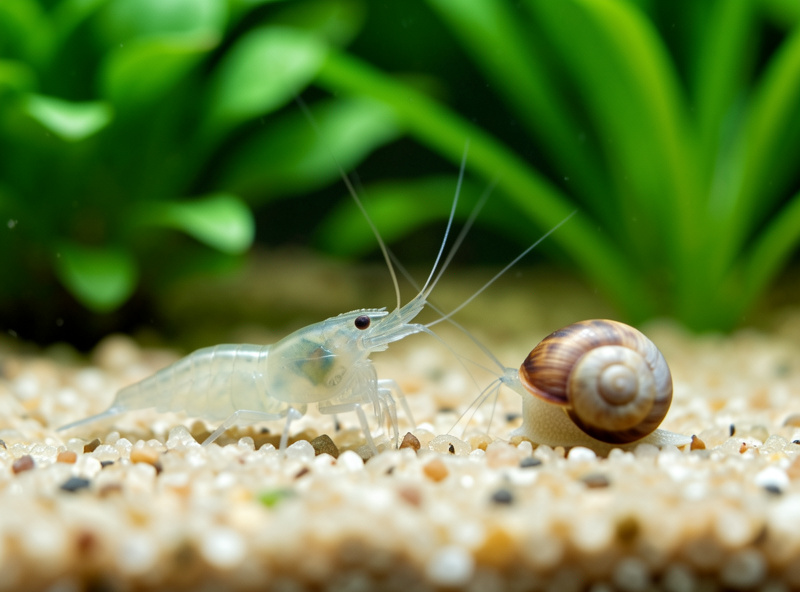
Snails and dwarf shrimp are the classic nano cleanup pairing, and they genuinely complement each other — shrimp graze what snails miss and vice versa. The recurring worry is competition: will the snails outcompete the shrimp for food, or foul the water the shrimp need clean? In practice they occupy slightly different niches and the bioload of both together is still trivial. The one real tension is water hardness, because shrimp and snails have overlapping but not identical parameter needs.
I keep both in the same water and log the results; the honest answer on diet overlap, hardness compromise, and stocking order is in the snails-with-shrimp guide. The short version: matched to the same KH, GH and TDS, they coexist without either species suffering, and the combined crew is the most self-sufficient cleanup I run.
The best algae eaters for small water
Not every algae problem wants the same grazer. Nerites dominate glass and hardscape; other snails specialise in soft film, dead leaves, or substrate. Matching the eater to the algae — and to your tank’s hardness — is the difference between a crew that works and one that starves or dissolves. I ranked the realistic options for nano volumes in the best algae-eating snails guide, and the whole approach sits under the wider algae-by-cause diagnosis method: a grazer manages algae, it never cures the imbalance feeding it. If you have green spot algae welded to the glass, a nerite is the only snail that reliably shifts it.
Building your crew: a stocking sequence
Order matters. I add a cleanup crew to an already-stable, cycled tank, never to a new one. My sequence is simple: let the tank run four to six weeks until parameters are boring, confirm KH is at least 4 dKH, then add snails a few at a time rather than all at once. Start with two or three nerites for a 20-litre nano — that is enough grazing power without an egg blizzard. Malaysian trumpet snails and ramshorns usually arrive on their own as plant hitchhikers; I let them establish and only intervene if feeding gets sloppy.
Acclimate new snails the way you would shrimp — slowly. Snails tolerate a wider parameter range than shrimp, but a nerite dropped straight from hard shop water into a softer tank still suffers the shock, and a stressed snail seals up and stops grazing for days. I drip-acclimate over 30 to 45 minutes, matching temperature and easing the parameter change, then place the snail upright on the substrate rather than dropping it. A snail that lands on its back in open water can struggle to right itself, so give it a surface to grip. New snails also carry hitchhikers and sometimes pest-snail eggs, so a fresh-plant-style dip or a short quarantine on a spare tank is cheap insurance against importing a bladder-snail population you did not order.
Everything downstream is feeding discipline and water changes. Keep the water-change cadence matched and small, feed the fish and shrimp what they finish in two minutes, and the crew stays balanced on its own. The tank tells you the truth in the test tube and on the glass — read it there, not on a forum. That is the entire method, and it works because it is chemistry, not luck.
As an Amazon Associate I earn from qualifying purchases. A basic liquid KH and GH test kit is the one purchase I would not run a snail tank without — it costs a fraction of the livestock it protects.
Reading your cleanup crew: thriving versus struggling
Snails are one of the most honest gauges in the tank if you learn to read them, because they respond to water quality before your fish visibly do. A thriving crew is active and spread out: nerites cruising the glass and hardscape, trumpet snails surfacing at night, ramshorns gliding across leaves. Their shells are intact and, on growing snails, the aperture edge is thick and glossy. That is the picture of adequate KH, stable pH and enough food — the state I aim to keep boring.
A struggling crew tells you something is off well before a test kit alarms. Snails clamped shut and immobile for a day or more, several climbing to the waterline at once, or a sudden collective retreat usually means a parameter has swung or something toxic entered the water — copper being the classic culprit. Shell tips going chalky and pitted point specifically at low KH. When my snails change behaviour, I test that day rather than wait; they have caught a slipping cycle and a mis-dosed treatment for me more than once. Treat the crew as livestock and it doubles as an early-warning system.
Cleanup-crew mistakes I see most often
The first mistake is adding snails to fix a dirty or uncycled tank. Snails are maintenance for a stable system, not a rescue for a struggling one — dropped into an uncycled tank they add to the ammonia load and often die in the swing. Cycle first, stabilise, then add the crew. The second is buying snails for water that cannot hold their shells: putting nerites or mystery snails into a soft, low-KH shrimp tank and watching them erode within weeks. Check KH before you buy, not after.
The third is overstocking grazers and then watching them starve. A nano tank produces a finite amount of algae and biofilm, and a crowd of nerites strips it bare in days and then thins at the shell. Fewer snails, better fed, outlast a crowd every time. The fourth is panic: reaching for a copper “snail killer” the moment a pest population appears, which in a nano wipes shrimp and other inverts and spikes ammonia from the die-off. Almost every cleanup-crew problem is solved with feeding discipline, a KH test, and patience — the same three tools that run the whole tank.
Frequently Asked Questions
Do snails increase the bioload in a nano tank?
Barely. A dozen small snails add roughly the waste of one small tetra. Snails eat organic matter already in the tank rather than importing it, so they redistribute existing load into a form the filter handles rather than adding new nitrate.
Will pest snails harm my plants or fish?
No. Bladder, ramshorn and Malaysian trumpet snails eat detritus and dead plant matter, not healthy plants, and they pose zero threat to fish. A population boom is a sign of overfeeding, not a danger in itself.
Which snail is best for algae in a small tank?
The nerite snail. It grazes glass, silicone and hardscape harder than any snail its size and cannot breed in freshwater, so you get algae control with no population risk. Its only downside is the sterile white eggs it lays on hardscape.
Why is my snail’s shell eroding or turning white?
Soft water. Shell is calcium carbonate, built from the calcium (GH) and carbonates (KH) in your water. When KH drops below about 4 dKH the shell pits and dissolves. It is a chemistry problem, not a disease, and it is fixed by raising KH and GH.
Can I keep snails and shrimp together?
Yes, and they make an excellent cleanup pairing. They occupy slightly different feeding niches and their combined bioload stays trivial. The only thing to match is water hardness, since both need adequate KH and GH but the shrimp set the softer end of the range.
How do I control a pest snail outbreak without chemicals?
Cut the food supply first, since population tracks feeding. Add manual culls, a blanched-vegetable trap, and if needed a small squad of assassin snails, which hunt and eat pest snails biologically. Copper-based snail killers are unnecessary and dangerous to shrimp.
Related Guides
- Nerite Snails in a Nano Tank: The Algae Workhorse
- How to Get Rid of Pest Snails Without Chemicals
- Are Pest Snails Actually Bad? A Bioload Reality Check
- Nerite Snail Eggs on Glass: Why They Appear and What to Do
- Best Algae-Eating Snails for Small Water
- Keeping Snails With Shrimp: Do They Compete?
- Assassin Snails: Controlling a Pest Snail Outbreak
- Snail Shell Erosion: The KH and GH Connection