Green spot algae in a nano tank shows up as small, hard green dots welded to the glass and the oldest leaves — and it is almost always a two-part signal: plenty of light, and not enough phosphate. It is the most stubborn algae to scrape, but also one of the most honest. Read those two parameters — keep phosphate off zero and the photoperiod near six to eight hours — and you can prevent it for good.
On my low-tech planted nano, green spot algae was the last algae I learned to control, because the standard advice — “reduce nutrients” — is exactly backwards for this one. Most algae blooms on a nutrient surplus. Green spot algae (GSA) is the rare type that blooms on a phosphate deficit under strong light. Once I understood that, the dots on my glass stopped being a mystery and became a reading on my parameter log. This guide is the cause-and-prevention breakdown I wish I had when I was scraping the same panel every weekend.
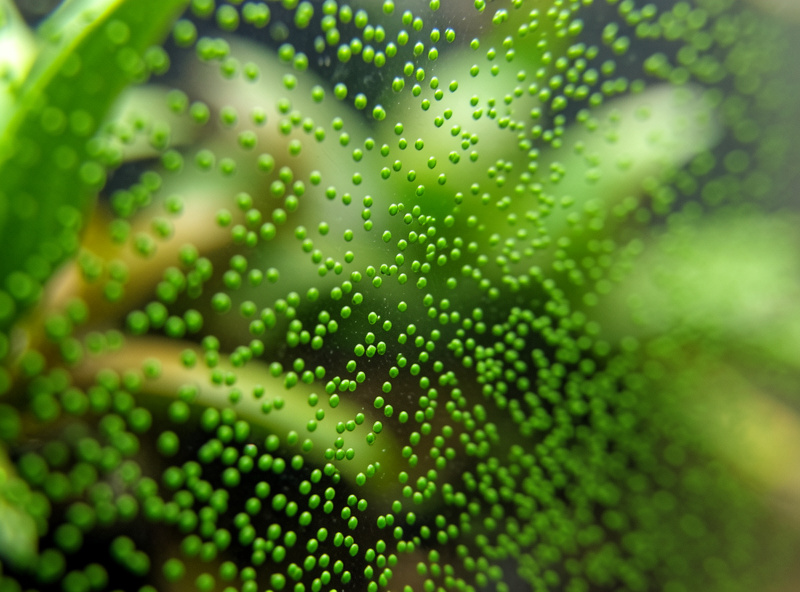
How to Identify Green Spot Algae
Green spot algae is exactly what the name says: discrete, circular green dots, hard to the touch, that resist a thumb and need a blade to remove. They appear first on the brightest glass and on slow-growing leaves like Anubias that have been in the tank a while. If you can wipe it away with a soft cloth, it is not GSA — it is the softer green film I cover separately.
The hardness is the tell. GSA bonds to surfaces and laughs at a sponge. On glass it scrapes off with a blade; on plant leaves it usually cannot be removed without damaging the leaf, which is why GSA on an old Anubias leaf is often a sign to simply trim that leaf. Distinguishing it from other glass algae matters because the fix is specific — and opposite to what you would do for most nuisance algae.
| Symptom | Green spot algae | Green film algae |
|---|---|---|
| Texture | Hard dots, need a blade | Soft haze, wipes off |
| Location | Brightest glass, old leaves | All glass evenly |
| Main cause | High light, low phosphate | Light plus minor nutrient surplus |
| Fix direction | Add phosphate, cut light | Cut light, wipe weekly |
If your glass is hazy and soft rather than dotted and hard, read the green film on glass guide instead — the prevention is different. For a full map of every algae type by cause, the aquarium algae guide is the place to start.
The Real Cause: High Light Meets Low Phosphate
Green spot algae is driven by the combination of strong light and a phosphate shortage. When light is abundant but phosphate (PO4) is scarce, your plants stall — and GSA, which tolerates low phosphate better than plants do, takes the brightest surfaces. The counterintuitive cure is to raise phosphate, not starve the tank further.
This trips up almost everyone, because the reflex with algae is to cut nutrients. With GSA that makes it worse: drive phosphate lower and you hand the slow-growing plants an even bigger disadvantage. In a planted nano, phosphate comes from fish food and waste, so a lightly stocked, lightly fed tank can genuinely run short — especially if you do large, frequent water changes with phosphate-free remineralised or RO water, which is exactly how I run my shrimp-adjacent tanks. The cleaner your water-change routine, the more likely GSA is a phosphate-limitation story.
Light is the other half. A nano sits close to its fixture, and modern LEDs are bright. High intensity over a long photoperiod pushes plant demand for phosphate up at the same time the supply is low, widening the gap GSA exploits. This is the same light-surplus mechanism behind algae from too much light, just expressed as hard dots instead of a general bloom.
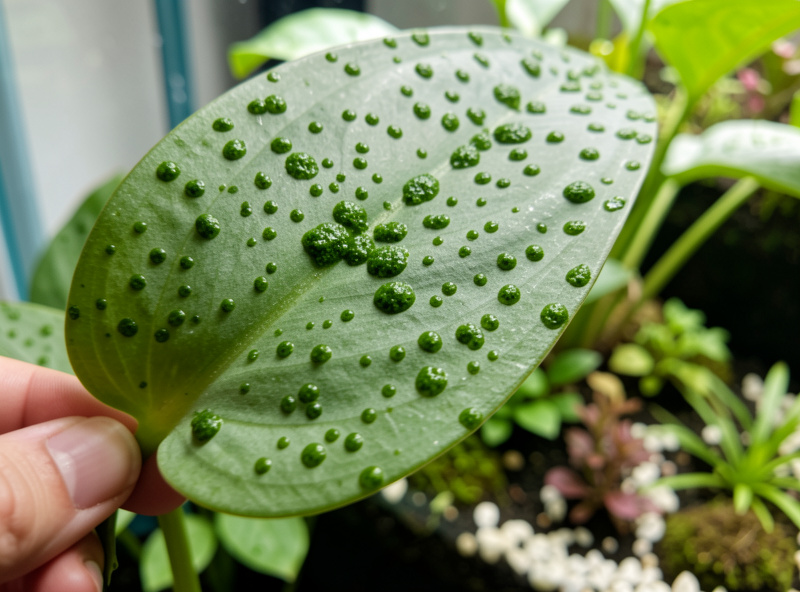
Why Nano Tanks Get It on the Glass First
Nano tanks are GSA-prone because the viewing panes are large relative to the water volume, and they sit directly under a bright fixture with little distance to diffuse the intensity. The front glass of a nano is some of the most strongly lit, nutrient-poor real estate in the tank — a perfect GSA niche. That is why the dots appear on the glass long before anywhere else.
Small volume compounds it. With only ten or twenty litres, phosphate swings between feedings are sharp, and a stretch of light feeding or a couple of big water changes can pull PO4 down to near zero. I have watched GSA appear within two weeks of tightening up a feeding schedule on my low-tech nano — the tank was simply cleaner than the plants could handle under that light. The lesson the volume math keeps teaching is that small water amplifies every input, including the ones you removed.
Prevention: Balance Phosphate and Tame the Light
Preventing green spot algae comes down to keeping phosphate available and keeping light proportionate to plant demand. The two levers are a modest, steady phosphate supply and a photoperiod your plants can actually use — six to eight hours for most nano setups. Get those in balance and GSA loses its foothold.
On the phosphate side, the fix is usually husbandry, not a bottle. Feed your livestock properly rather than starving the tank in the name of cleanliness; fish food is a phosphate source. In a heavily planted tank with light stocking, a comprehensive plant fertiliser that includes phosphate keeps PO4 off the floor — this is plant nutrition, the same logic as root tabs versus liquid ferts, not an algae treatment. The goal is simply to stop phosphate hitting zero under your light.
On the light side, shorten the photoperiod before you do anything else, and check that no afternoon sun is adding an uncontrolled dose. A timer is non-negotiable; inconsistent light is its own GSA trigger. If your fixture is strong, a shorter day or a dimmer setting brings plant demand back in line with the phosphate you have. My full approach to dialing this in lives in the nano lighting guide, and the broader balance of light, nutrients and flow is covered in controlling algae with plants and flow.
Maintenance closes the loop. GSA on glass scrapes off cleanly with a flat blade at each water change — I keep a dedicated aquarium blade scraper for exactly this. As an Amazon Associate I earn from qualifying purchases. Nerite snails are one of the few grazers that genuinely eat GSA, and a couple of them in a nano keep the glass and hardscape far cleaner than scraping alone. Neither of these is a treatment — they are tools and livestock that manage the dots while your parameters remove the cause.
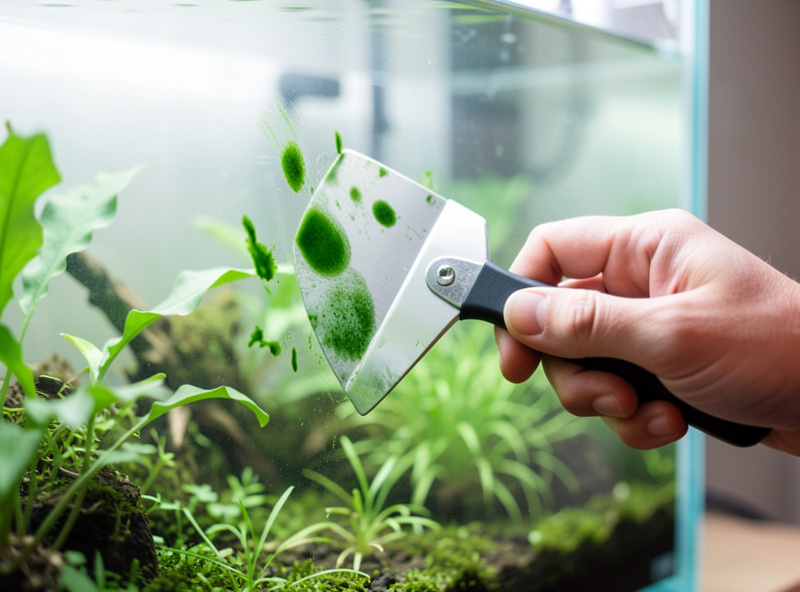
The Spot Worth Leaving Alone
A light scatter of green spot algae on the back glass or on the oldest hardscape is not a problem — it is a sign of a stable, mature tank, and in a low-tech setup I leave it. GSA is one of the slowest-growing algae there is, and a thin amount on surfaces you do not view through is harmless. Chasing it to zero usually means over-correcting your light or phosphate and triggering something worse.
I only act on GSA when it builds on the front viewing pane or coats a leaf I want to keep. Everywhere else, a little GSA is part of a tank that has found its balance — the same way a thin film on the glass is normal in any established system. The goal of a planted nano is a stable ecosystem, not a sterile box, and the keeper who can tell the difference spends a lot less time scraping. If the dots are spreading fast across the whole tank, that is when you return to the parameters: check the photoperiod, confirm phosphate is not bottoming out, and read the bloom as the signal it is.
Frequently Asked Questions
Why does green spot algae mean low phosphate?
Green spot algae tolerates low phosphate better than your plants do, so when light is strong but phosphate runs short, plants stall and GSA takes the brightest surfaces. Unlike most algae, the fix is to raise phosphate, not lower it, so plants can compete again.
How do I get green spot algae off the glass?
GSA is hard and bonded to the surface, so a soft cloth will not remove it. Use a flat blade aquarium scraper on glass at each water change. On plant leaves it usually cannot be removed without damage, so trim affected old leaves instead.
What eats green spot algae in a nano tank?
Nerite snails are one of the few grazers that genuinely eat green spot algae, and a couple of them keep nano glass and hardscape much cleaner than scraping alone. They are a husbandry tool, not a cure — your parameters still have to remove the underlying cause.
Should I cut my light to stop green spot algae?
Yes, shortening the photoperiod to six to eight hours is the first and cheapest move, because GSA is driven by strong light meeting low phosphate. Also make sure no afternoon sun is adding an uncontrolled dose, and run the light on a timer for consistency.
Is a little green spot algae a bad sign?
No. A thin scatter of GSA on back glass or old hardscape is normal in a stable, mature tank and harmless, since it is one of the slowest-growing algae. Only act when it builds on the front viewing pane or on leaves you want to keep.
Related Guides
- The aquarium algae guide — diagnose every algae type by cause
- Green film on glass — the soft algae GSA is often confused with
- Black beard algae — when the cause is CO2 and flow instead
- Controlling algae with plants and flow — the prevention system
- Water change cadence — how clean water can starve phosphate too far