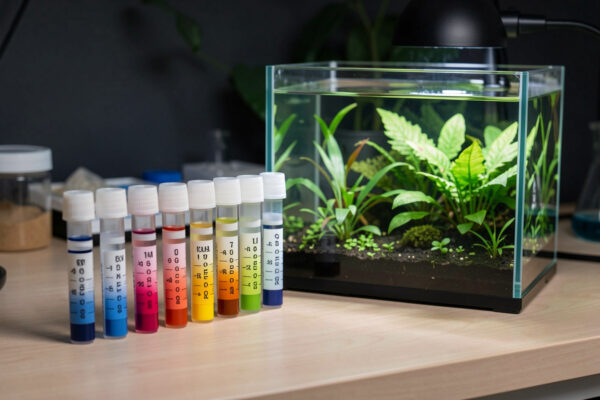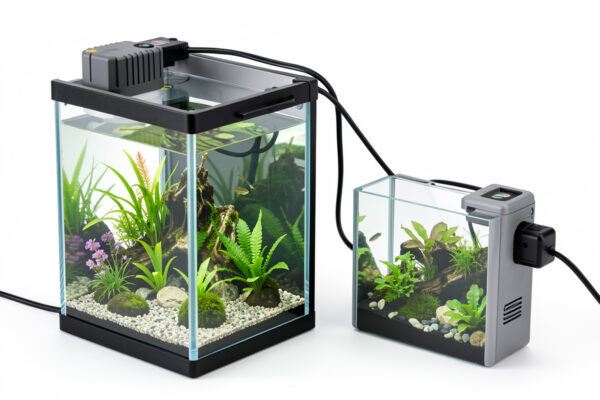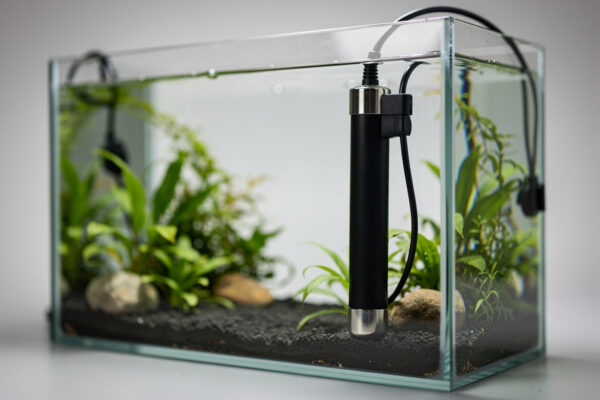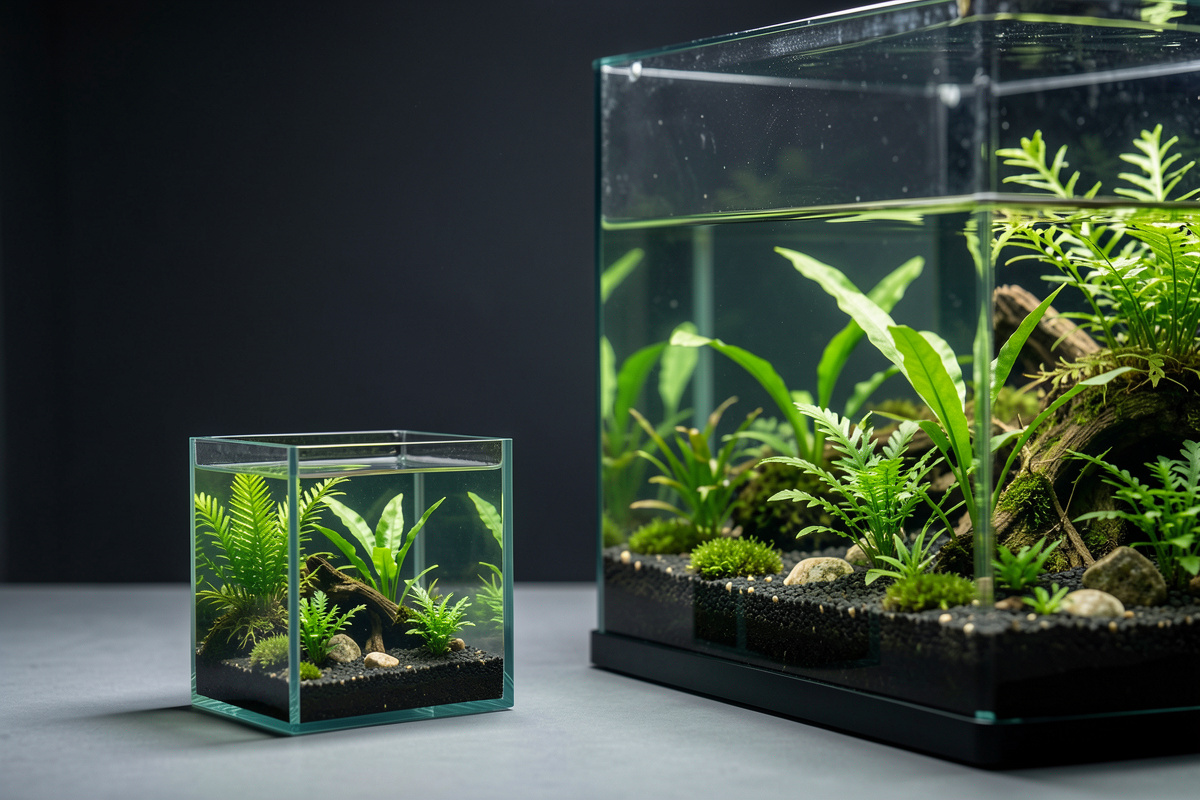
The most expensive myth in this hobby is that a small tank is the easy one. I believed it too, right up until I started logging numbers. The honest answer to whether small aquariums are harder is yes — and it isn’t a matter of opinion or skill. It’s arithmetic. A nano tank obeys exactly the same chemistry and biology as a big one; it just does everything faster and with less margin, because there is less water to absorb your mistakes. Once you see the math, the whole “easy starter tank” pitch falls apart.
This is the foundational piece behind the entire nano tank stability guide. If you understand why small volume amplifies every swing, you’ll understand why every nano routine that follows — top-off, water changes, heater choice — exists. So let’s actually run the numbers.
The dilution math, in plain numbers
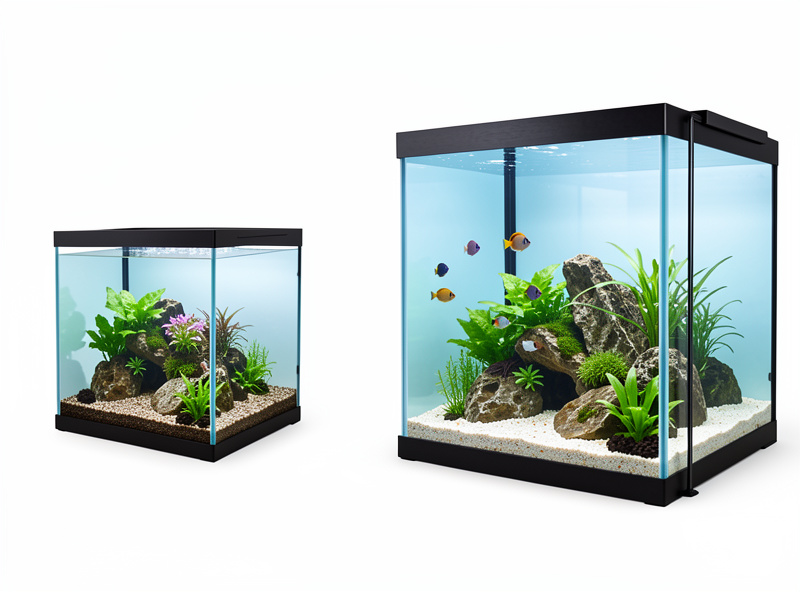
Picture two tanks: a 20-litre nano and a 200-litre community tank. A single small fish dies in each and goes unnoticed for a day, releasing the same amount of ammonia as it decays. In the 200-litre tank, that ammonia is spread across ten times more water, so the concentration your test kit reads is one-tenth of what shows up in the nano. Same event, same gram of ammonia, ten times the reading on the small tank. The nano keeper sees a dangerous spike; the big-tank keeper might not even notice.
That ratio is the whole story, and it repeats for every variable. Dump in a bit too much food: ten times the nutrient concentration. Lose a fraction of the water to evaporation: the dissolved minerals concentrate far faster in the smaller volume. Add a splash of un-dechlorinated tap water: a much higher chlorine concentration. There is nothing magical happening — the small tank is simply a smaller denominator, so every numerator hits harder. My years on hydroponic reservoirs hammered this in: the smaller the tank of water, the tighter the chemistry has to be controlled.
Temperature: the swing that scales worst
Volume doesn’t just buffer chemistry — it buffers heat. Thermal mass is literally a function of how much water you have, so a nano has very little of it. A heater that sticks on will drive a small tank’s temperature up fast, because there’s so little water to soak up the extra energy. A cold room overnight will pull a nano’s temperature down faster than it ever could a big, slow-to-cool tank. The same wattage of fault, the same draft, lands harder on small water.
This is why I treat temperature as the single most dangerous parameter on a nano and why heater reliability gets its own deep-dive. A big tank gives you hours or days of warning when something thermal goes wrong. A nano can move into the danger zone before you’re home from work. It’s not that nano heaters are worse — it’s that the water can’t argue back.
Comparison: the same insult, two tank sizes
| The insult | 20-litre nano | 200-litre tank | Why |
|---|---|---|---|
| Unnoticed dead fish | Sharp ammonia spike | Barely a blip | Same ammonia, one-tenth the water |
| Heater sticks on | Heats fast, can reach lethal temps | Slow, catchable rise | Little thermal mass to buffer |
| A week of evaporation | Hardness/TDS creep up noticeably | Minor change | Minerals concentrate into less water |
| Overfeeding | Nutrient and bioload spike | Diluted away | Smaller denominator |
| Low KH | pH can crash overnight | Buffer lasts longer | Less total buffer reserve |
So why does anyone keep a nano?
Because the trade is genuinely worth it once you accept what it is. A nano is small, beautiful, cheap to plant heavily, and fits anywhere — a desk, a shelf, a Swedish flat where a six-foot tank is never happening. Through a dark northern winter, a lit planted nano is the best window in the house. The “harder” part isn’t a wall; it’s just a requirement to be consistent. And consistency is a habit, not a talent.
The reframe that changed everything for me: a nano isn’t a forgiving beginner tank, it’s a small, controlled experiment. Run it like one — log the numbers, change one thing at a time, keep the routines steady — and it becomes one of the most stable, rewarding systems you can own. The people who fail with nanos aren’t unskilled; they were told it would be easy and never built the routine. You now know better.
What “harder” actually demands of you
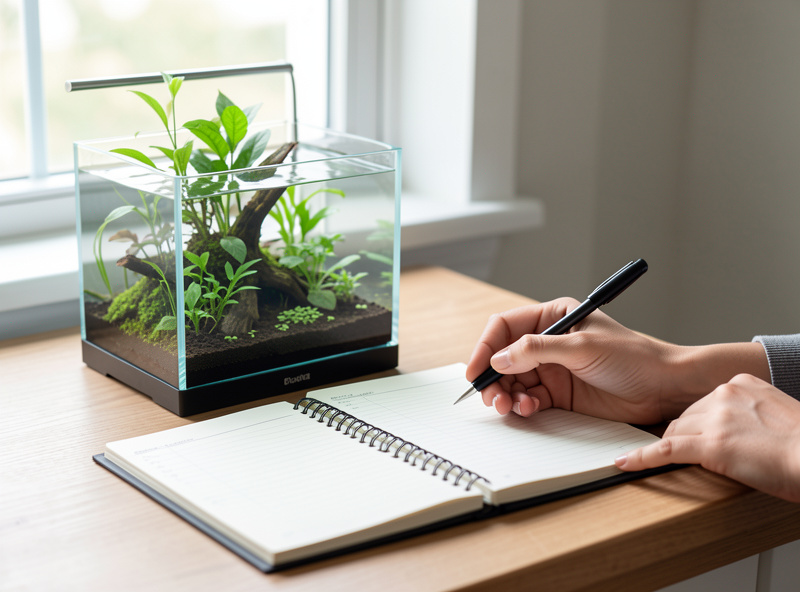
In practical terms, the extra difficulty of a nano cashes out as a handful of non-negotiable habits, none of them hard individually. Top off evaporated water consistently so the concentration stays flat. Keep stocking light so the bioload can’t overwhelm the small volume. Run a fully cycled filter so ammonia never gets the chance to spike. Verify your heater with an independent thermometer. And change water on a steady cadence with parameter-matched replacement so nitrate never climbs and nothing swings during the change itself.
That’s it. That’s the whole “harder.” Each habit is five minutes, but skipping them on a nano carries a much steeper penalty than on a big tank — because, again, the math. The rest of this cluster is just each of those habits, explained properly.
More from the stability cluster
- The nano tank stability guide — the full overview of running small water well.
Frequently Asked Questions
Are small aquariums really harder than big ones?
Yes, and it is arithmetic rather than opinion. A small tank has less water to dilute any insult, so a dead fish, a heater fault, or a week of evaporation moves the parameters roughly ten times harder in a 20-litre nano than in a 200-litre tank. The chemistry is identical; the margin for error is much smaller. Consistent routines remove the difficulty entirely.
Why do beginners get told small tanks are easy?
Because there is less water to change and less surface to clean, which sounds easier on paper and sells more starter kits. The catch is that the same small volume that means less maintenance also means less buffering, so mistakes land harder and faster. It is the advanced class marketed as the beginner one.
What is the single hardest thing about a nano tank?
Temperature stability, because thermal mass scales with volume and a nano has almost none. A stuck heater can drive a small tank to dangerous temperatures within hours, where a large tank would rise slowly enough to catch. This is why an independent thermometer and a reliable heater matter more on small water, not less.
Can a beginner succeed with a nano tank?
Absolutely, as long as they treat it as a small controlled system rather than a forgiving one. The keepers who fail were told it would be easy and never built a routine. Top off consistently, stock lightly, run a fully cycled filter, verify the heater, and change water on a steady cadence, and a nano is as stable as anything larger.
Does a bigger nano make stability easier?
Generally yes, within the nano range. Every extra litre is more buffer against swings, so a 30-litre tank is forgiving in ways a 5-litre pico simply cannot be. If you want the look of a nano with a little more margin for error, sizing up toward the top of the nano range is the easiest single improvement you can make.