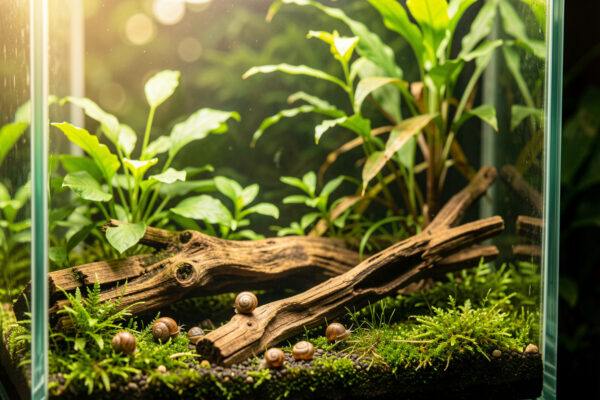
No — pest snails are not actually bad. In a healthy nano tank, bladder, ramshorn and Malaysian trumpet snails are harmless detritivores that eat waste you would otherwise have to remove yourself. A population of thirty small snails adds roughly the bioload of a single small tetra, and in my parameter log a ramshorn colony never once moved my nitrate outside its normal band.
The “pest snail” label is one of the most persistent pieces of bad advice in the hobby, and it costs beginners tanks — not because the snails are dangerous, but because the panic they trigger leads people to dump copper into shrimp tanks and crash their own cycles. Let me make the actual case, with the numbers, for why the snail crawling on your glass is a symptom worth reading rather than an enemy worth poisoning.
What “pest snail” actually means
“Pest snail” is not a species — it is a reputation. It gets applied to any snail that arrived uninvited on a plant and then bred visibly: bladder snails, ramshorns, and Malaysian trumpet snails, mostly. Notice what that definition is really describing. It is not describing harm. It is describing an animal that reproduced without your permission, which offends our sense of control far more than it damages the tank.
Every one of those species is a detritivore. They eat leftover food, decaying plant matter, fish waste and biofilm. They do not eat healthy plants — the classic accusation — because their radula is not built to breach living plant tissue; a snail on a dying leaf is eating the rot, not causing it. So the entire premise that they are “pests” rests on the crime of breeding, and breeding is the part we can decode.
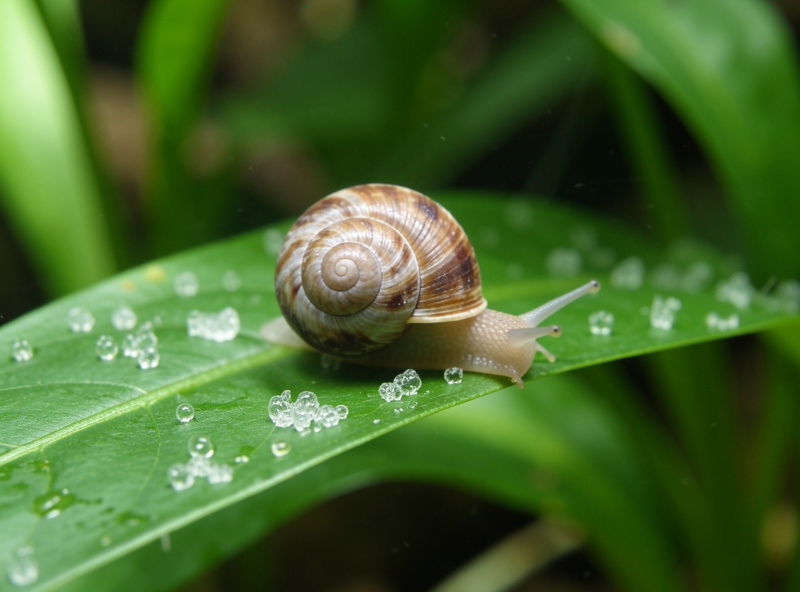
The bioload reality check
Here is the number that should end the panic. A pest snail is tiny — a bladder snail weighs a fraction of a gram — and, critically, it imports no new waste into the tank. It eats organic matter that is already there and would have decayed anyway, converting it into a smaller, slower waste stream your biofilter already handles. The snail is not adding load; it is reprocessing existing load.
Run the comparison. A single neon tetra produces meaningfully more waste than a dozen bladder snails, because the fish is fed food from outside the system every day while the snails live on internal leftovers. When I deliberately let a ramshorn population build to several dozen in my 20-litre low-tech nano, my weekly nitrate stayed in its usual 5–10 ppm band and ammonia and nitrite read a flat zero throughout. If snails caused overload, the test tube would have shown it. It never did — because the thing that actually overloads a small tank is fish stocking and feeding, which you can read about honestly in the overstocking signs guide.
Read the population, don’t fight it
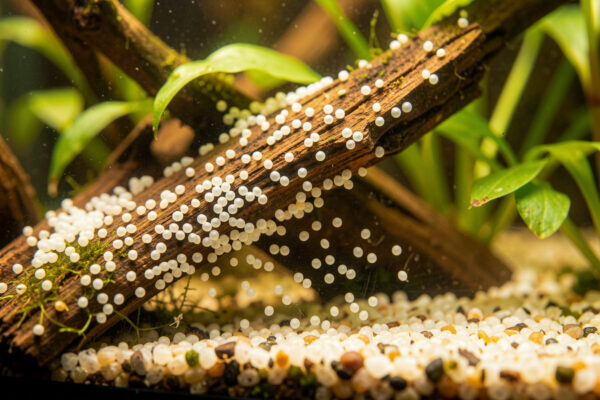
A snail boom is information. Because pest snails breed precisely to match available food, the size of your population is a live readout of how much surplus food is in your tank. A handful of snails means a lean, well-fed system. An explosion crawling up the glass means you are overfeeding, full stop — the snails simply metabolised the excess into more snails and made your mistake visible.
This is why I treat a snail bloom as one of the most useful diagnostic signals in the tank. It is a free, living overfeeding alarm. The correct response is not to reach for poison; it is to look at your feeding, cut it back, and watch the population self-correct over the following weeks. The snails told you something true about your husbandry, and killing the messenger leaves the message unread. My water-change routine and honest feeding are the levers that actually move the number.
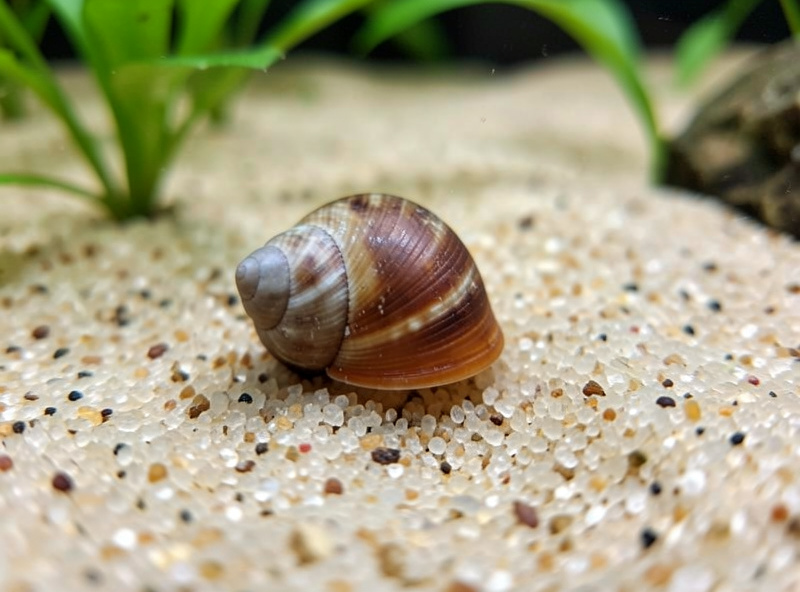
The genuine benefits nobody mentions
Pest snails do real work. Malaysian trumpet snails burrow through the substrate day and night, tilling it and breaking up the anaerobic pockets where hydrogen sulphide builds up in still, deep sand — a job that otherwise requires manual gravel-poking. Ramshorns and bladder snails patrol for uneaten food and dead leaves, clearing debris before it can rot into an ammonia source. Together they are a distributed cleanup workforce you did not have to buy.
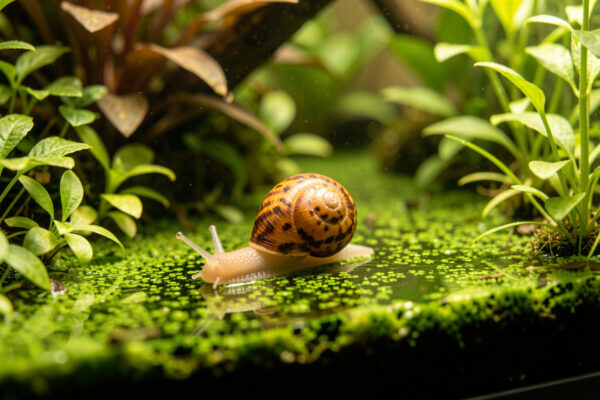
There is a genuine benefit for planted tanks specifically: pest snails clean the surfaces plants need. A film of algae and detritus on a leaf blocks light and slows growth, and a ramshorn grazing that film keeps the leaf working. Trumpet snails doing the same job in the substrate keep the root zone from going stagnant. In my low-tech planted nano the plants are visibly healthier for the snail traffic across them, and I have never once dosed anything to achieve it — the cleanup is free and continuous.
They are also an early-warning system for water quality. Snails are sensitive to copper and to badly crashed parameters; if your snails suddenly retreat into their shells and stop moving, something has gone wrong with the water before your fish or shrimp show it. A thriving snail population is, quietly, a certificate that your basic chemistry is sound. That is the opposite of a pest — it is a canary.
When they do become a genuine problem
I am not pretending there is never a downside. Two real problems exist. The first is aesthetic: a glass wall crawling with snails looks unpleasant to most people, and that is a legitimate reason to reduce the population even if the water is perfect. The second is that some species — Malaysian trumpet snails especially — can reach densities that disturb delicate carpet plantings or simply overwhelm a small tank’s visual calm.
Both of those are population-management questions, not extermination questions, and both are solved without chemicals by fixing feeding and thinning adults mechanically — the full method is in how to get rid of pest snails without chemicals. If the plague is truly entrenched, a few assassin snails resolve it biologically. The point is that even the real downsides are managed with a trap and a teaspoon of feeding discipline, never with poison.
Knowing which “pest” you actually have
The three species lumped under the label behave differently enough that identifying yours changes nothing about the threat — still zero — but helps you understand what it is doing. Bladder snails (often miscalled pond snails) have a thin, pointed, translucent tan shell that coils to the left, and they are the fast breeders that colonise glass and hardpieces; they are the ones most people mean by “pest snail.” They are prolific because they are hermaphrodites — a single one can populate a tank — which is exactly why feeding, not headcount, is the control lever.
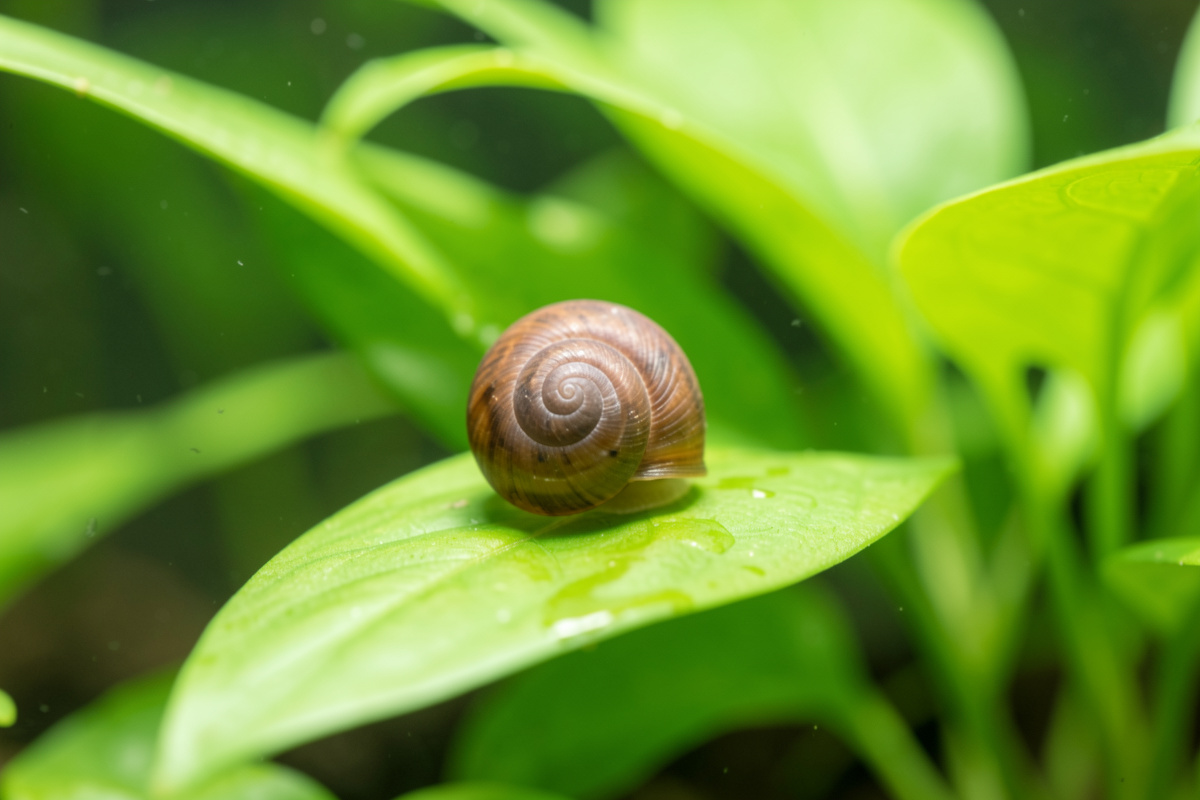
Ramshorn snails carry a flat, coiled shell like a tiny cinnamon roll, in colours from brown to a striking red, and they graze leaves and soft algae in the open where you see them constantly. Malaysian trumpet snails are the ones you rarely see at all: long, cone-shaped shells, and almost entirely nocturnal and burrowing, surfacing after lights-out. If your substrate seems to “come alive” at night, those are trumpet snails doing the aeration work no glass grazer can. None of the three eats healthy plants, all three eat detritus, and all three are reading your feeding — the identification just tells you where in the tank each is doing its job.
One practical note: a shell you find empty and being cleaned out by others is not a die-off to panic over. Snails scavenge the calcium from dead shells, and a few empties are normal turnover. A sudden mass of clamped or dead snails, by contrast, is the early-warning signal worth acting on — usually a copper contamination or a hard parameter swing, the same things that threaten your shrimp and fish.
The verdict from my parameter log
After years of running small tanks as logged experiments, my position is settled: pest snails are livestock the hobby taught you to fear for no good chemical reason. They cost you nothing in water quality, they do free maintenance, and their numbers are a truthful readout of your feeding. Manage the population if the look bothers you — that is fair — but do it as husbandry, not warfare. For the species genuinely worth adding on purpose, the nano tank snails guide lays out the whole roster, and if you keep dwarf shrimp too, keeping snails with shrimp covers how the cleanup crew shares a tank. Test, don’t guess — and the test tube has never once told me a snail was the problem.