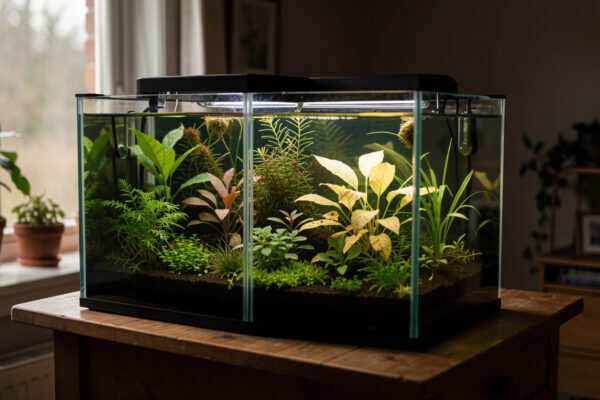
If your planted tank’s nitrate reads at or near zero and the oldest leaves are fading to pale yellow, your plants are starving for nitrogen. In a planted nano I want nitrate holding around 10–20 ppm. Below that, a lightly stocked, heavily planted tank strips it to nothing and growth stalls within a week.
This is the reading that breaks a new keeper’s brain, because it contradicts everything the first six months taught. You spent that time terrified of nitrate — the end product of the nitrogen cycle, the number you chased down with water changes. Now a test tube shows almost none and that is suddenly a problem. Same molecule, opposite meaning, and the flip depends entirely on whether your tank is mostly fish or mostly plants.
Get this wrong and you’ll do the exact thing that deepens the hole: more water changes, chasing a lower number, while the plants melt for want of the nutrient you keep exporting.
What Does “Nitrate Too Low” Actually Mean for Plants?
It means the tank has run out of usable nitrogen, the single largest nutrient input a plant needs after carbon. Nitrate is how that nitrogen shows up in your water column, so a nitrate reading on the floor is a direct signal that the plants have eaten the pantry bare. The damage lands on the oldest leaves first because nitrogen is mobile — the plant pulls it out of old tissue to feed new growth, so the bottom of the plant pales while the tip hangs on.
Nitrogen is the backbone of chlorophyll and every protein a plant builds, which is why a shortage reads as uniform yellowing and flat-out stalled growth rather than spots or holes. The University of Florida IFAS plant-nutrition material describes nitrogen as the nutrient plants demand in the largest quantity, and a fast-growing stem tank proves it — mine can drink measurable nitrate out of the water in days. If you want the full symptom map for telling this apart from iron, potassium, or magnesium shortfalls, that’s the plant nutrient deficiency chart; this guide is the deep dive on the nitrogen case specifically.
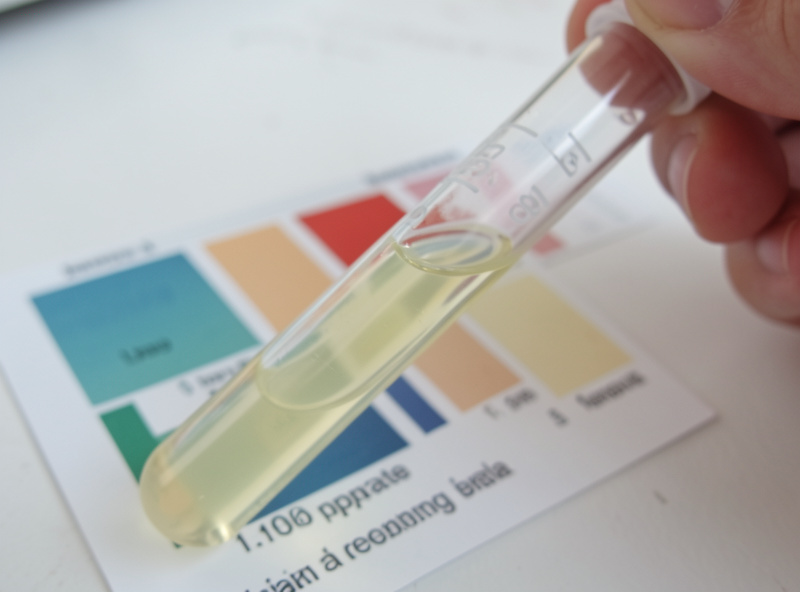
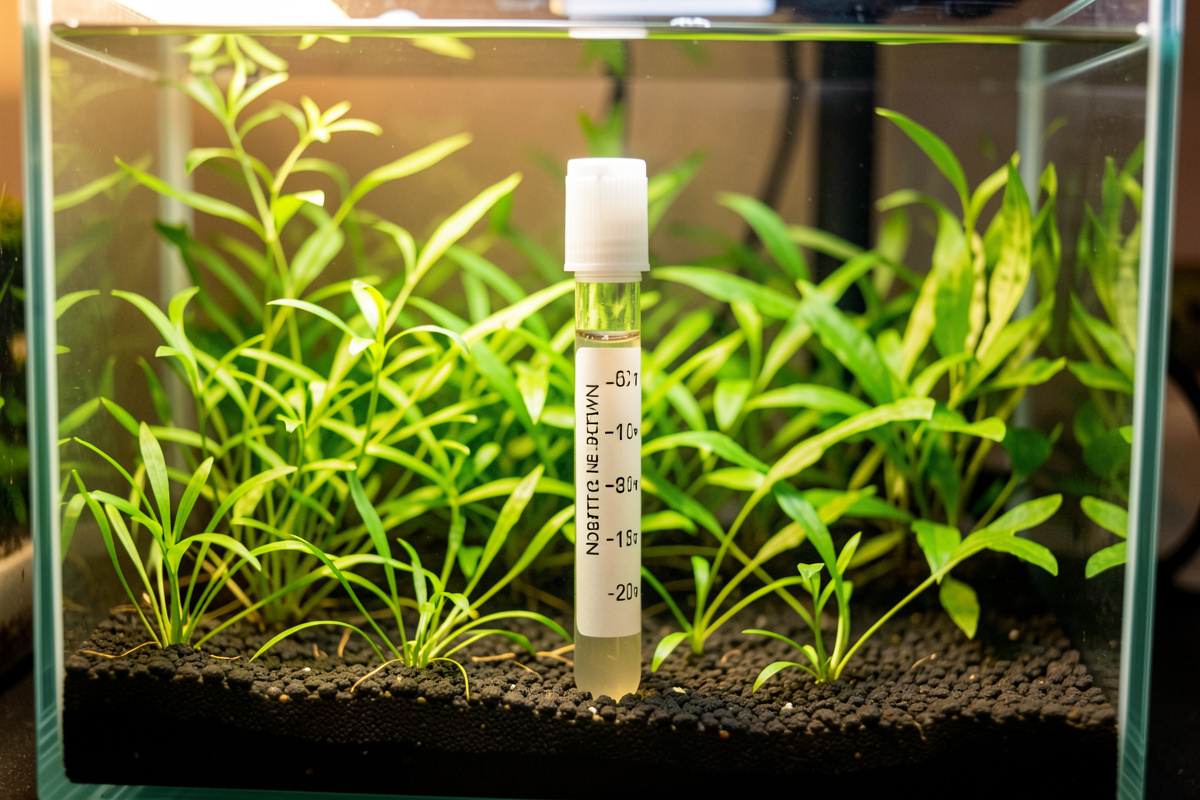
The photo is what “too low” looks like in the tube: a pale, barely-there yellow against the reference card, well under the 10 ppm mark. When my planted 60-liter reads like that, I already know what the lower leaves are doing before I look at them. The tube tells me the cause; the leaves just confirm the effect.
Why Did My Nitrate Crash to Zero?
Three things drive nitrate to the floor, usually working together. Heavy plant mass with a light bioload — lots of hungry stems, few fish producing waste — is the classic setup, and it’s exactly what a well-planted nano tends to be. Aggressive water changes export nitrate faster than the tank rebuilds it. And a genuinely under-fed tank simply never generates much in the first place.
My daily-reference low-tech nano sat at zero nitrate for weeks once, and it was the light-bioload trap: a dense carpet and stem thicket over a shrimp-only colony that produces almost no waste. There was nothing generating nitrogen to keep up with what the plants were eating. That’s the counterintuitive part — a tank can be perfectly cycled, biologically flawless, and still starve its plants because the cycle’s whole job is to consume ammonia and hand you nitrate, and if nothing’s making ammonia, there’s no nitrate to hand over. The mechanics of that conversion are in the aquarium cycle guide. A low nitrate reading isn’t a broken cycle; often it’s a working cycle with nothing to work on.
How Low Is Too Low? What Nitrate Number to Target
For a planted tank, aim to keep nitrate in the rough band of 10–20 ppm as a working target. That’s a plant-nutrition figure, not a toxicity figure — it’s enough dissolved nitrogen to keep growth moving without letting a surplus sit around feeding algae. Zero is too low for plants; I treat anything that tests as a flat zero on a hobby kit as an active deficiency, not a clean tank.
The number that matters is stability more than the exact digit. A tank parked at a steady 15 ppm outperforms one bouncing from 40 down to 0 between water changes, because plants adapt to a supply rate, not a snapshot. This is the whole reason I log the reading weekly instead of testing only when something looks wrong — a nitrate that has fallen 5 ppm three weeks running is a trend I can dose against before the leaves ever show it. The trade-off between exporting waste and keeping nutrients available is the same tension I cover in the water change cadence guide.
How Do I Raise Nitrate in a Planted Tank?
You have four levers, and which one you pull depends on why the nitrate is low. Here’s how I choose between them:
| Method | Best when | Trade-off |
|---|---|---|
| Dose a nitrogen macro (KNO3) | Nitrate is genuinely zero and you want control | Requires testing; easy to overshoot without a scale |
| Use an all-in-one with nitrogen | You want simplicity and don’t dose separately | Locked N:P:K ratio; less precise |
| Reduce water-change volume | You’re exporting nitrate faster than it builds | Watch other parameters don’t drift |
| Feed the tank a little more | Bioload is genuinely too low | Only if livestock can use it; never overfeed |
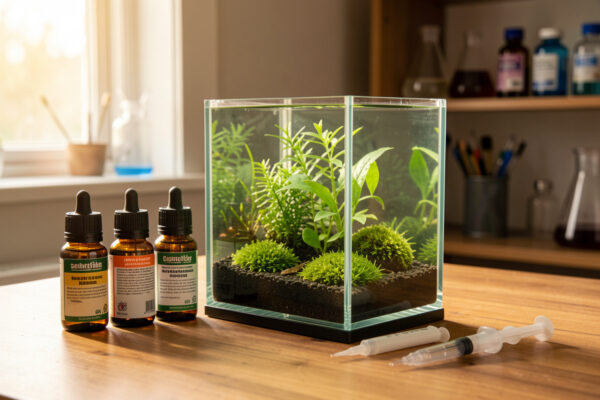
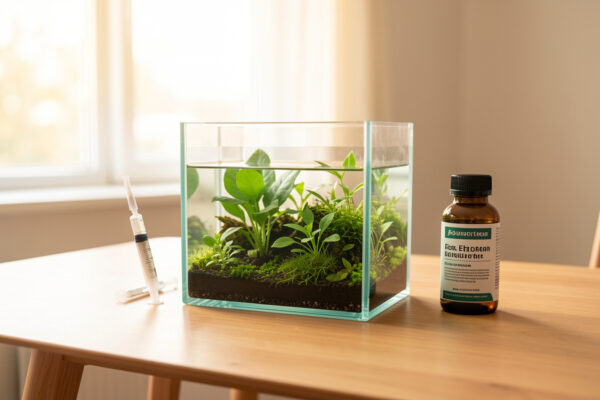
On my planted 60-liter I dose a measured nitrogen macro because I want the number where I choose, and I confirm with a test the next day. Potassium nitrate is the standard workhorse for this — a small amount of dry aquarium potassium nitrate goes a very long way, which is exactly why a kitchen scale matters more than eyeballing. If you’d rather not juggle separate salts, a complete all-in-one already carries nitrogen, and the case for each approach is in the all-in-one vs separate fertilizers comparison. The full schedule for dialing macros to a target sits in the EI dosing on a nano tank guide.
As an Amazon Associate I earn from qualifying purchases.
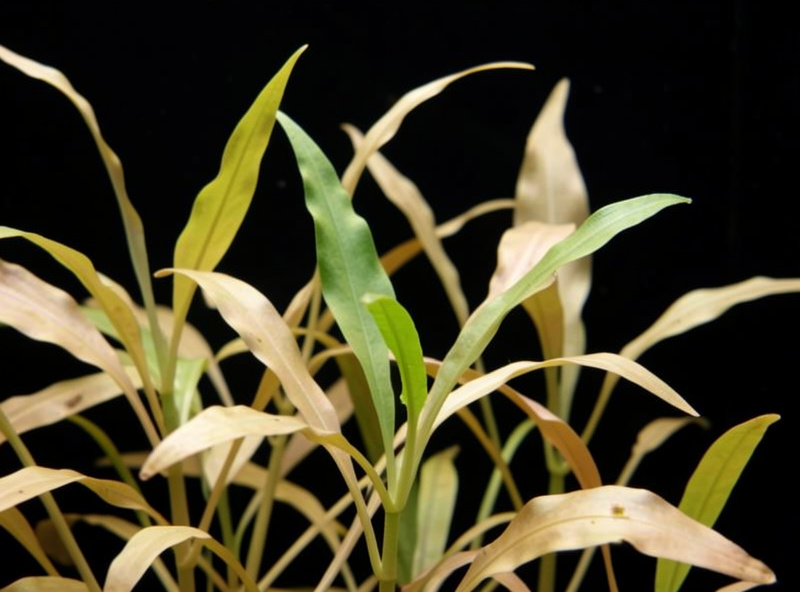
The starved stems above are what I’m dosing to prevent: green tips, dying bottoms. Once you correct the nitrogen, new growth comes in green but those bottom leaves rarely recover — the plant already stripped them. So you’re never repairing old damage; you’re stopping the next round. That’s why I’d rather catch the trend in the log than the symptom on the leaf.
The Nitrate Mistake That Cost Me a Carpet
I lost a Monte Carlo carpet to this, and it stung because I did it to myself. I was running big twice-weekly water changes on a fresh scape to fight early algae, and every change was exporting the nitrate the new carpet needed to establish. The tops looked fine for a while, then the whole mat started yellowing from underneath and lifting off the substrate in patches. I blamed the substrate. I blamed the light. I dosed iron. None of it was the problem.
When I finally tested nitrate instead of assuming, the tube came back bone-pale — a flat zero. I’d been so conditioned to treat nitrate as the enemy that I never considered the plants were starving for it. The fix was almost embarrassingly simple: cut the water changes back, start a small nitrogen dose, and hold at around 15 ppm. The next scape’s carpet took hold without drama. The lesson I keep coming back to: in a planted tank, test the thing you assume you already know, because the number that means “danger” in a fish tank can mean “starvation” in a planted one.
Is Low Nitrate Ever Bad for Shrimp or Fish?
For livestock, low nitrate is not a health risk the way high nitrate is — animals don’t need nitrate, plants do. My Neocaridina colony is perfectly happy in water that tests near zero nitrate, because they’re driven by hardness and stable parameters, not by the plant-food number; their actual requirements are in the cherry shrimp water parameters guide. So when I dose nitrogen into a shrimp tank, it’s for the plants, and I do it in small, tested increments to keep the total dissolved load steady rather than swinging.
The one caution is dosing method, not the nitrate itself. Raising nitrate by overfeeding to boost bioload is a bad trade in a small tank — you get an ammonia spike and algae before you get a nitrate rise, and that swing is genuinely dangerous to shrimp. Add nitrogen as fertilizer, not as fish food. And if plants are struggling while algae thrives on the same water, the problem usually isn’t nitrate at all but light and carbon balance, which the nano tank algae guide untangles by cause.
What I’d do starting today if my nitrate read zero and my plants looked pale: stop the reflex water change, run a nitrogen test to confirm, dose a small measured amount of potassium nitrate, and retest in 24 hours. Aim for a steady mid-teens number and let the plants tell you the rest.
Is zero nitrate bad in a planted tank?
For the plants, yes. Nitrate is how nitrogen reaches the water column, and nitrogen is the nutrient plants need in the largest amount. A reading of zero on a heavily planted, lightly stocked tank usually means an active nitrogen deficiency, and the oldest leaves start to pale within a week. For fish and shrimp, low nitrate is not a health risk.
What causes nitrate to drop to zero in a planted aquarium?
Three things, usually together: heavy plant mass eating nitrogen faster than it is produced, a light bioload of fish or shrimp making little waste, and frequent large water changes exporting nitrate before plants can use it. A perfectly cycled tank can still read zero if nothing is generating ammonia for the cycle to convert.
How do I raise nitrate in a planted tank?
Dose a nitrogen macro such as potassium nitrate to a target, switch to an all-in-one fertilizer that contains nitrogen, reduce water-change volume so you export less, or increase feeding only if the bioload is genuinely too low. Dosing a measured macro and confirming with a test the next day gives the most control.
What nitrate level should I aim for in a planted nano?
A common working target is roughly 10 to 20 ppm nitrate. That is a plant-nutrition figure, not a toxicity limit, and it provides enough dissolved nitrogen for growth without a surplus that feeds algae. Stability matters more than the exact number, so a steady mid-teens reading beats one that swings from high to zero.