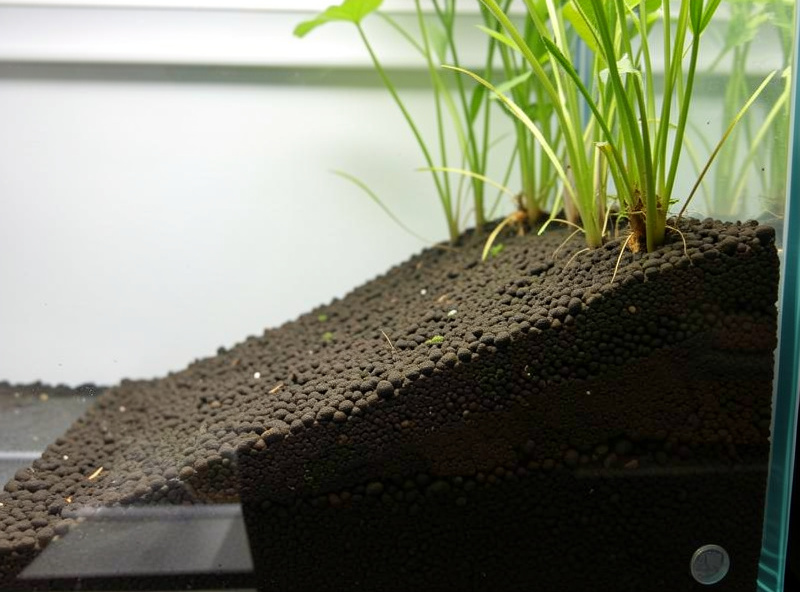
Substrate depth is the spec people guess at and regret, because it is the one thing you cannot adjust without a teardown. For most planted nano tanks the answer is a sloped bed: roughly 2–3 cm at the front rising to 5–7 cm at the back. That gives carpet roots enough up front, rooted stems enough at the rear, and a slope that buys visual depth in a small footprint — all while staying shallow enough to avoid the anaerobic gas pockets deep substrate breeds.
I set the slope on every tank I build the same way, because depth is foundational in the literal sense: it sits under everything and gets decided before the first plant goes in. Too shallow and rooted plants tear loose and the soil exhausts fast; too deep and the lower layer goes dead and starts producing gas. This guide is the depth logic I actually use — by plant type, by substrate type, and by the hard limits a small tank imposes — so you lay it once and never have to wish you had done it differently.
Why depth matters more than it looks
Depth does three jobs. It gives roots somewhere to anchor and spread, it determines how much nutrient reserve an active soil or dirted base holds, and it sets whether the bottom of the bed stays oxygenated or goes anaerobic. Get it too shallow and you lose on all three: plants float free, the soil runs out of food in a year, and there is nowhere for a proper root system to develop. A swordplant in 2 cm of substrate is a swordplant that will lift itself out the week it puts down real roots.
Get it too deep and a different problem appears. Below a certain depth, oxygen does not reach the lower layer, anaerobic bacteria take over, and the bed produces hydrogen sulphide — the rotten-egg gas that can harm livestock if a big pocket releases at once. In a small nano with a fine substrate, that ceiling arrives sooner than people expect, which is why “deeper is better” is wrong past a point. Depth is a balance between root room and dead zones, not a bigger-is-better dial.
The front-to-back slope
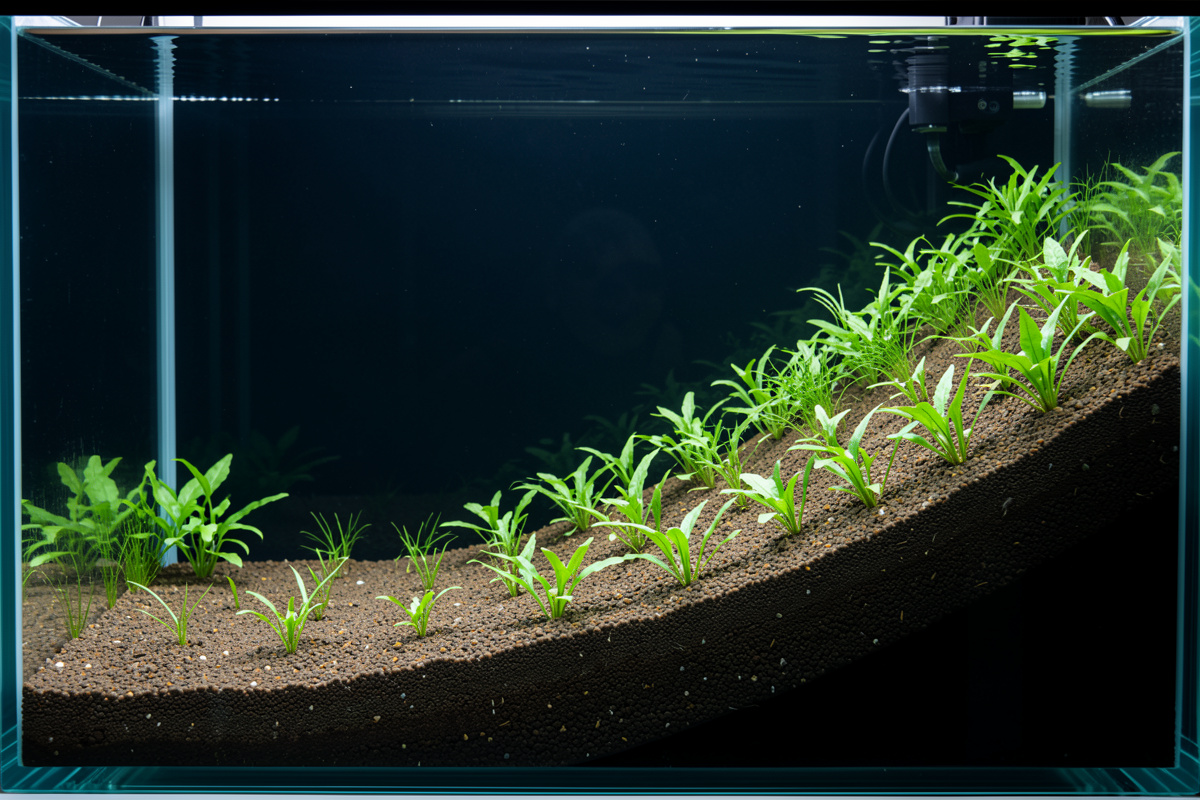
The single best move in nano substrate is to slope it. A flat bed looks shallow and wastes the little depth a small tank has; a bed that rises from front to back creates the illusion of distance and puts the deepest substrate exactly where the tallest, hungriest plants go. My standard nano slope is about 2–3 cm at the front glass climbing to 5–7 cm at the back. The front stays shallow for carpets and for a clean viewing line; the back holds the reserve for stems and rooted feature plants.
The challenge in a nano is keeping that slope from collapsing flat over time, because shrimp, flow, and maintenance all nudge substrate downhill. Hardscape helps — rocks and wood set into the bed act as terraces that hold the rear height in place. This is where the substrate layer and the aquascaping layout overlap: the slope is both a planting decision and a design one, and good hardscape placement locks in the depth you built.
Depth by plant type
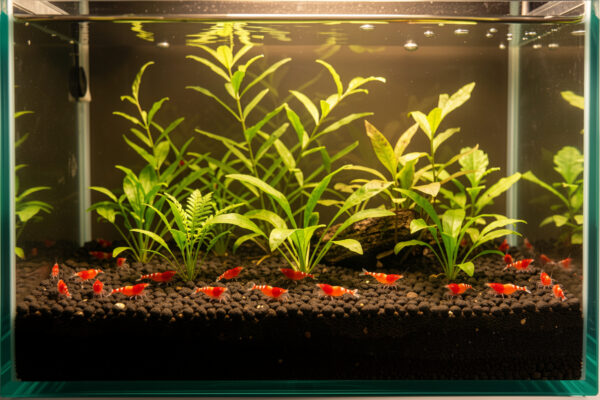
Different plants need wildly different depths, and matching the bed to your plant list is the whole game. Epiphytes need none at all; carpets need a shallow, even layer; big root-feeders need real depth. Here is the working guide I plant by.
| Plant type | Examples | Substrate depth needed |
|---|---|---|
| Epiphytes | Anubias, Bucephalandra, java fern, mosses | None — attach to hardscape |
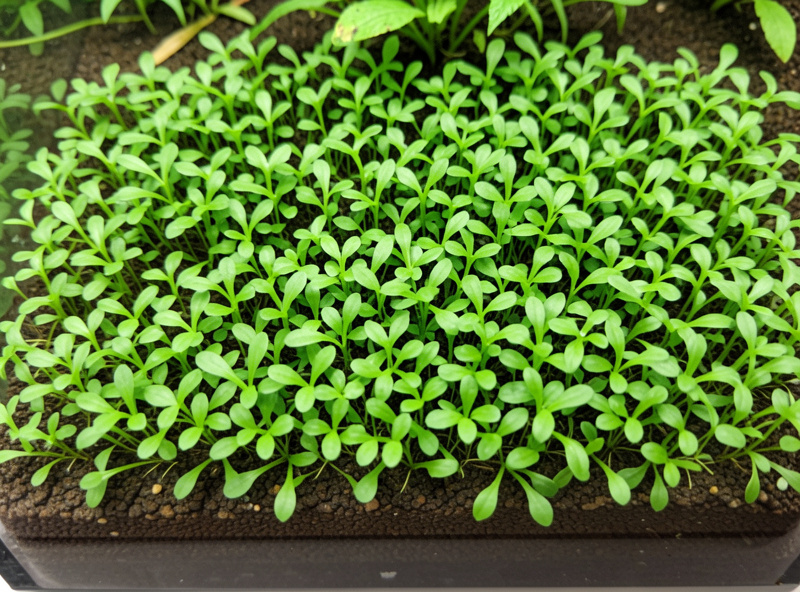
| Carpet plants | Monte Carlo, dwarf hairgrass, S. repens | 2–3 cm, even |
| Stem plants | Rotala, Ludwigia, Bacopa | 4–5 cm |
| Large root-feeders | Swords, large crypts | 5–7 cm+ |
The lesson the table hides is about matching, not maximising. If your tank is all epiphytes lashed to wood, you barely need substrate at all — a thin layer for looks is enough, because those plants feed from the water column and never touch it. If you are carpeting, you want a shallow, even front more than a deep one. Only the big rooted feeders genuinely demand depth, and they belong at the back where your slope already provides it. Plan the bed around the deepest-rooting plant you actually intend to keep, not around a hypothetical jungle.
Depth and substrate type interact
How deep you go also depends on what the substrate is. An active aqua soil like ADA Amazonia holds its nutrient reserve in its volume, so a slightly deeper bed at the back genuinely extends how long it feeds before exhausting — within the anaerobic limit. A capped dirt setup needs to account for two layers: a base of around 2 cm plus a cap of around 2.5 cm, which naturally lands you in a sensible total depth. Inert sand or gravel holds no reserve, so depth there is purely about root anchorage and looks — you gain nothing nutritionally by piling it deeper, and fine sand piled deep is exactly what goes anaerobic fastest.
That interaction is why I treat depth as part of the whole substrate decision rather than a number in isolation. The choice between active and inert changes what depth buys you, and both sit inside the bigger picture covered in the planted tank substrate guide. Decide the material and the plants together, and the depth falls out of those two answers.
Tank size changes the math
Depth advice that works in a 60L can be wrong in a 10L, because the smaller the tank, the more a deep substrate eats your water volume and your viewing height. In a true pico — a 5 to 10 litre tank — a 7 cm back wall of substrate swallows a quarter of the tank and leaves little room for water and fish. There I keep the whole bed shallower, lean on epiphytes and a thin carpet, and accept that big root-feeders simply do not belong in that footprint. Small water is already the advanced class; do not make it harder by burying half of it.
In a more typical 20 to 60 litre nano, the 2–3 cm front to 5–7 cm back slope works comfortably, and the back depth is genuinely usable for stems and a feature plant. The principle scales by ratio, not by fixed numbers: the substrate should read as a proportion of the tank’s height, deep enough to root what you are keeping but never so deep that the water column it sits under feels like an afterthought. When in doubt in a smaller tank, go shallower and choose plants that do not need depth, rather than forcing depth the volume cannot spare.
The depth mistakes I see most
Three errors come up again and again. The first is a flat bed: people lay an even 3 cm across the whole floor, and the tank looks shallow and lifeless because there is no slope to create distance. The second is piling inert sand deep in the belief it helps plants — it does not, because inert substrate holds no nutrients, so all that extra depth does is bring the anaerobic ceiling closer. The third is the opposite: a carpet planted into 6 cm of soil at the front, where the plant sits proud, the runners struggle to grip, and the front viewing line is ruined.
All three trace back to the same root cause — choosing a number before choosing the plants and the material. Depth is not a default you apply; it is an output of two earlier decisions. Settle what you are growing and what it is growing in, and the right depth is already decided for you. That is the same test-first, decide-from-the-data discipline I bring to every parameter on these tanks: the bed, like the water, rewards being planned rather than guessed.
Getting it right the first time
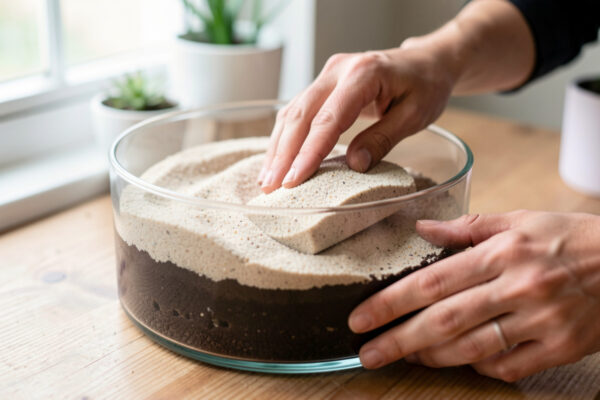
Because adding depth to a planted tank later means tearing it down, this is a measure-twice decision. Before I fill, I dry-set the substrate to the slope I want and eyeball it from the front: shallow and clean at the glass, climbing steadily to a back wall of substrate that disappears behind the tallest plants. I keep the deepest point under the anaerobic ceiling — for a nano with fine substrate I do not push past roughly 7 cm even at the back. And I set hardscape to hold the rear height so the slope survives the first month of shrimp and flow nudging it flat.
If you only remember one thing, make it this: depth is matched to your deepest-rooting plant and your substrate type, sloped front to back, and capped below the dead-zone limit. Build it that way at setup and the bed gives you years of stable rooting. When the day finally comes to change it, do it carefully — my guide on replacing substrate in an established tank walks through swapping the bed without crashing your cycle. Lay it deliberately now and that day stays a long way off.