Caridina shrimp need soft, acidic, mineral-poor water held inside a tight window: TDS around 100–150 ppm, GH of 4–6, KH at or near zero, and a pH of roughly 5.8–6.8. Hit those numbers consistently and the colony breeds. Miss them by a wide margin and it thins out. There is no in-between, and there is no shortcut around measuring.
I keep Neocaridina, not Caridina — my colony tank runs cherry shrimp because they tolerate the harder, buffered water my tap throws. But Caridina is exactly where the water-chemistry bench in my aquarium drawer earns its keep, because you cannot keep these shrimp on tap water at all. You build their water from scratch with RO and a remineralizer, and that is a chemistry job before it is a fishkeeping one. This guide is the parameter-first map: the numbers specialist breeders converge on, why each one matters, and the spoke guides that go deep on every piece.
Why Caridina Are the Advanced Class, Not a Step Up From Cherries
The shrimp hobby sells Caridina — Crystal Reds, Taiwan Bees, Tigers — as the prettier, more prestigious cousins of cherry shrimp. That framing hides the real difference: Neocaridina forgive, Caridina do not. A cherry colony shrugs off a stray water change with the wrong KH. A Crystal Red colony reads the same mistake as a slow decline in breeding and survival.
The honest version is that small water is already the advanced class — a 20–30 litre tank swings faster than a 200 litre one because there is less volume to buffer any change, something I cover in depth in my nano tank stability guide. Caridina layer a second demand on top of that: the water itself has to be manufactured to a narrow spec and then held there. You are running a buffered, low-mineral system in a volume that wants to drift. That is two hard problems stacked, which is why I treat every Caridina decision as a logged experiment rather than a guess. If you are new to keeping shrimp at all, start with Neocaridina cherry shrimp and graduate to Caridina once the parameter-log habit is automatic.
The Caridina Parameter Target
Caridina want soft, acidic water with almost no carbonate hardness. The single number that separates them from Neocaridina is KH: cherries want a few degrees of carbonate buffer, Caridina want it gone so an active substrate can pull the pH down into the low 6s. Here is how the three groups compare side by side.
| Parameter | Caridina (Crystal/Bee) | Tiger (Caridina mariae) | Neocaridina (Cherry) |
|---|---|---|---|
| TDS (ppm) | 100–150 | 120–180 | 150–250 |
| GH (degrees) | 4–6 | 4–8 | 6–8 |
| KH (degrees) | 0–1 | 0–3 | 2–5 |
| pH | 5.8–6.8 | 6.2–7.2 | 6.5–7.5 |
| Temperature | 20–24°C | 20–24°C | 18–26°C |
| Water source | RO + remineralizer | RO + remineralizer | Tap (often) or RO |
| Substrate | Active/buffering | Buffering or inert | Inert |
Read that KH row carefully, because it is the whole story. Neocaridina want carbonate hardness to hold pH steady. Caridina want it near zero so that an active aquasoil can do its job and drop the pH into the band where Crystal Reds and Bees breed. Putting Caridina into hard, buffered tap water is the most common way the hobby loses an expensive colony — not disease, just the wrong water held confidently. The temperature row matters too: Caridina prefer the cooler end, and Sweden’s winters make that easy for me to deliver without a chiller.
Water First: Why RO Is Non-Negotiable
You cannot keep Caridina on tap water in most of the world. Tap carries whatever your municipality and pipes contribute — carbonate hardness, dissolved metals, chloramine, nitrate — none of which you can subtract once it is in the tank. The only way to hit GH 4–6, KH 0 is to start from water that contains nothing and build up to spec. That is what a reverse osmosis unit gives you: water at roughly 0–10 ppm TDS, a blank canvas.
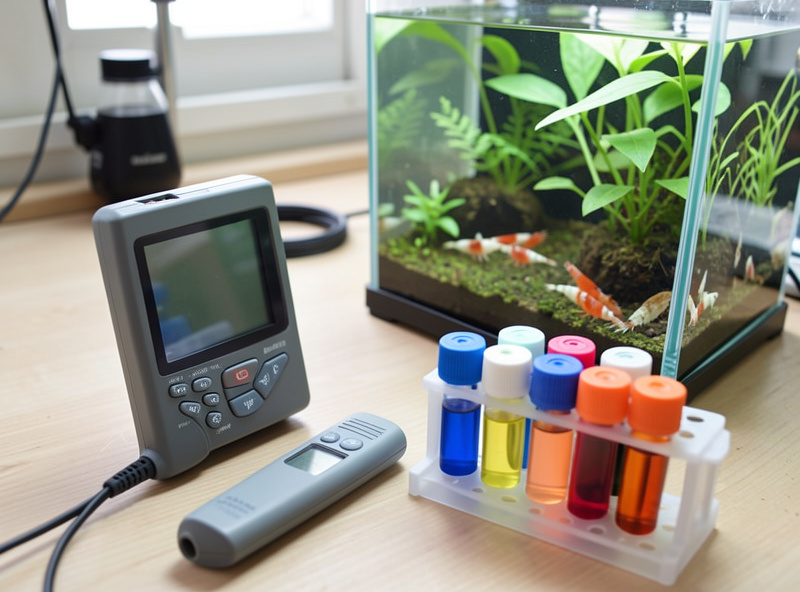
My TDS pen is the same instrument that ran my hydroponic nutrient reservoirs for years — the discipline transfers exactly: test, do not guess, whatever is living in the water. A small aquarium RO unit pays for itself fast once you are mixing every water change from scratch, and it is the one piece of Caridina gear I would not improvise around. The full walkthrough — sizing a unit, waste-water ratios, storage, and why RO/DI matters for the fussiest Bees — lives in my RO water for Caridina guide. If you only want the remineralization half of the picture, my older RO water remineralization for shrimp walkthrough covers the general method.
Remineralizing RO Back to a Caridina Spec
Pure RO water is not safe for shrimp on its own — it has no minerals for shell building and no buffering at all, so parameters become unstable. You remineralize it back up to a target. The critical detail for Caridina is that you use a GH-only remineralizer, not the GH/KH product cherries use. A GH+ mineral raises general hardness (the calcium and magnesium shrimp need for molting) while leaving KH at zero, which is exactly what lets the active substrate hold the low pH.
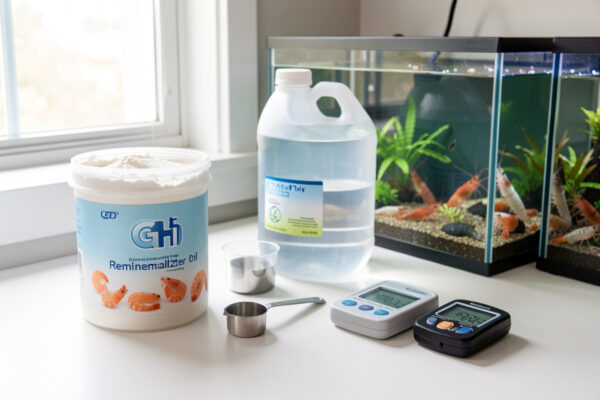
The method is simple and repeatable: fill a mixing container with RO, add the GH+ remineralizer a little at a time while stirring, and stop when the TDS pen reads your target — around 110–130 ppm for most Caridina. Let it dissolve fully before testing, because a half-dissolved dose reads low. That single target number is why the parameter log works: you are matching every new batch of water to the same figure, so water changes stop being a source of swing. I break down product choice, dosing to TDS, and the GH-versus-GH/KH decision in the Caridina remineralizer guide.
Substrate and the pH Question
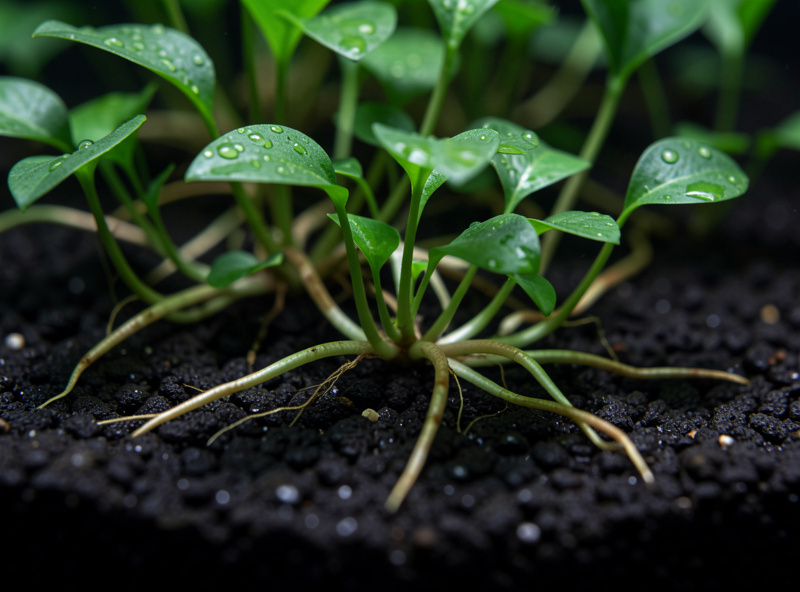
Caridina depend on an active, buffering substrate — an aquasoil that actively lowers and holds pH in the 5.8–6.5 range by stripping carbonate hardness out of the water column. This is the opposite of Neocaridina, who do fine on inert gravel or sand. With Caridina the substrate is life-support equipment, not decoration.
Two things follow from that. First, an active soil has a finite buffering lifespan — it exhausts over a year or two and the tank slowly loses its ability to hold the low pH, which is a planned replacement, not a failure. Second, you never add KH to a Caridina tank, because raising carbonate hardness fights the soil and the soil loses, burning through its capacity faster. The soil sets the pH; your job is to feed it KH-free remineralized water and stay out of its way. Because that buffered system still sits in a small, swing-prone volume, the small-and-often water change cadence I use everywhere matters even more here.
Setting Up a Caridina Tank From Scratch
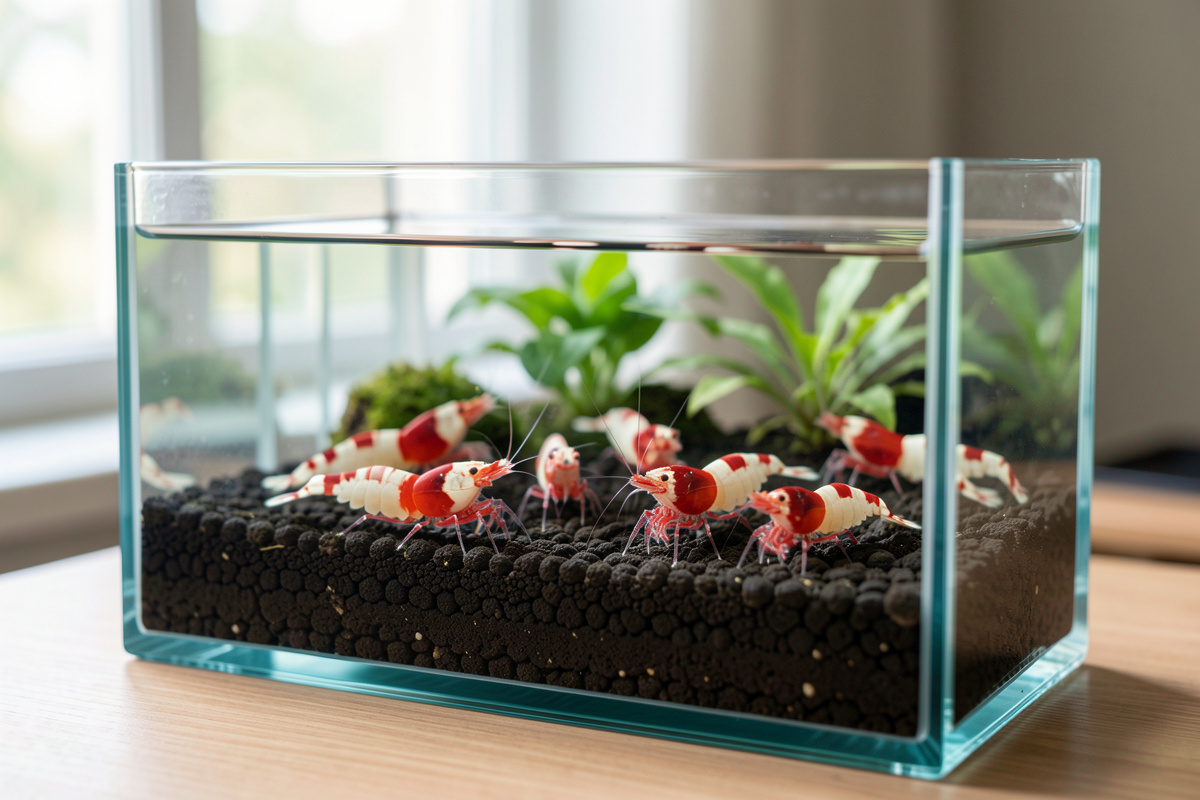
A Caridina tank is a deliberate build, not a tank you convert on a whim. The sensible volume is 20–40 litres — large enough to give the active soil and the buffered water a fighting chance at stability, small enough to keep RO mixing manageable. Smaller than that and the swings I keep warning about become unforgiving; much larger and you are mixing buckets of RO for every change. My own shrimp work sits in this range for exactly that reason.
The build order matters. Active soil goes down first as both substrate and pH engine. Filtration should be gentle and shrimp-safe — a sponge filter or a guarded intake, because newborn shrimplets are small enough to be drawn into an unguarded filter and lost. Hardscape and easy epiphyte plants like Anubias and Bucephalandra come next; they tolerate the soft, acidic, low-light conditions Caridina live in and give shrimplets the biofilm-covered surfaces they graze. Then you fill with remineralized RO at your target TDS, get flow and temperature settled, and walk away to cycle. Heating is often optional: Caridina want 20–24°C, and a cool room frequently sits there on its own, which is one of the few ways these shrimp are easier than tropical fish. The point of the slow build is that every variable is set deliberately and logged, so when you add shrimp weeks later nothing about the system is a surprise.
Cycling and Bioload at Nano Scale
Caridina go into a fully cycled tank, never a new one. The nitrogen cycle is non-negotiable physics, not a patience test — ammonia and nitrite both read zero before any shrimp arrive, with nitrate as the only end product you are managing down through water changes. A fishless cycle on an active soil has a wrinkle worth knowing: fresh aquasoil leaches ammonia for the first weeks, which actually feeds the cycle but means you wait it out and test until the ammonia spike from the soil itself has cleared. My fishless cycle walkthrough and the double-zero test pattern cover the rhythm; the nitrogen cycle guide covers the why.
Bioload discipline matters more for Caridina than almost any other livestock because the whole point is a low-mineral, low-buffer system that cannot absorb a heavy feeding or an overstocked tank. Shrimp are tiny, so the temptation is to add a lot — resist it. A modest colony in a stable tank outbreeds a crowded one in a swinging tank every time, and the parameter-swing math behind that is in my parameter swings article.
Acclimation: Drip, Slowly, Every Time
Caridina are sensitive to TDS and pH shock, so they get a slow drip acclimation — not a float-and-dump. The reason is concrete: shrimp from a shop or a breeder were raised at their water’s TDS and pH, and dropping them straight into yours forces an instant osmotic shift their bodies cannot buffer. A drip line that adds your tank water to their bag over an hour or more lets that shift happen slowly enough to survive.
I match the destination tank’s TDS to the shipping water as closely as I reasonably can before I even start, then drip from there, which shrinks the gap the animal has to cross. The first 24 hours after introduction are the honest test — shrimp that vanish into the plants and start grazing the next morning have acclimated; the ones that sit exposed are telling you the gap was too wide. This is husbandry, not medicine: the fix is always slower acclimation and matched water next time, never a treatment.
The Main Caridina You Will Actually Keep
Two groups dominate the Caridina side of the hobby. Crystal Reds and Bees (Caridina cantonensis) are the iconic red-and-white and black-and-white shrimp — the fussiest about soft, acidic water and the reason the RO-and-remineralizer ritual exists. My full Crystal Red shrimp care guide walks the exact parameters, grading, and colony management.
Tigers (Caridina mariae) are the more forgiving entry point — they tolerate slightly harder, higher-pH water than Crystals, which makes them the sensible first Caridina for a keeper stepping up from cherries. Blue Tigers, Black Tigers, and Orange-Eye lines all sit in roughly the same care band, detailed in my Tiger shrimp care guide. A genuine warning that holds across both groups: Caridina and Neocaridina can crossbreed in some pairings and produce muddy, gradeless offspring, so the species comparison and what not to mix is its own piece — my Caridina vs Neocaridina comparison.
Grading, Briefly
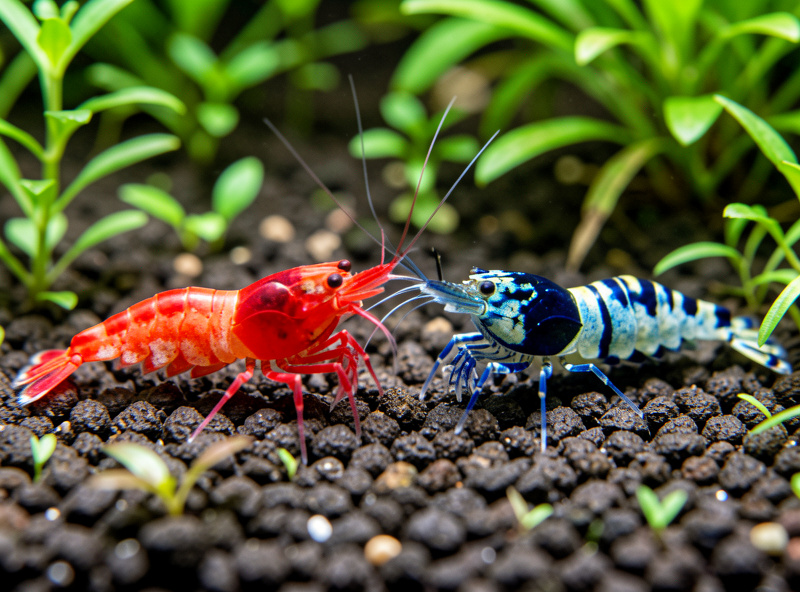
Caridina are graded on the coverage and opacity of their white — a low-grade Crystal Red shows thin, translucent white bands, while a high-grade SSS or Mosura shows thick, chalk-opaque white over most of the body. Grading drives price more than any other factor, and it is genetic: high grades come from breeding high grades, not from water tricks. Specialist breeders have built a whole vocabulary around it — Hinomaru, Mosura, Crown, no-entry — and I lay the full system out in the shrimp grading system guide so you know what you are paying for.
Breeding: What I Can Tell You, and Where Breeders Take Over
The basics of getting Caridina to breed are the same as any shrimp: a stable, cycled, well-fed tank in the right parameter window will produce berried females without intervention. Caridina carry fewer eggs than cherries and breed more slowly, and they are stricter about parameter stability while berried — a swing that a cherry would shrug off can cause a Caridina female to drop eggs.
Where I hand off is selective line-breeding for grade. My colony work is Neocaridina culling for colour, which I document in my cherry shrimp culling guide; the deep Caridina line-breeding craft — fixing Taiwan Bee patterns, managing recessive traits, stabilizing a high-grade line over generations — is genuinely specialist territory, and I report what experienced breeders converge on rather than claiming a Taiwan Bee project I have not run. The husbandry-level breeding picture is in my Caridina breeding guide.
Maintenance: The Parameter-Log Method
Everything above only works if you measure. The method I imported wholesale from years of hydroponics is dull and it works: a logged number for every test, every water change matched to the same TDS target, and one change isolated at a time so cause and effect stay legible. A Caridina tank that gets a logged weekly TDS reading and a matched small water change will sit stable for years; the ones that fail are almost always the ones run by feel.
The kit is modest. A liquid test kit for ammonia, nitrite, nitrate, GH and KH; a calibrated TDS meter for the daily reality check; a small RO unit to make blank water; and a GH+ remineralizer to build it back to spec. That is the whole Caridina toolkit, and none of it is exotic. As an Amazon Associate I earn from qualifying purchases. Watch molts as a free diagnostic too — a clean molt means GH is right, a failed one points at hardness, which I cover in shrimp molting problems and the water parameter explainer.
The Handful of Mistakes That Kill Caridina Colonies
Almost every Caridina failure I have read about or watched trace back to the same short list, and none of them are exotic. The first is hard water held confidently — a keeper who skips RO and runs tap because the shrimp “looked fine for a few weeks.” They do look fine, right up until the wrong KH stops a colony from breeding and slowly thins it. The second is chasing pH with chemicals instead of letting the active soil set it; pH-down products and buffer additives fight the soil and destabilize the exact thing you are trying to hold steady.
The third is impatience at acclimation — a fast transfer that shocks shrimp on TDS, where the cost shows up over the following days rather than immediately, so the keeper never connects the loss to the cause. The fourth is overfeeding and overstocking a low-mineral system that cannot absorb the extra load. The fifth, quietly, is not measuring: running the tank by appearance until a parameter has drifted far enough to do visible damage. Every one of these is a husbandry decision, not bad luck, and every one is prevented by the same logged, measured, one-change-at-a-time discipline rather than by any product. That is the throughline of this whole site — small water rewards the keeper who measures and punishes the one who guesses.
Frequently Asked Questions
Can you keep Caridina shrimp in tap water?
Almost never. Tap water carries carbonate hardness and dissolved metals you cannot subtract, and Caridina need KH near zero with GH of 4 to 6. You build their water from RO and a GH-only remineralizer instead.
What TDS should Caridina shrimp water be?
Around 100 to 150 ppm for Crystal Reds and Bees, and 120 to 180 ppm for the more forgiving Tigers. Mix RO water up to your target with a GH+ remineralizer and confirm it with a TDS pen before the water change.
Are Caridina harder to keep than cherry shrimp?
Yes. Neocaridina forgive water mistakes that Caridina read as a slow decline. Caridina require manufactured RO water, a GH-only remineralizer, an active buffering substrate, and tight parameter stability in a small swing-prone volume.
Why do Caridina need an active substrate?
Active aquasoil strips carbonate hardness and holds pH in the 5.8 to 6.5 band Caridina breed in. Inert gravel cannot do this. The soil is life-support equipment with a one to two year buffering lifespan, not decoration.
Can Caridina and Neocaridina live together?
They can share a tank only if their parameter needs overlap, which they largely do not, and some pairings crossbreed into muddy gradeless offspring. Keep Crystal Reds and cherries in separate tanks to protect both the water spec and the genetics.
What temperature do Caridina shrimp prefer?
The cooler end, roughly 20 to 24 degrees Celsius. Warmer water speeds metabolism and shortens lifespan, and high grades especially hold colour better when kept cool. A cool room often removes the need for any heater at all.