Everyone sells the nano tank stability story backwards. The pet-store pitch is that a small tank is the easy way in — less water to change, less to clean, a tidy little starter. I came to aquariums from years of running hydroponic reservoirs, where water chemistry is logged daily and guessing kills the crop, and the first thing the nano taught me was that the marketing has it exactly inverted. Small water is the advanced class sold as the beginner one. Less volume does not mean less work; it means less margin for error, and that is a completely different thing.
This guide is the spine of everything I keep on this site about running small tanks well. It is the case for why a 20-litre nano swings faster than a 200-litre tank, and — far more useful — the routines that tame those swings until a nano is genuinely as stable as anything larger. None of it is hard. All of it is disciplined. If you internalise the volume math here, every other decision (heater choice, water-change cadence, whether an auto top-off is worth it) stops being a guess and becomes arithmetic.
Why small volume = fast swings (the math nobody runs)
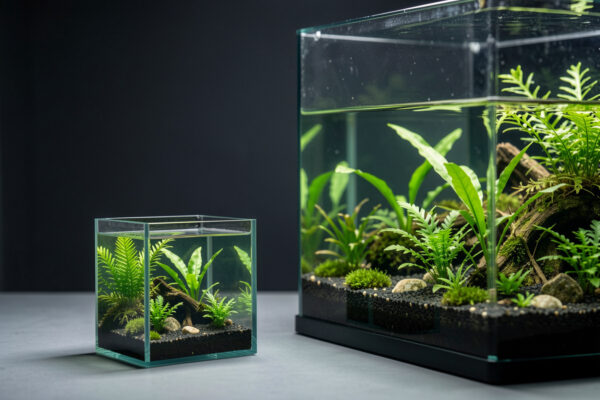
Here is the single idea this whole site is built on. Imagine you add the same small “insult” to two tanks — a fish dies unnoticed, a handful of food gets dumped, a heater sticks on. In a 200-litre tank that insult is diluted across 200 litres of water. In a 20-litre nano it is concentrated into a tenth of the volume, so the resulting spike — in ammonia, in temperature, in anything — is roughly ten times sharper. Same mistake, ten times the consequence. That is not an opinion; it is just division.
The same dilution logic runs through every parameter at once. Evaporation removes pure water and leaves the dissolved minerals behind, so a nano’s general hardness and TDS creep up measurably in days, not weeks. A small heater failure cooks or chills the water fast because there is so little thermal mass to buffer it. A pH swing that a large, well-buffered tank shrugs off can crash a nano overnight if the KH is low. The lesson I carried straight over from hydroponics is brutal and clean: the smaller the reservoir, the tighter the control has to be. Small water punishes neglect on a much shorter timescale.
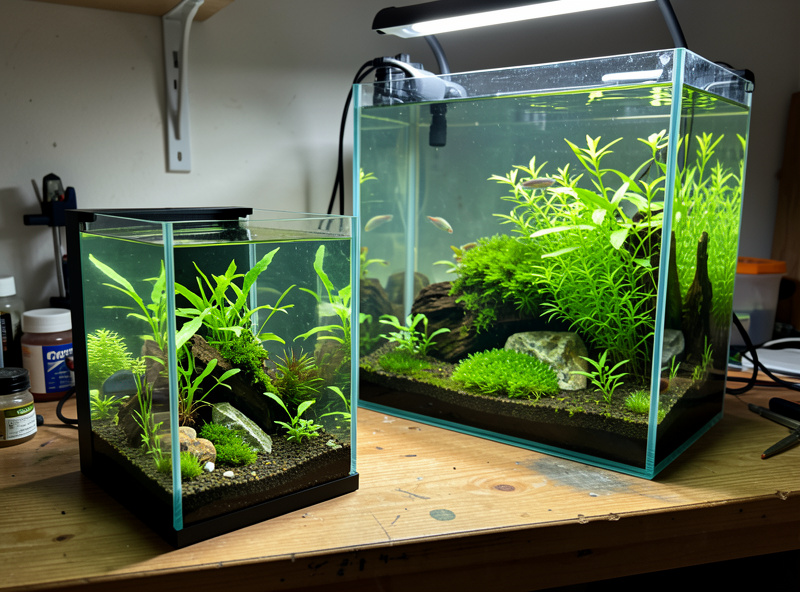
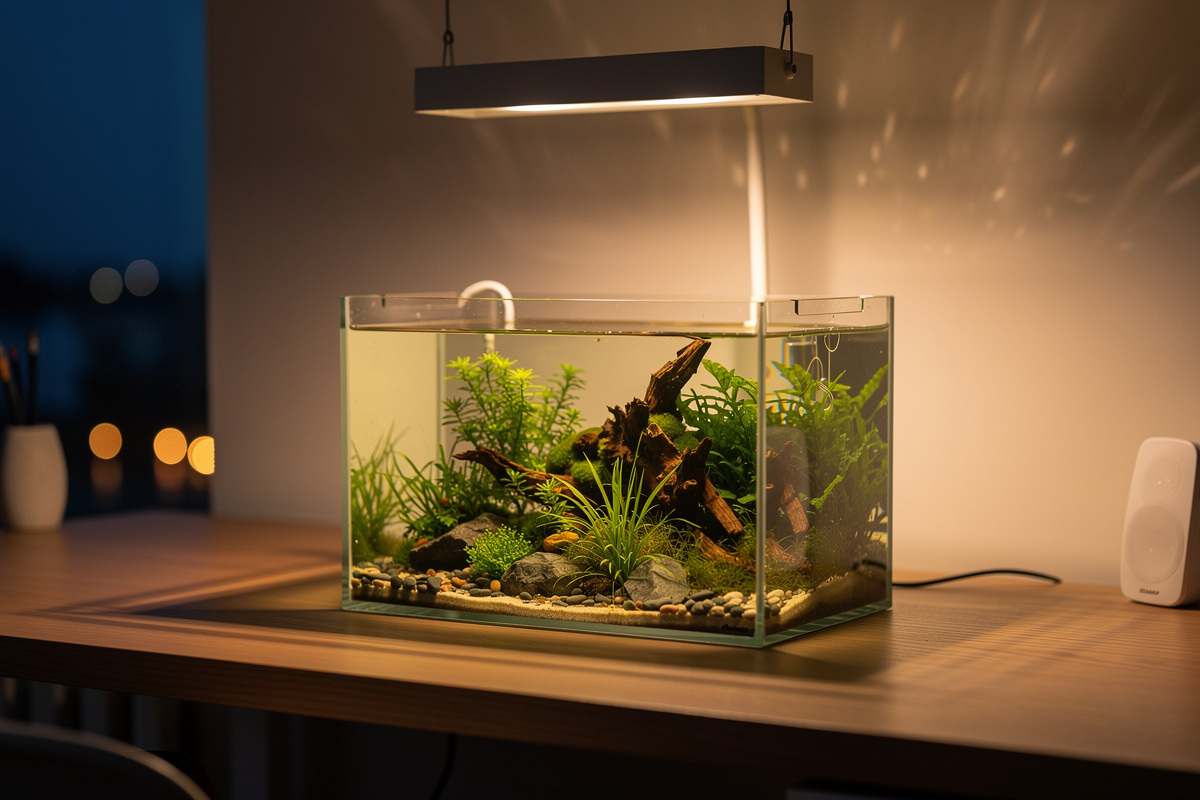
So why keep a nano at all? Because the upside is real and the downside is entirely manageable. A planted nano is the best-looking, most absorbing thing you can put on a desk, and through a long Swedish winter a lit, planted box of green is the best window in the house. The trade is simple and honest: you accept a tighter control loop in exchange for a small, beautiful, low-footprint system. The rest of this guide is that control loop, broken into routines.
Evaporation and the top-off discipline
The most underrated source of nano instability is the one nobody warns beginners about: evaporation. When water evaporates, only the water leaves — every dissolved mineral, salt, and buffer stays behind in a now-smaller volume. In a big tank you barely notice. In a nano losing a visible fraction of its water in a week, the general hardness, the TDS, and any dosed minerals concentrate steadily upward. Your livestock didn’t change; your water did, silently, while you weren’t looking.
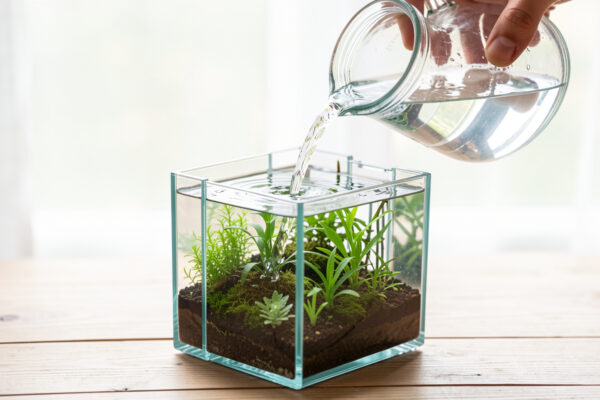
The discipline that fixes it is almost embarrassingly simple: top off with fresh, dechlorinated water only — never with anything that adds more minerals — and do it consistently, ideally daily, in small amounts. Topping off with RO or remineralised water at the same TDS your tank is meant to sit at keeps the concentration flat. Topping off with tap water on a shrimp tank, by contrast, slowly drives hardness up until the colony stops breeding and you have no idea why. This is exactly why I keep a marked fill line on every nano: it turns “is it low?” into a glance, not a guess. The full method lives in the evaporation and top-off deep-dive in this cluster.
Two pieces of cheap gear do most of the work of keeping evaporation from destabilising a nano. A TDS meter tells you, in seconds, whether your top-off routine is holding the dissolved-solids level flat or letting it creep — it is the same kind of pen I used on nutrient reservoirs for years, and it is the single most clarifying instrument on a small tank. And for a tank you can’t top off by hand every day, a simple auto top-off keeps the water level — and therefore the concentration — dead steady.
- A TDS / conductivity pen — reads dissolved solids so you can see evaporation creep before it becomes a problem. Browse TDS meters on Amazon.
- A nano auto top-off (ATO) kit — replaces evaporated water automatically to hold the level and concentration steady. Browse nano ATO kits on Amazon.
The parameters that swing — and what each one does to livestock
Not every parameter swings the same way or matters the same amount, so it helps to know which ones the small volume actually amplifies. Temperature is the fastest and most dangerous in a nano because thermal mass is tiny — a stuck heater or a cold draft moves the number quickly. Ammonia and nitrite spike sharply because there is so little water to dilute a bioload event. pH crashes when KH (the carbonate buffer) runs low, and a nano’s small buffer reserve gets exhausted faster than a big tank’s. General hardness and TDS drift upward with evaporation as described above.
The reason all of this matters is that livestock — shrimp especially — care about the rate of change as much as the absolute number. A Neocaridina colony will tolerate a fairly wide hardness range if it is stable, but a fast swing during a clumsy water change is what triggers bad molts and culls. I learned that on my own shrimp tank the hard way before the parameter log made the pattern obvious. The deep-dive on parameter swings in small volume walks through each parameter and the swing that actually hurts.
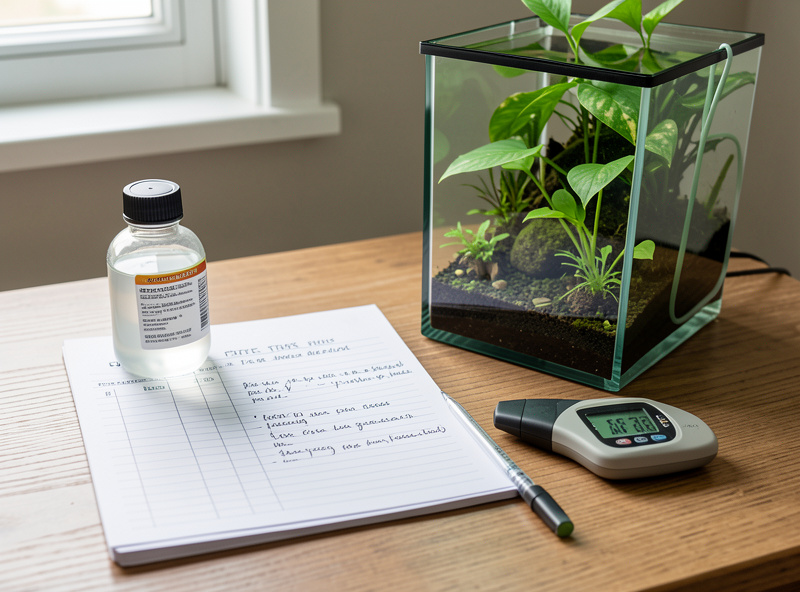
Water-change cadence for a nano
The water change is the master reset for a small tank — it is how you export accumulated nitrate and refresh the buffer and minerals before they drift too far. But on a nano the cadence question has a twist most guides miss: because a small water change is a large fraction of the tank, the change itself is a swing. Replacing half a 20-litre tank with water at a different temperature, pH, or hardness is a bigger shock to the inhabitants than the same volume in a big tank.
So the nano answer is usually smaller, more frequent changes with carefully temperature- and parameter-matched replacement water, rather than one big infrequent change. A modest weekly change on a lightly stocked planted nano keeps nitrate in check without ever jolting the system. A heavily stocked or shrimp tank may want a smaller change more often. The point is consistency: the tank adapts to a steady rhythm, and the parameter log tells you whether your chosen cadence is actually holding nitrate where you want it. The full breakdown is in the water-change cadence guide in this cluster.
One more nano-specific point worth making: the replacement water is where most cadence mistakes actually happen. A perfectly timed change with mismatched water — too cold, wrong pH, wrong hardness — does more harm than a slightly late change with matched water, because the mismatch is the swing you were trying to avoid. I prepare and temperature-match every drop of change water before it goes in, the same way I’d never pour a cold, un-pH’d nutrient batch into a hydroponic reservoir. On a nano the discipline isn’t optional; the small volume makes a careless change visible in the next day’s readings.
Heater reliability — the failure that kills nanos fastest
If there is one component where I will not buy cheap, it is the nano heater. The math is unforgiving: a small volume has almost no thermal buffer, so a heater that sticks in the “on” position can cook a nano to lethal temperatures in hours, and one that fails “off” lets a tank chill fast in a cold room. In a big tank a heater fault is a slow problem you can catch; in a nano it is a fast one that can wipe a tank before you’re home from work.
Two rules cover it. First, never trust the heater’s own dial or built-in thermostat as gospel — verify the actual water temperature with a separate, independent thermometer, the same instinct as never trusting a single uncalibrated meter on a hydro reservoir. Second, size and choose the heater for reliability, not just wattage, and on a truly tiny tank consider a heater with a hard temperature ceiling. The heater-reliability deep-dive covers what fails, how to spot it, and what I actually run.
Comparison: where stability is won or lost in a nano
| Factor | How fast it swings in a nano | Main risk | The routine that tames it |
|---|---|---|---|
| Temperature | Very fast — tiny thermal mass | Heater stuck on/off cooks or chills | Reliable heater + independent thermometer check |
| Evaporation (TDS/GH) | Fast — days, not weeks | Minerals concentrate upward silently | Daily fresh-water top-off, ATO, TDS pen |
| Ammonia / nitrite | Sharp — little water to dilute | Bioload event spikes hard | Light stocking, a fully cycled filter, testing |
| pH (via KH) | Fast if KH is low | Buffer exhausts, pH crashes | Adequate KH, steady water-change cadence |
| Nitrate | Climbs steadily | Stress, algae, poor shrimp breeding | Right-sized regular water changes |
Is an auto top-off worth it on a nano?
This is the question I get most, and the honest answer is “it depends on whether you can be consistent by hand.” An auto top-off replaces evaporated water automatically, holding the level — and therefore the concentration of everything dissolved — dead steady between water changes. On a nano, where evaporation drives hardness and TDS creep faster than on any big tank, that steadiness is genuinely valuable, not a gadget for gadget’s sake.
That said, a marked fill line and a daily jug of dechlorinated water do the same job for free if you are the kind of keeper who actually tops off every day. The ATO earns its place when you travel, when the tank is small enough that a day’s evaporation moves the parameters meaningfully, or when you simply know you won’t keep up the manual habit. I weigh the real cost and the genuine cases for and against in the dedicated auto top-off article — it is one of the few nano gadgets I think pays for itself, with caveats.
How the routines fit together
Step back and the whole thing is one loop. The volume math says a nano swings fast. Top-off discipline holds concentration steady against evaporation. A sane water-change cadence exports nitrate without shocking the tank. A reliable, verified heater keeps temperature from being the thing that kills you. And the parameter log ties it all together — it is the instrument panel that tells you whether your routines are working or whether something has started to drift. Run that loop and a nano is not fragile; it is one of the most controlled, rewarding systems in the hobby. Skip it and the small water will find you out, fast.
That is the site thesis in one paragraph: small water done right. Everything else here — the cycle, the shrimp work, the plants, the algae diagnosis — sits on top of this stability foundation. Get the loop running first, then build.
An honest word on livestock
One non-negotiable runs through all of this: a nano is a home for living animals, not just a chemistry exercise. Everything in this guide is husbandry and prevention — stable water, the right routines, gear that doesn’t fail. If a fish or shrimp shows signs of actual illness, that is diagnosis and treatment territory, which belongs with an aquatic vet or a species specialist, not a blog. Keep the water right and most problems never start; that is the whole point of running a nano like an experiment instead of a guess.
Frequently Asked Questions
Are nano tanks really harder than big tanks?
Yes, and the reason is just volume. A small tank dilutes nothing, so any insult — a heater fault, a bioload spike, evaporation concentrating minerals — moves the parameters further and faster than the same event would in a large tank. It is not harder because it is mysterious; it is harder because there is less water to buffer mistakes. The upside is that disciplined routines make a nano just as stable as anything larger.
How often should I top off a nano tank?
Ideally daily, in small amounts, using only fresh dechlorinated water — or RO water remineralised to your tank’s target level. Topping off little and often keeps the dissolved-mineral concentration flat. A marked fill line makes it a glance instead of a guess, and an auto top-off does the same job automatically if you cannot be consistent by hand.
What parameter swings the fastest in a small tank?
Temperature, because a nano has almost no thermal mass to buffer a heater fault or a cold room. A stuck heater can reach dangerous temperatures within hours. Ammonia and nitrite spike sharply too, since there is so little water to dilute a bioload event. This is why an independent thermometer and a fully cycled filter matter more on a nano, not less.
How big and how often should nano water changes be?
Usually smaller and more frequent than on a big tank, with replacement water matched closely for temperature and parameters. Because a given volume is a large fraction of a nano, a big infrequent change is itself a swing that can shock livestock. A modest weekly change on a lightly stocked planted nano keeps nitrate in check without jolting the system; let your parameter log confirm the cadence is holding.
Is an auto top-off worth it for a nano?
It is one of the few nano gadgets I think earns its place, because evaporation drives hardness and TDS creep faster on small water than anywhere else, and an ATO holds the level and concentration dead steady. That said, a marked fill line plus a daily jug of dechlorinated water does the same job for free — if you are genuinely consistent. The ATO is worth it for travel, very small tanks, and keepers who know they will skip the manual habit.
Why does my nano’s hardness keep rising?
Almost always evaporation. When water evaporates only the water leaves, so the dissolved minerals concentrate into a smaller volume and your general hardness and TDS climb. Topping off with tap water makes it worse by adding even more minerals. Top off with fresh dechlorinated or remineralised water at your target level, and use a TDS pen to confirm the number is holding flat rather than creeping up.
Guides in This Cluster
The full nano-stability cluster, in the order most nano keepers work through them:
- Evaporation and Top-Off Discipline for Nano Tanks
- Parameter Swings in a Small Tank: What Moves and Why
- Water Change Cadence for Nano Tanks: Small, Often, Matched
- Heater Reliability on Small Tanks: The Component I Never Cheap Out On
- Is an Auto Top-Off Worth It on a Nano Tank? My Honest Verdict
- Neocaridina Shrimp Care: The Complete Cherry Shrimp Guide
- Are Small Aquariums Harder? The Volume Math, Honestly