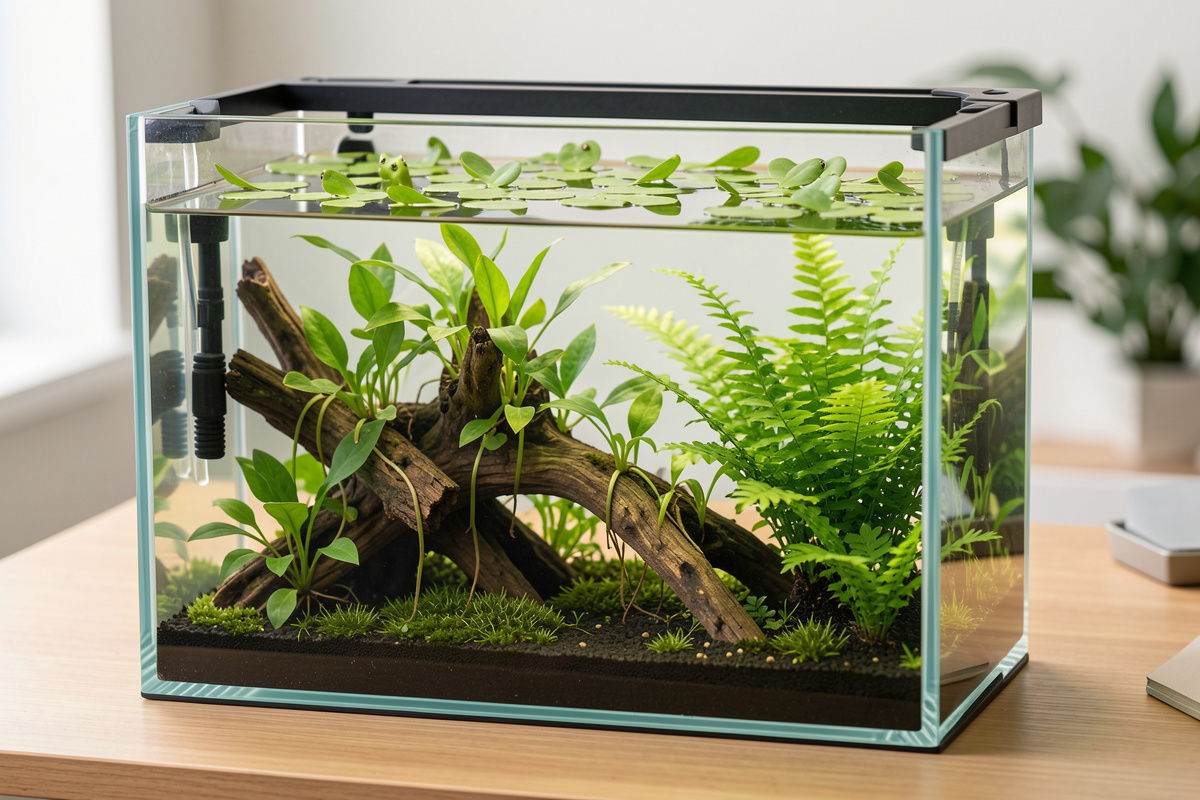
A low tech planted nano tank is a small aquarium (roughly 10 to 40 litres) that grows live plants without injected CO2, relying only on modest light, the fish or shrimp it already houses, and the substrate beneath. Done right, it stays stable for years on a 20 to 30 minute weekly routine.
I run one as my daily reference tank: a Fluval Spec-class roughly 20-litre box with a Neocaridina shrimp colony that has held steady for years. It is the tank I point people to when they ask whether they need pressurised CO2 and a $200 light to grow plants. They do not. They need the right plants, honest expectations, and the discipline to let the system settle instead of chasing it. This guide is the whole playbook I wish someone had handed me before I drowned my first three carpets and bought gear I never needed.
The reason I am chemistry-first about all of this is that I came to aquariums through years of hydroponics, where the same TDS pen and the same “test, don’t guess” reflex decided whether plants lived. Water chemistry does not care whether the roots have fins. A low tech planted nano is that bench with a heartbeat, and the plants are the most forgiving teachers in it. Before plants ever go in, the tank has to be cycled, and I treat the nitrogen cycle as non-negotiable physics rather than a patience test.
What Makes a Tank “Low Tech”?
Low tech means no pressurised CO2 and modest light, so plant growth runs at the pace the tank’s own biology supports. Photoperiods sit around 6 to 8 hours, light is low-to-medium PAR, and the bioload from livestock plus the substrate supplies most of the nutrients. Growth is slow and steady rather than explosive.
The trade-off is the whole point. A high-tech tank with CO2 grows a carpet in six weeks and demands daily attention, a tight fertilising schedule, and a willingness to fight algae the moment the balance tips. My high-tech 60-litre showpiece is genuinely more work every single week than my low tech 20-litre, which I sometimes ignore for ten days at a time with nothing worse than a slightly thirsty Amazon sword to show for it. Low tech is not the beginner version of high tech. It is a different philosophy: choose plants that thrive at low input, then stop interfering.
People hear “low tech” and assume “low effort and bulletproof.” That is the beginner-store lie that kills more plants than any deficiency. Low tech is forgiving of neglect but unforgiving of impatience and bad plant choices. Pick a demanding stem that wants CO2, jam it under a weak light, and it will melt no matter how diligent you are. The skill in low tech is selection, not intervention.
Do You Need CO2 for a Planted Nano?
No. A planted nano grows fine without injected CO2 as long as you choose plants matched to low light and accept slower growth. The dissolved CO2 from livestock respiration and biofilm activity, typically a few parts per million, is enough for hardy species like Anubias, Java fern, Cryptocoryne, and Vallisneria.
CO2 is a growth accelerator, not a survival requirement. What it buys you is speed and the ability to grow demanding species: dense red stems, true carpets like dwarf hairgrass, the aquascaping-magazine look. What it costs you is a regulator, a diffuser, a drop checker, ongoing gas refills, and a much narrower margin for error, because faster plant metabolism means faster algae too the instant your balance slips. On a tank under 40 litres I would not bother for a first planted build. The volume is so small that the parameter swings CO2 introduces are harder to tame, and the species that actually suit a nano grow contentedly without it.
If you find yourself wanting that high-tech look, the honest path is to master a low tech tank first, then graduate. Every skill that keeps a low tech nano alive (light discipline, water-change cadence, reading algae as a symptom) transfers directly. Skipping straight to CO2 on a nano is how beginners end up with a $300 algae farm.
There is also a chemistry footnote that the bottle aisle never mentions. Injecting CO2 lowers pH as carbonic acid forms, and in a soft-water nano that swing can be sharp enough to stress livestock if the gas is not on a tight day-night cycle. My high-tech 60-litre runs the CO2 on the same timer as the light, ramping up an hour before lights-on and off an hour before lights-out, precisely so the pH does not yo-yo on the shrimp and fish. That coordination is doable but it is one more system to get right, and on a tank this small there is almost no buffer for error. A low tech nano simply does not have that failure mode: no gas, no pH swing, no panic. For a first planted build that absence of risk is worth more than any growth rate.
Best Low Tech Plants That Actually Survive
The most reliable low tech nano plants are the epiphytes (Anubias and Java fern), the Cryptocoryne genus, and a few undemanding stems and floaters. These tolerate low light, draw nutrients from the water column or substrate without fuss, and survive the mistakes every beginner makes in the first three months.
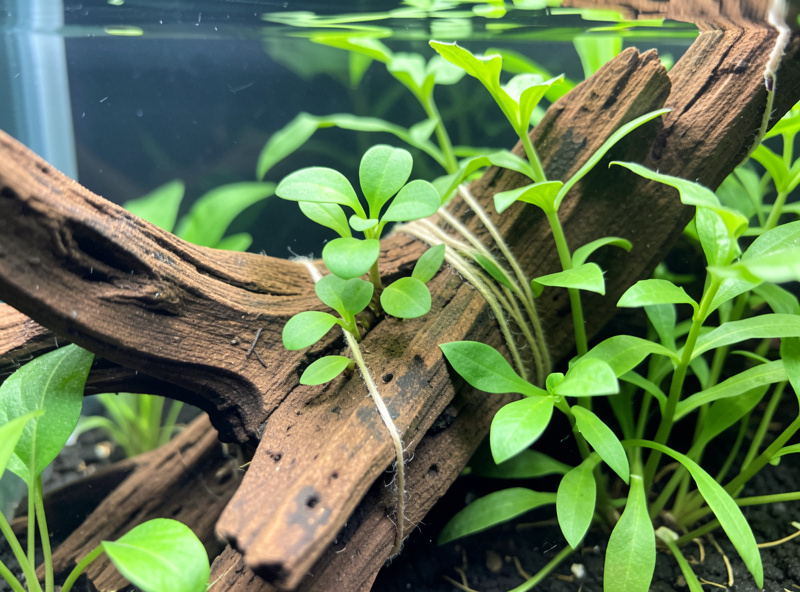
My daily-reference nano runs Anubias nana petite tied to a piece of spiderwood, a clump of Java fern on the back glass, two Cryptocoryne wendtii at the substrate, and a raft of floating frogbit for shade and nitrate export. Floaters are the most underrated tool in a low tech nano: they pull nitrate straight from the column with roots in the richest part of the water, dim the surface so shrimp colour up and algae starves, and they grow fast enough to be a visible nutrient gauge (when frogbit yellows, the tank is hungry; when it carpets the surface in a week, you are overfeeding). I cover which species behave and which become a maintenance nightmare in my floating plants for a nano tank guide. That is the whole planted side of my reference tank. No ferts schedule for years at a stretch, no melting once they established, and the shrimp graze the biofilm off every leaf. A reliable starter pack here is a beginner low-light plant bundle rather than single delicate stems. The single most common beginner failure is buying a pretty stem plant that demands more light and CO2 than the tank provides, watching it rot, and concluding they have a “black thumb.” They do not. They bought the wrong plant. I keep a running list of the species that actually hold up in a neglected nano in my low tech aquarium plants that actually survive guide, sorted by how much abuse each tolerates before it sulks.
Here is the honest tier list from my own benches. The top tier survives almost anything; the bottom tier is where beginners lose plants and confidence.
| Plant | Light Need | CO2 Need | Nano Difficulty | Placement |
|---|---|---|---|---|
| Anubias nana petite | Low | None | Beginner-proof | Tied to wood or rock |
| Java fern | Low | None | Beginner-proof | Tied to wood or rock |
| Cryptocoryne wendtii | Low to medium | None | Easy (expect a melt) | Substrate, midground |
| Java moss | Low | None | Beginner-proof | Anywhere it can grip |
| Vallisneria | Medium | None | Easy | Background |
| Bucephalandra | Low to medium | Helpful, not required | Easy but slow | Tied to hardscape |
| Amazon sword | Medium | None (wants root tabs) | Easy if fed at roots | Substrate, centrepiece |
| Dwarf hairgrass (carpet) | High | Strongly wanted | Hard without CO2 | Foreground |
Note the bottom row. Carpeting plants are where the honest failure rate lives, and I will not pretend otherwise: a true low-CO2 carpet is the hardest thing on this list and most beginners fail it. There are carpet-adjacent species that work better at low tech, but if your heart is set on a lush foreground in a nano, that is the one project I would genuinely tell you to learn elsewhere in the tank first. I put real numbers to how often each carpet species melts at low tech in my easy carpet plants without CO2 failure-rate breakdown, because the marketing photos never show the dead attempts.
Substrate: Do You Need Special Soil?
For a low tech nano, no, you do not strictly need aquasoil. Plain inert gravel or sand works if you feed root-hungry plants with root tabs, and the epiphytes that suit a nano take nothing from the substrate at all. Aquasoil is a convenience and a growth boost, not a requirement.
This is the decision that paralyses beginners, so let me make it simple. If your plant list is epiphytes (Anubias, Java fern, Buce) tied to hardscape plus a floater, the substrate is purely cosmetic. Use whatever sand or fine gravel you like; those plants never touch it, because they anchor to wood and rock instead. Getting that attachment right matters more than people expect: tie too tight with thread and you crush the rhizome, glue carelessly and you smother the growth point, and a loose Anubias that keeps floating off into the filter intake will rot before it ever roots. I walk through the cotton-thread, superglue-gel, and crevice-wedging methods I actually use in my guide to attaching aquarium plants to driftwood and rock. If you want root-feeders like Cryptocoryne, Amazon sword, or Vallisneria, you have two honest routes: inert substrate plus root tabs, or a nutrient-rich aquasoil that feeds them for a year or two before it exhausts. Aquasoil also lowers pH and softens water, which suits some livestock and fights others, so it is not a free lunch.
One more honest point on aquasoil that the unboxing videos skip: it leaches ammonia for the first week or two as it breaks in, which is fine if the tank is empty and still finishing its cycle, and a disaster if you have already added shrimp. I always run a fresh aquasoil tank through its fishless cycle and test until ammonia and nitrite both read zero before any livestock goes in. Inert substrate does not leach, so it is the more forgiving choice if you are impatient to stock. That single difference matters more for a beginner than any nutrient comparison.
The deep dive into specific substrate brands, capping technique, and depth belongs in my soil vs inert substrate guide for low tech tanks, which walks the actual decision tree. For a first low tech nano the call is straightforward: pick inert plus root tabs for control and lower cost, or aquasoil for convenience and a faster start, and do not agonise beyond that. Both grow the same plants.
Lighting and Photoperiod for Low Tech
A low tech planted nano wants low-to-medium light on a 6 to 8 hour photoperiod, ideally on a timer so it never varies. Too much light without the CO2 to match is the single biggest cause of algae in these tanks, not too little.
Beginners reliably set the light too high and too long, reasoning that more light grows more plants. In a low tech tank the plants cannot use the extra light because CO2 is the limiting factor, so the surplus energy feeds algae instead. When I commission a low tech nano I start at 6 hours, watch for two weeks, and only extend toward 8 if the plants look starved and the glass stays clean. After I moved one tank’s schedule down from 9 hours to 7, a nagging green-spot problem on the glass simply faded over a month with no other change. A cheap plug-in light timer is the best ten-dollar upgrade you can make; consistency matters more than intensity.
A siesta schedule (a few hours on, a midday gap, then on again) is a tool some keepers use to let CO2 recover and starve algae, and it can help, but it is an optimisation, not a starting point. Get the basics consistent first. The full photoperiod and PAR discussion is a topic of its own; for a first build, a timer set to 7 hours of modest light is correct far more often than not.
Fertilising a Low Tech Nano: Less Than You Think
Most low tech nanos need little or no added fertiliser. Fish or shrimp waste plus fish food supplies nitrogen and phosphorus, and slow low-light growth keeps demand modest. Heavy ferts dosing on a low tech tank usually feeds algae, not plants.
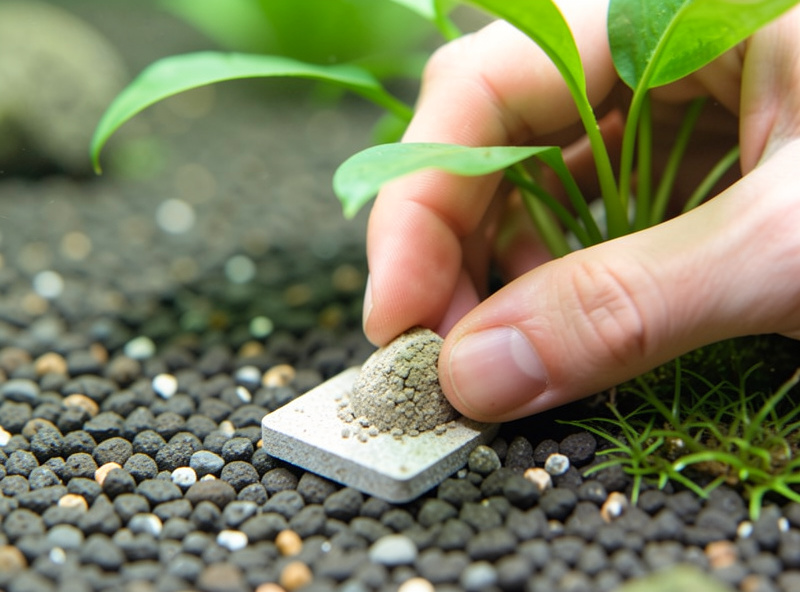
This runs against everything the bottle aisle wants you to believe. On my shrimp-and-Anubias reference nano I have gone a year at a time dosing nothing and the plants are fine, because the bioload feeds them and the epiphytes are not greedy. The exception is root-feeders in inert substrate: an Amazon sword or a hungry Crypt in plain sand will yellow and stall without nutrients at the roots, and that is what root tabs are for, pushed into the gravel near the plant base every few months. A light all-in-one liquid dosed sparingly can help a column-feeder, but the rule for low tech is start at nothing, watch the plants, and add only what visible deficiency demands. The full root-tabs-versus-liquid call, including when each one actually earns its place, is in my do low tech tanks need fertiliser breakdown. Dosing on a schedule because a label said to is how low tech tanks tip into algae.
The First Three Months: What Actually Happens
A new planted nano goes through predictable phases: a diatom bloom around weeks 2 to 4, a Cryptocoryne melt as Crypts adjust to your water, and slow establishment before any real growth. None of it means you are failing; it means the tank is settling.
The brown dusty diatom film that coats glass and plants in the first month frightens every beginner into buying products. Do nothing. It is the new-tank silica-and-instability phase and it passes on its own as the system matures, usually wiped out by the time you have a stable biofilm and a hungry cleanup crew. The Crypt melt is the other classic panic: you plant a healthy Cryptocoryne and within a fortnight it dissolves to mush. Leave the roots in place. It is shedding its emersed-grown leaves and will regrow submersed ones from the rhizome within weeks. Pulling it out because it “died” is the mistake. Patience is the active ingredient in a low tech tank, and the first three months are mostly an exercise in resisting the urge to intervene.
Maintenance Routine That Keeps It Stable
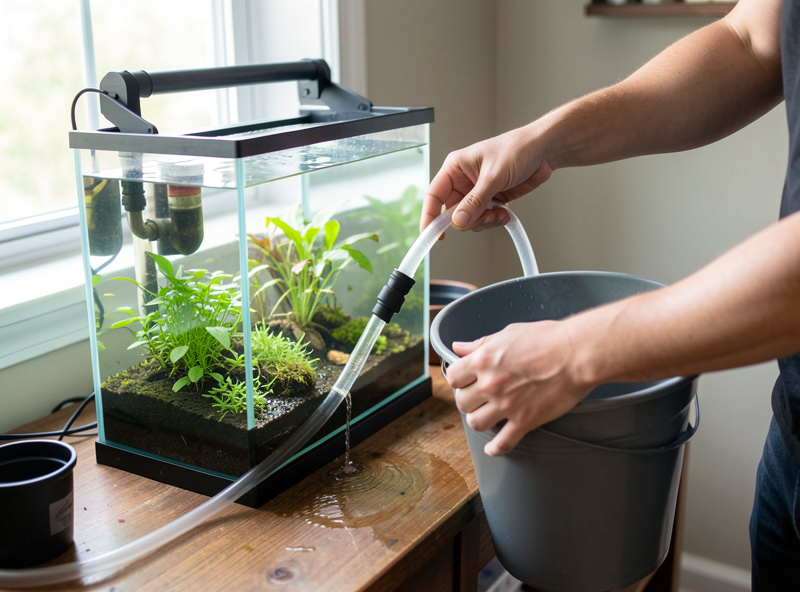
A low tech planted nano runs on a roughly 20 to 30 minute weekly routine: a 20 to 30 percent water change with dechlorinated, temperature-matched water, a glass wipe, a quick trim, and a top-off of evaporation between changes. That is the whole job.
Because a nano’s small volume swings fast, I keep the cadence boringly consistent rather than large and occasional; the parameter-log method I imported from years of hydroponics says steady beats heroic every time. The right water-change cadence for a nano is the backbone of the whole routine. Top-off matters more than people expect on a small tank: evaporation concentrates minerals and raises TDS, so I replace evaporated water with dechlorinated tap or remineralised RO between water changes, and I verify with a TDS pen rather than guessing. Trim floaters before they blanket the surface and choke gas exchange. Wipe the front glass, leave the back for the cleanup crew. The discipline of small, regular, measured maintenance is what separates a nano that holds for years from one that crashes every few months, and it is the same discipline whether the water grows lettuce or shrimp.
One piece of gear I will not let a beginner skimp on is temperature control, even though plants barely care about it. A nano under 40 litres has so little thermal mass that a cheap preset heater sticking on can cook a tank by several degrees in an afternoon, and the shrimp pay for it long before the plants notice. I run a small adjustable heater on every tank and verify the actual water temperature with an external thermometer rather than trusting the dial, because I have measured dials that were off by two to three degrees straight out of the box. Plants in a low tech nano are happiest in a stable 22 to 25 degrees Celsius range, and stable is the operative word: the slow swings a tank this small is prone to stress livestock and stall plant growth more than the absolute number ever does. The same parameter-log discipline that runs the water chemistry runs the temperature too.
Stocking a Planted Nano Ethically
A planted nano suits small, low-bioload livestock: a Neocaridina shrimp colony, a few nano fish appropriate to the volume, or snails. Overstocking a small tank is the fastest route to crashed parameters, and it is an animal-welfare issue, not just a chemistry one.
My reference nano is a shrimp-only colony, and shrimp are the ideal planted-nano residents: tiny bioload, constant biofilm grazing that keeps leaves clean, and fascinating to watch. Keeping their water parameters stable is far easier in a planted tank, because the plants buffer the swings. If you want fish, the honest line is that a 20-litre box is not a community tank and a single betta is the upper end of what belongs there, kept properly with cover and enrichment, never a bowl, and you should think hard about whether fish and shrimp belong together at all in that volume. The plants help: they export nitrate, give shrimp grazing and cover, and floaters dim the light shrimp prefer. But plants do not license overstocking. Match the bioload to the volume, remember that small aquariums are genuinely harder not easier, let the cycle and the parameters lead, and the planted nano becomes the calm, lit window that gets me through a Swedish winter rather than a chore that crashes. If you want the full discipline of holding a small tank steady, my nano stability guide is the companion to this one.
Frequently Asked Questions
Can you have a planted tank without CO2?
Yes. Hardy plants like Anubias, Java fern, Cryptocoryne, and floaters grow well without injected CO2, using the few ppm produced by livestock and biofilm. Growth is slower, but the tank is far less work and far less algae-prone than a high-tech setup.
What plants survive in a low tech nano tank?
Anubias nana petite, Java fern, Java moss, Cryptocoryne wendtii, Vallisneria, Bucephalandra, and floating frogbit are the most reliable. Epiphytes tied to wood or rock are the most beginner-proof because they take nothing from the substrate.
Do low tech planted tanks need fertiliser?
Usually very little. Fish or shrimp waste supplies most nutrients, and slow low-light growth keeps demand low. Root-feeders in inert substrate benefit from root tabs every few months, but column dosing on a schedule often feeds algae rather than plants.
How much light does a planted nano need?
Low to medium light on a 6 to 8 hour photoperiod, ideally on a timer. Too much light without matching CO2 is the leading cause of algae in low tech tanks. Start at six hours and extend only if plants look starved while the glass stays clean.
Why are my new aquarium plants melting?
Cryptocoryne and other substrate plants commonly melt in the first two weeks as they shed emersed-grown leaves and adapt to your water. Leave the roots in place; they regrow submersed leaves from the rhizome within weeks. It is adjustment, not death.
Is a low tech nano good for beginners?
Yes, if you choose the right plants and accept slow growth. Low tech is forgiving of neglect but unforgiving of impatience and bad plant choices. Epiphytes plus a floater on a timer is the most beginner-proof planted nano you can build.
As an Amazon Associate I earn from qualifying purchases.