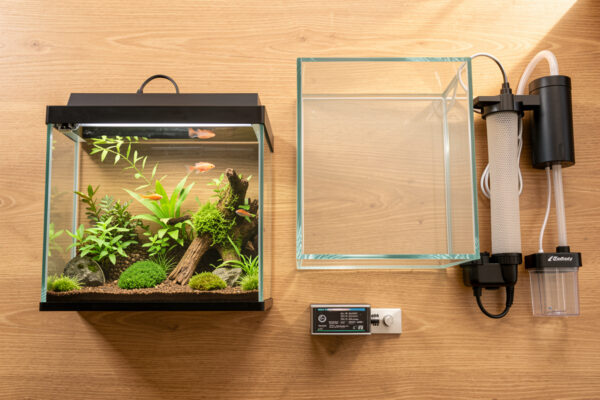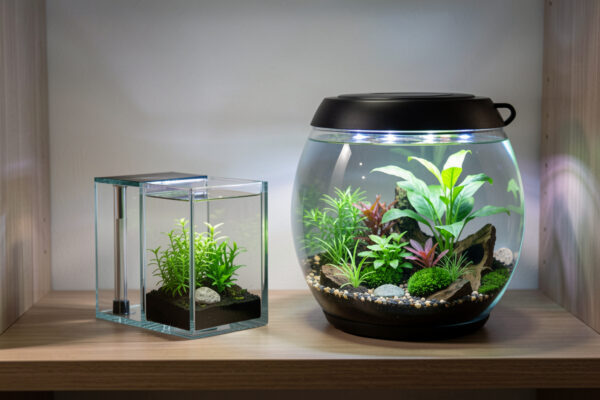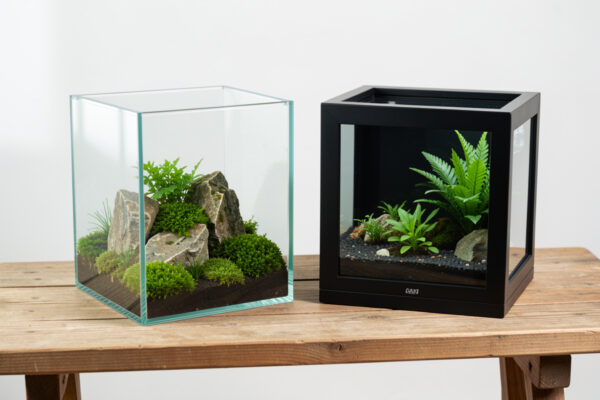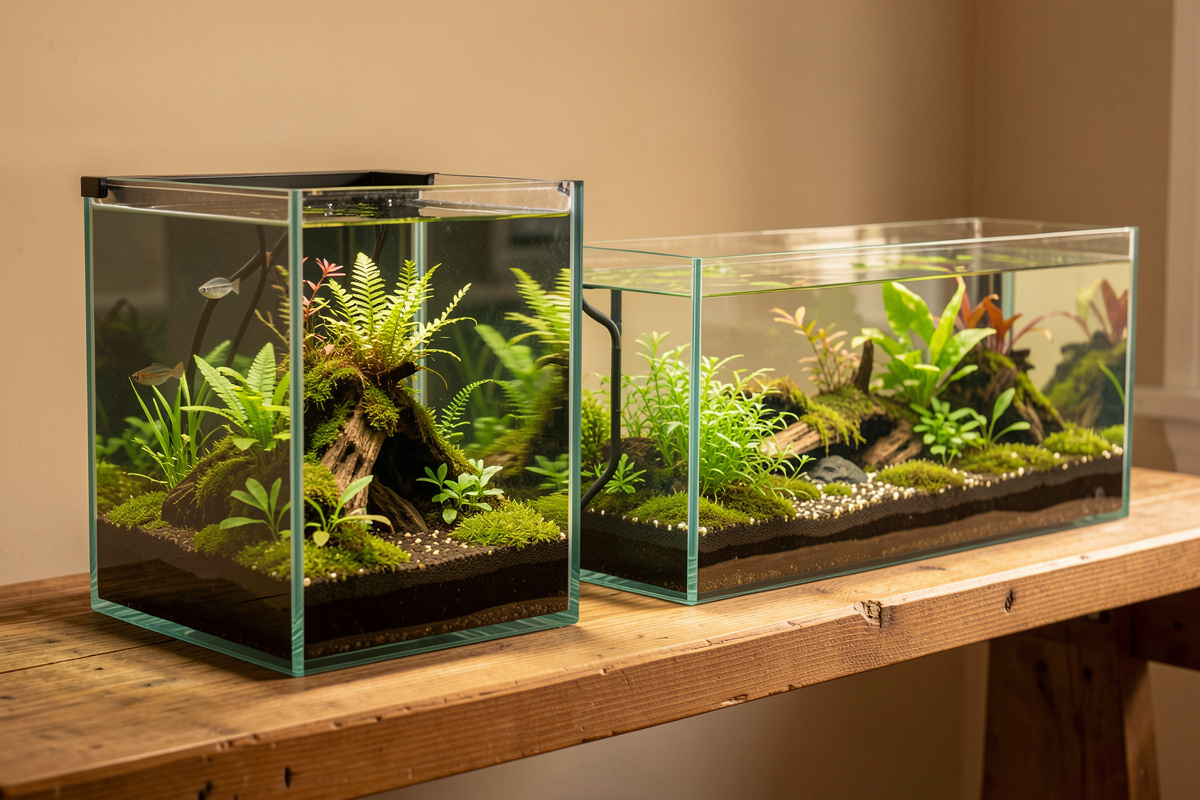
Choose a rectangle nano if you want fish, and a cube if you want an aquascape. Shape is not cosmetic: what stocks a tank is surface area and swimming length, not litres, so a 30-litre rectangle carries more fish and more oxygen than a 30-litre cube that piles the same water tall and narrow. Cubes frame a single central layout beautifully and photograph like a diorama; rectangles give fish room to school and gas more room to exchange. Same volume, genuinely different tanks.
I keep both shapes on my rack and the trade-offs show up in my parameter log, not just in the photos. The tall cube runs a touch warmer at the top and gasses off slower; the long rectangle holds a steadier oxygen level and lets a shoal actually behave like a shoal. Before you fall for a shape, understand what it costs you, because the wrong pick quietly caps what you can keep.
Does Tank Shape Actually Matter?
Yes, and mostly through two numbers: water surface area and horizontal swimming length. Surface area is where oxygen enters and carbon dioxide leaves the water, so a wide, shallow footprint gasses better than a tall, narrow one of identical volume. Swimming length is the runway fish use — a long tank lets a school stretch out and cruise, while a cube forces them into a short back-and-forth. Two tanks can both say “38 litres” on the box and behave like different homes.
This is why I tell people to read the footprint, not just the volume, when they shop — a point I hammer in my nano tank kit guide. A 45-centimetre-long rectangle and a 30-centimetre cube might hold similar water, but the rectangle offers more surface, more length, and a calmer environment for anything that swims. The cube trades that away for height and a compact base, which is a fair trade only if what you want from the tank is the view.
Cube vs Rectangle: The Trade-Offs
Here is how the two shapes compare on the things that decide day-to-day keeping. Notice that most of the rectangle’s wins are biological and most of the cube’s wins are visual — which is exactly why the right answer depends entirely on your goal.
| Factor | Cube | Rectangle |
|---|---|---|
| Surface area per litre | Lower (tall, narrow) | Higher (wide, shallow) |
| Gas exchange / oxygen | Weaker | Stronger |
| Swimming length for fish | Short | Long |
| Aquascaping impact | Excellent for a central layout | Good for a landscape scene |
| Lighting evenly | Harder (deep water column) | Easier (shallower) |
| Best for | Aquascapes, shrimp, one betta | Schools, active fish |
The table hides one nuance worth saying out loud: for shrimp, the shape barely matters, because shrimp do not need swimming length and a colony is happy in either. So if you keep Neocaridina, buy whichever shape you find prettier and spend your attention on the water instead — the parameters that actually run a shrimp tank are in cherry shrimp water parameters.
Which Shape Is Better for Fish?
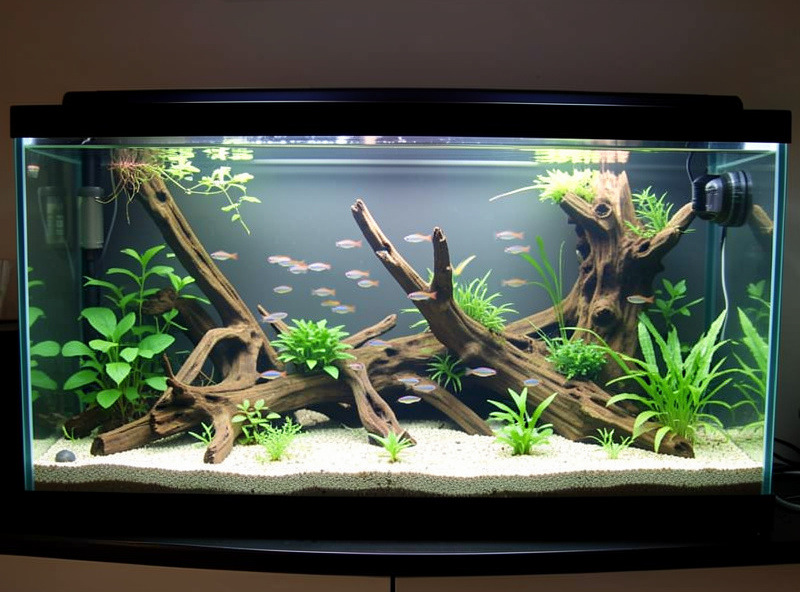
The rectangle, clearly, and for two reasons that compound. First, the extra surface area means more dissolved oxygen and easier off-gassing of carbon dioxide, which matters most in the small volumes where a nano’s parameters already swing fast — the mechanism is in parameter swings in a small tank. Second, the length gives a school somewhere to go. A group of chili rasboras in a long rectangle spreads out and cruises; the same fish in a cube look cramped and skittish.
If fish are the plan, the rectangle also makes honest stocking easier, because you are working with more surface and more length for the same water — though the bioload limits still apply, and I would not let the extra room tempt you into overstocking, which is the trap I warn about in the nano tank stocking guide and the bioload math. A rectangle is the better fish tank; it is not a licence to add more fish.
Which Shape Is Better for Aquascaping?
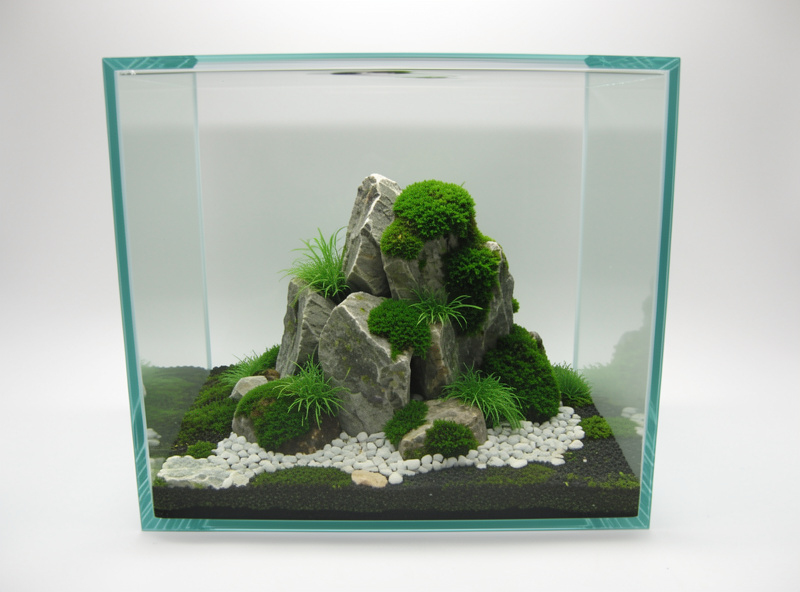
The cube, most of the time, and this is where it earns its price. A cube’s near-square footprint frames a single central composition — one dramatic stone arrangement, one piece of driftwood reaching upward — the way a picture frame flatters a portrait. The height gives you room to build vertically, and the compact base draws the eye to one focal point. It is the classic canvas for the iwagumi and nature-aquarium styles I break down in aquascaping styles for nano tanks.
Rectangles aquascape well too, but they ask for a different composition — a landscape that flows across the length, with foreground, midground, and background staged left to right, using the layering approach in the complete nano aquascaping guide. Both can be stunning; the cube just makes the single-focal-point scape almost automatic, while the rectangle rewards planning. If you dream in dioramas, the cube is your shape, and the hardscape choices that make it work are in hardscape for nano tanks.
Surface Area and Gas Exchange: Why It Beats Litres
Here is the chemistry that most shape debates skip. Oxygen dissolves into water at the surface and carbon dioxide leaves the same way, so the ratio of surface area to volume sets how well a tank “breathes.” A tall cube has a small surface relative to its water, so it exchanges gas slowly; a wide rectangle has a large surface, so it breathes freely. And temperature stacks the odds: as Fondriest’s dissolved-oxygen reference spells out, fully saturated water holds about 10.9 mg/L of oxygen at 4°C but only 8.7 mg/L near 21°C — so a warm summer cube is short on both surface and solubility at once. In a big aquarium this is a footnote. In a nano, where the whole system already runs on thin margins, it is a real variable.
The practical upshot: a rectangle is more forgiving of a heavier stock or a warm afternoon, because warm water holds less oxygen and the rectangle recovers faster. A cube demands you keep the stock light and the surface moving — a gentle ripple from the filter return goes a long way. It is the same “test, don’t guess” instinct I brought from years of running water chemistry: the TDS pen in my aquarium drawer is the same one that ran my nutrient reservoirs, and water does not care whether the roots have fins. Shape changes how the tank breathes, and the numbers in my log show it every summer.
The Shape Mistake I Made
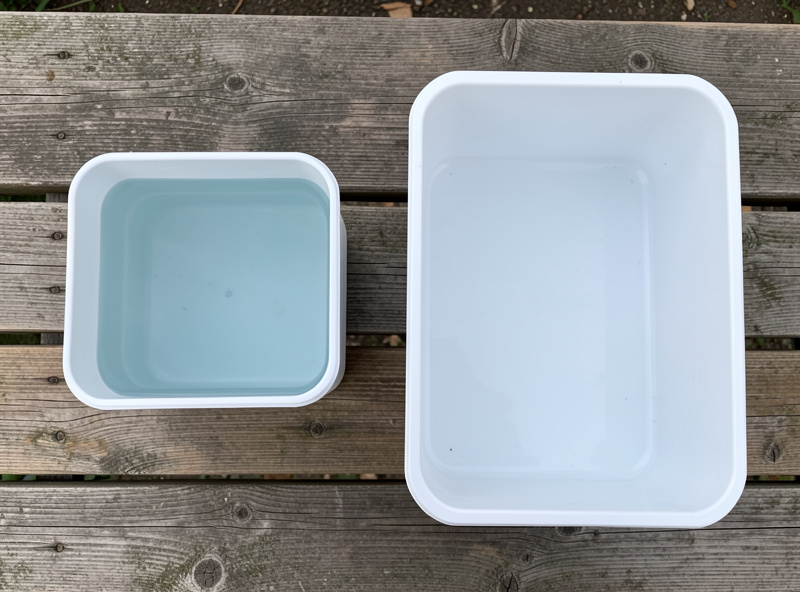
I once bought a tall cube for a group of small tetras because I liked how it looked on the shelf, and I spent months watching fish that never settled. They hung in the front third, darting rather than cruising, and the surface was so calm the tank felt stuffy on warm days — my dissolved-oxygen instincts were screaming before I did the honest thing and moved them to a longer tank, where they immediately relaxed into a proper shoal. The cube was not a bad tank; it was the wrong tank for that fish. I rescaped it as a shrimp-and-moss cube and it has been one of my favourite tanks since.
The lesson stuck: buy the shape for the inhabitant, then make it beautiful. A gorgeous cube full of stressed fish is a failure with good lighting. The height that flatters a hardscape is the same height that steals swimming length and surface area from a school. Decide what lives there first — the whole reason stocking comes before shape in my stability method.
Height, Light, and Carpets: The Cube’s Other Catch
Depth of water changes what your light can do, and this catches carpet-plant dreamers out constantly. Light falls off fast through water, so a tall cube’s deep column means far less light reaches the substrate than in a shallow rectangle of the same volume. A carpeting plant that needs high light to stay compact will grow leggy and reach upward in a deep cube, while the same plant hugs the floor in a shallow tank. If a lush foreground is the goal, the shallow footprint has a real, physical advantage.
It also changes what light you buy. To push adequate intensity to the bottom of a deep cube you need a stronger unit, which is one more reason I tell people to match the light to the tank, not the other way round — the options and their reach are in the best LED light for a nano planted tank, and the intensity-versus-usable-spectrum question is in PAR vs PUR in nano lighting. A cube is not off-limits for carpets, but it makes them harder and more expensive to light, whereas a low rectangle almost carpets itself under a decent unit.
There is a maintenance angle too. A deep cube is genuinely harder to reach into — trimming a carpet or replanting stems at the bottom of a 40-centimetre column means wet sleeves and long tools, while a shallow rectangle is an easy arm’s reach. None of this is a dealbreaker, but it is the kind of practical detail that never shows up in the product photo and shapes how much you enjoy the tank week to week.
My Rule for Choosing a Shape
Rectangle for fish, cube for scapes, either for shrimp. If you want a school, buy the longest tank that fits your space and your budget, because length and surface area are the quiet upgrades that make active fish thrive. If you want a single-focal-point aquascape to photograph, buy the cube and lean into its strengths. And if you are keeping a Neocaridina colony, ignore the debate entirely and choose the shape that makes you happy to look at every day.
Whichever you pick, the shape is one input among several — it sits alongside the all-in-one-versus-rimless question in rimless tank vs an all-in-one kit and the size decision in the best 10-gallon nano tanks. Read the footprint, not just the litres on the box, and the tank you buy will match the tank you imagined. If you want the full buying framework, it all ties back to my nano tank kit guide — shape included.
As an Amazon Associate I earn from qualifying purchases. The aisles: nano cube aquariums and rimless rectangle tanks. I check surface movement and oxygen behaviour with the same instruments — a liquid kit from API — on every shape I run, and rimless cube brands publish their exact footprints so you can compare surface area before you buy — the UNS 60U spec, for instance, lists a 60 × 36 cm footprint, so you can do the surface-area math instead of guessing from the gallon number.