Stocking a nano tank is a bioload calculation, not a shopping decision. In water under 30 litres there is no margin: the fish you add set the ammonia load your filter and water changes have to absorb, and a single overstocked nano swings faster than any big tank ever will. This nano stocking guide is the framework I use across my own small systems — volume first, cycle second, livestock last.
I came to aquariums through years of hydroponics, where you measure water daily because guessing kills the crop. The aquarium is the same chemistry with a heartbeat, and stocking is where most nano keepers get the chemistry wrong. They buy the fish, then try to make the water cope. I do it backwards: I decide what the volume and the cycle can carry, and I stock to that number. Everything below is built on that order of operations.
Stocking starts with the cycle, not the fish
No fish goes into an uncycled nano. The nitrogen cycle is the bacterial engine that converts fish waste (ammonia) to nitrite and then to far less toxic nitrate — it is physics, not a patience test, and in a small volume it is the only thing standing between your livestock and an ammonia burn. A nano with no established biofilter cannot carry any bioload at all, regardless of how the volume math works out.
Before you read a single line about which fish fits, your tank needs to pass the double-zero test: 0 ppm ammonia and 0 ppm nitrite twenty-four hours after dosing ammonia. If you have not done a fishless cycle yet, that is step one — not stocking. I walk the whole process in the nitrogen cycle guide, and the finish line is defined in the double-zero test pattern. Stock before that and you are cycling with live animals in the smallest, least forgiving water there is.
The reason this matters more in a nano is dilution. In a 200 litre tank, a slug of ammonia from a new fish is diluted across a large volume and a large bacterial colony. In a 10 litre tank, the same slug is concentrated, and your established colony is small. Stocking conservatively is how you keep the ammonia signal — the thing that actually harms gills — below the level your small system can clear between water changes. If you ever see a nitrite spike after adding fish, that is the system telling you the bioload outran the biofilter.
The volume map: what each nano size can actually carry
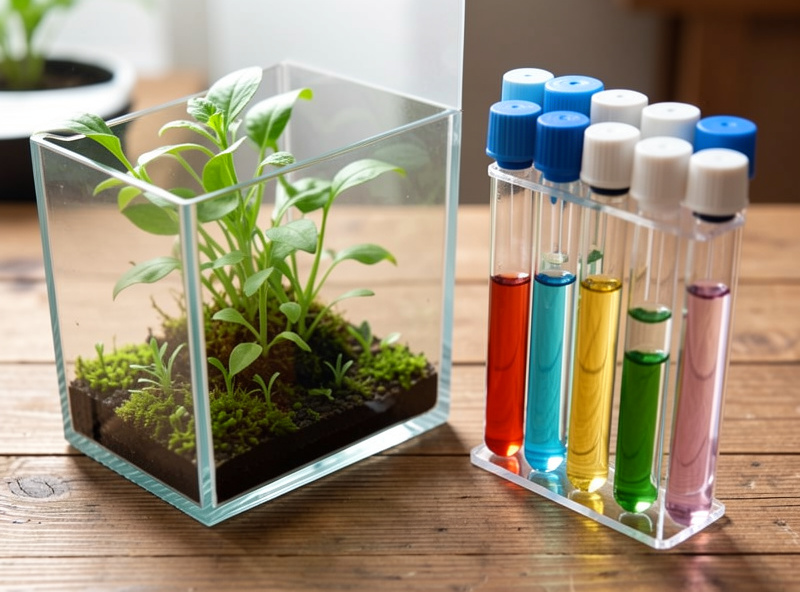
Match livestock to litres, not to the inch-per-gallon myth. As a working map: a 10 litre nano is an invertebrate or single-betta tank, a 20 litre nano holds one small nano-fish school, a 30 litre opens up gentle community options, and anything under about 8 litres is a planted or shrimp display, not a fish tank. The number that matters is dissolved waste per litre, and small water concentrates it.
Here is how I think about the common nano footprints. These are conservative on purpose — a lightly stocked nano is a stable nano, and stability is the entire game in small water.
| Tank volume | Realistic stocking | What it cannot carry | Best use |
|---|---|---|---|
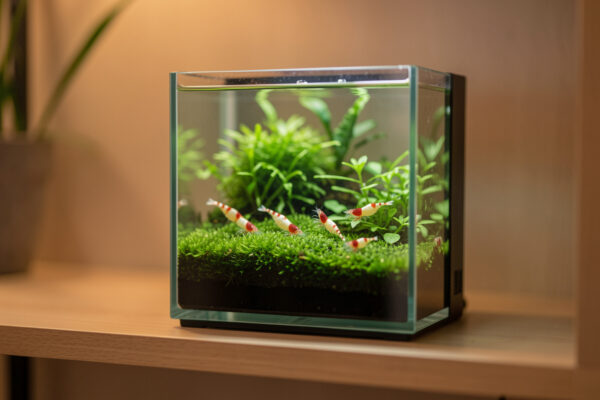
| 5–8 L (pico) | Neocaridina shrimp colony or snails only | Any fish, including a betta | Shrimp / planted display |
| 10 L (~2.6 gal) | Shrimp colony, or 1 betta + snails | Schooling fish, bottom loaches | Invert tank or single specimen |
| 20 L (~5 gal) | 1 school (6–8) of one micro species + shrimp | Two fish species, any barb/tetra over 3 cm | One nano-fish school |
| 30 L (~8 gal) | Small school + a single centrepiece or dwarf cory group | Cichlids, fancy goldfish, gouramis | Gentle nano community |
| 60 L (~16 gal) | Two compatible schools + shrimp + centrepiece | Anything sold as “needs 75 L+” | Aquascaped community |
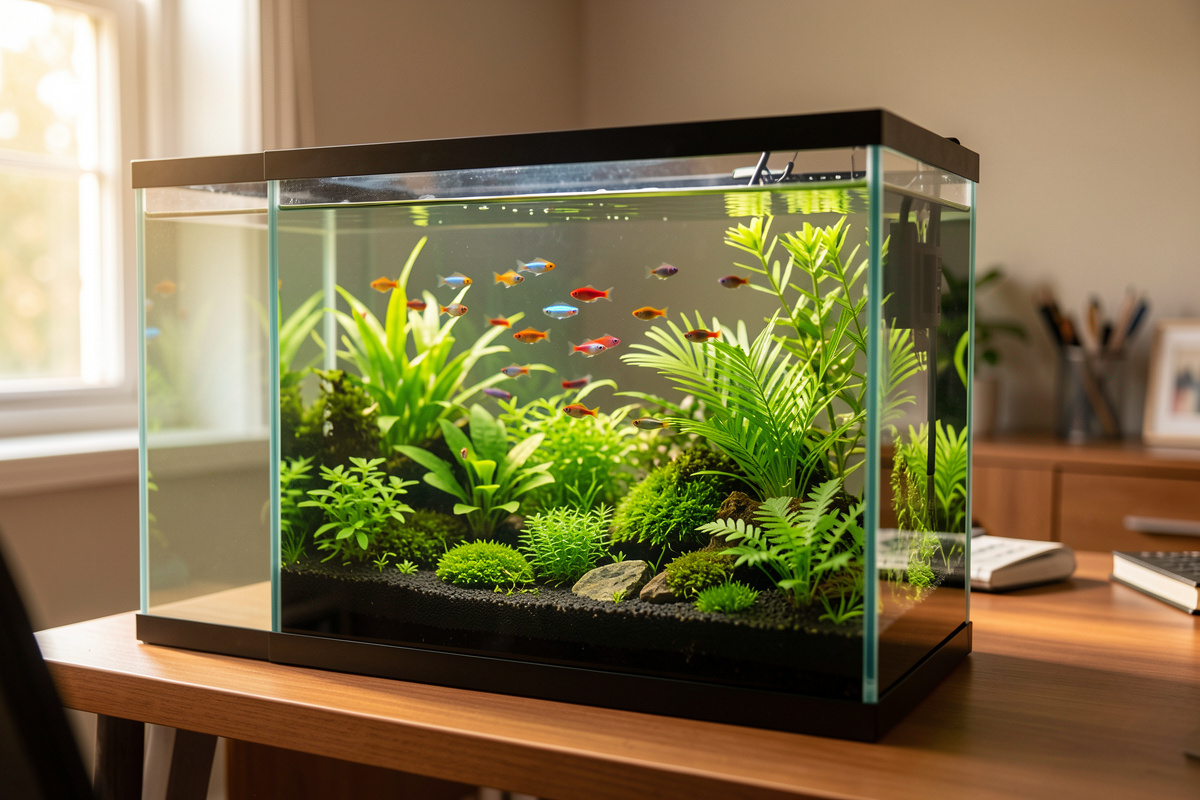
I keep a planted low-tech ~20 litre as my daily reference tank, and it runs one small school of micro rasboras plus a shrimp colony — nothing else. It has been stable for years precisely because it is under-stocked by pet-store standards. My high-tech ~60 litre carries more because the volume, the planting and the filtration are all larger, but I still stock it below what the calculators say. The detailed builds live in the 10 litre stocking guide and the 20 litre stocking guide.
Bioload is the real currency, not fish count
Two fish of the same length can produce wildly different waste. Bioload is the rate at which an animal adds ammonia to the water through respiration and feeding, and it scales with mass, metabolism and how messy a feeder the species is — not with body length. A single fancy goldfish out-pollutes a dozen chili rasboras, which is why fish count is a useless stocking metric on its own.
This is the concept that replaces the old “one inch of fish per gallon” rule, which fails badly at nano scale because it ignores metabolism, surface area for gas exchange, and the fact that a small volume cannot buffer a waste spike. A high-metabolism, heavy-eating fish in a 20 litre tank is a bigger bioload than its length suggests. I break the whole calculation down in the nano bioload guide, including why surface agitation and planting change how much waste a given volume can carry.
The practical upshot for stocking: choose small, slow-growing, modest-appetite species, feed less than you think you should, and plant heavily so the plants pull nitrate and the system has biological slack. A well-planted nano with a small bioload barely registers nitrate between water changes. A bare overstocked one climbs all week, and you spend your time chasing the numbers instead of enjoying the tank. The mechanics of why small volumes swing are in my parameter-swings write-up.
Reading the signs of an overstocked nano
An overstocked nano tells you in the water chemistry before it tells you in dead fish. The earliest, most reliable signal is nitrate that climbs faster than your water change cadence can reset, often paired with a slow KH sag as the system burns through buffer. Behaviour — fish hanging at the surface gasping, gulping at the top in the morning — is a later, more urgent sign that oxygen and waste are out of balance.
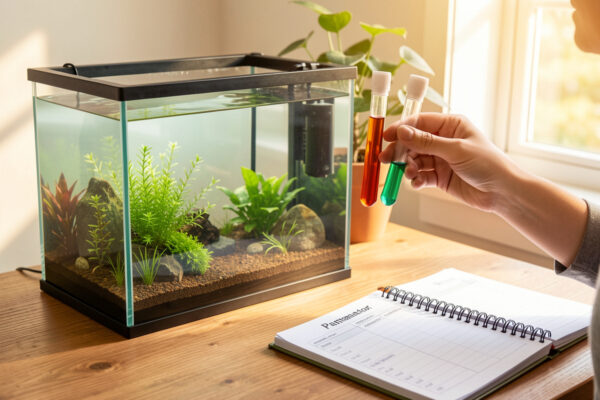
Because small water swings fast, you get less warning than a big-tank keeper does. That is why I log parameters: a rising nitrate trend across two weeks is the difference between a quiet adjustment and an emergency. I cover the full diagnostic list — chemistry signs, behavioural signs, and the algae that overstocking feeds — in the overstocking signs guide. If you are already seeing morning surface-gulping, treat it as a stocking problem first and a water-change problem second.
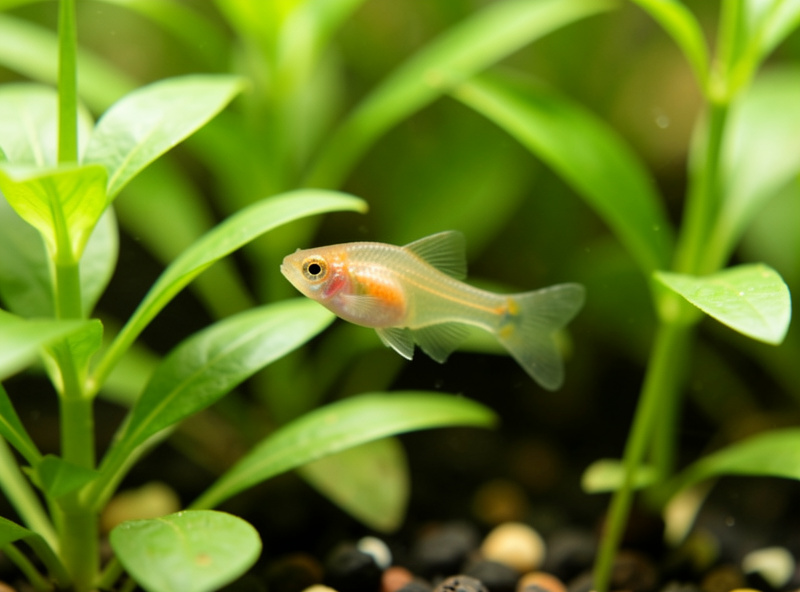
Overstocking also shows up as parameter instability that looks like other problems — pH that drifts, recurring algae, fish that never quite settle. Before you blame your light or your filter, count the bioload. More often than not, the tank is simply carrying more animal than the volume was ever going to support. A nano that is correctly stocked is a quiet tank, and quiet is the goal.
Choosing tankmates that fit small water
Nano tankmates have to clear three gates: adult size, temperament, and parameter overlap. A good nano community species stays under about 4 cm as an adult, is peaceful enough not to harass a small group, and shares the same temperature, KH and GH window as everything else in the tank. Miss any one gate — a fish that “stays small in the store” but grows, or a nippy species in tight quarters — and the stocking fails no matter how good the chemistry is.
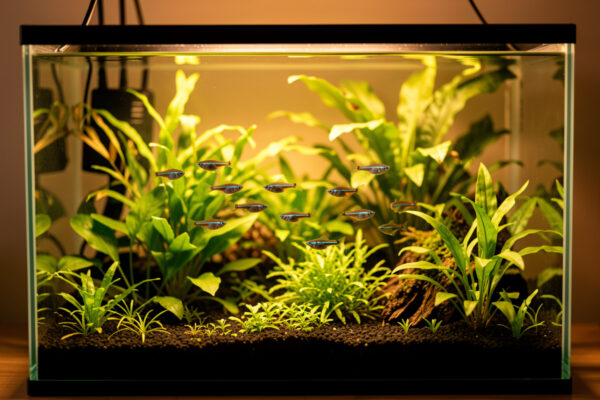
The species that genuinely belong in nanos are a short list: micro rasboras like chili and phoenix, ember tetras, celestial pearl danios, pygmy and dwarf corydoras in groups, Endlers, and the invertebrate crew — Neocaridina shrimp and nerite or ramshorn snails. The fish that get sold for nanos but do not belong — common plecos, goldfish, most barbs, anything that schools loosely and needs swimming length — are the recurring heartbreak. I lay out the working list and the parameter-overlap method in the compatible tankmates guide.
Shrimp deserve a special mention because they are the lowest-bioload, highest-reward nano livestock there is. A Neocaridina colony adds almost nothing to your waste load and does real cleanup work, which is why my reference tank pairs a small fish school with shrimp rather than a second fish species. If you are weighing shrimp-with-fish, read the honest risks of keeping shrimp with fish first — the shrimplets are the variable. The full colony care lives in the Neocaridina shrimp guide and the parameter targets in the shrimp water-parameter guide.
Adding livestock: the slow way is the only way
Stock a nano in stages, never all at once. Every fish you add is a step increase in bioload, and your biofilter needs days to grow more bacteria to match it — dump a full stock list into a freshly cycled nano and you can trigger a mini-cycle that spikes ammonia in the smallest, least forgiving volume you own. I add livestock in small groups with a week or more between additions, testing ammonia and nitrite after each.
The mechanics of getting an individual fish in safely — temperature matching, drip acclimation for parameter differences, and the lights-off settling period — matter more in a nano because the water the fish came from is rarely the water it is going into. A shrimp moved from a hard-water shop tank into a softer nano without slow acclimation can fail to molt correctly; the same drip discipline I use for moving shrimp applies to fish. The step-by-step is in my guide to introducing new fish, and the parameter side connects to the shrimp molting checklist if inverts are involved.
Staging your stock list also protects the cycle you worked to build. Add the lowest-bioload animals first — shrimp, snails — let the system settle, then add the fish school in one or two groups. By the time the tank is fully stocked, the biofilter has grown alongside the load instead of being asked to absorb all of it on day one.
Quarantine: an observation period, not a hospital
On a nano, quarantine is a husbandry tool: a separate small tank where new livestock settles and is observed under stable parameters before joining the colony you already keep alive. The point is not treatment — it is isolation and observation, giving a new fish time to eat, settle and acclimate to your water chemistry without exposing your established stock to whatever rode in with it. Anything that looks like illness is a vet or aquatic-specialist conversation, not a DIY one.
I keep a small spare tank for exactly this. New arrivals go in there first, on the same parameters as the display, and I watch them eat and behave for a couple of weeks before moving them across. It is the single most underrated stocking habit in the hobby, and it is pure husbandry — stable water, good food, careful observation. The full method, kept strictly to husbandry and observation, is in the nano quarantine guide. If a fish shows signs of disease, that is the point where you stop reading hobby blogs and talk to an aquatic vet.
Maintenance is what makes a stocking level sustainable
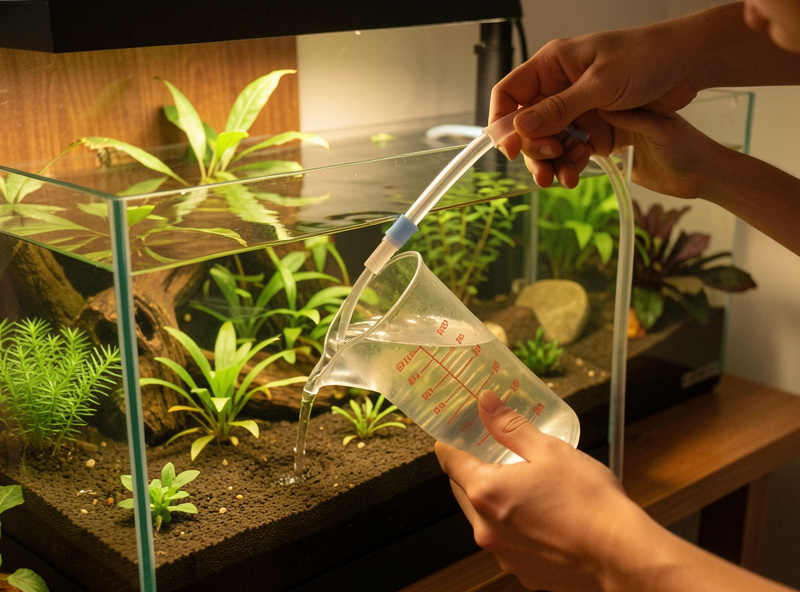
A stocking level is only “safe” relative to the maintenance behind it. The same fish count is sustainable with a matched weekly water change and impossible without one, because in a nano the water change is your nitrate reset and your trace-element top-up in one move. Stock to the maintenance you will actually do, not the maintenance you imagine doing.
My rule is small, often, and parameter-matched — the cadence I argue for in the nano water-change guide. Overstock and you are forced into larger, more disruptive changes that swing the parameters you were trying to protect. Under-stock and a modest weekly change keeps everything flat. Evaporation matters too: as water evaporates from a nano the dissolved load concentrates, so top-off discipline (covered in the evaporation and top-off guide) is part of holding a stocking level steady. A stable heater is the other quiet half of the equation — temperature swings raise metabolism and waste output, which is why I never cheap out, as I explain in the nano heater write-up.
For a planted nano, the plants are part of your stocking budget too. Heavy planting pulls nitrate and gives the system biological slack, which is one more reason my stocked tanks are also my most heavily planted ones — the setup logic is in the low-tech planted nano guide. Plants do not replace water changes, but they widen the margin a small volume gives you. The broader stability picture, including why nano water swings at all, is in the nano stability guide and the volume-math case that small tanks are harder.
A working stocking checklist
If you take one thing from this guide, make it the order. Stocking failures almost always come from running these steps out of sequence — buying the fish before the cycle, or trusting fish count instead of measured nitrate. This is the checklist I run before any animal joins one of my tanks.
- Confirm the cycle. Double-zero ammonia and nitrite, 24 hours after dosing. No exceptions in small water.
- Set the volume ceiling. Use the volume map above to cap your livestock at what the litres can carry, not what looks sparse.
- Budget by bioload, not length. One modest school plus inverts beats two species every time in a nano.
- Plant first, stock second. Heavy planting buys biological slack before the fish ever arrive.
- Stage the additions. Inverts first, then the fish school in one or two groups, a week or more apart, testing after each.
- Observe new arrivals separately. A two-week settling period protects the stock you already keep alive.
- Match the maintenance. A small, regular, parameter-matched water change is what keeps the whole stocking level honest.
None of these steps is glamorous, and none of them involves buying a gadget. That is the point: a correctly stocked nano is boring in the best possible way — flat numbers, calm fish, and a colony that quietly grows itself.
The one tool I would not stock a nano without
You cannot stock by eye. The whole framework above — cycle confirmed, bioload tracked, overstocking caught early — depends on actually measuring ammonia, nitrite and nitrate, and a liquid test kit is the cheapest insurance in the hobby. My parameter log is built on the same liquid kits and the same calibrated pens I used on my hydroponic reservoirs: test, do not guess, whatever is living in the water.
A basic liquid test kit covering ammonia, nitrite, nitrate, KH and GH is the one purchase I would make before a single fish. As an Amazon Associate I earn from qualifying purchases. You can find a standard freshwater aquarium liquid test kit for less than the cost of the fish you are about to add, and it will outlast every gadget you are tempted to buy in a panic later. Test strips drift and lie; the liquid kit is what my whole method runs on.
Frequently Asked Questions
How many fish can I keep in a 20 litre nano tank?
Plan for one small school of a single micro species, around six to eight fish under 3 cm adult size, plus a shrimp colony or snails. That is a conservative, sustainable load for 20 litres with weekly water changes. Two fish species or anything larger overstocks the volume.
Can I add all my fish at once when I stock a nano tank?
No. Add livestock in small groups with a week or more between additions, testing ammonia and nitrite after each. Your biofilter needs days to grow bacteria to match each increase in bioload, and a full stock list at once can spike ammonia in the small volume.
What is bioload and why does it matter more in a nano?
Bioload is the rate an animal adds waste (ammonia) to the water through respiration and feeding. It scales with mass and metabolism, not body length. Small volumes concentrate waste and cannot buffer spikes, so bioload, not fish count, is the real stocking limit in a nano.
How do I know if my nano tank is overstocked?
The earliest sign is nitrate climbing faster than your water changes reset it, sometimes with KH sagging. Later signs are fish gulping at the surface, especially in the morning, and recurring algae. Log your parameters so a rising trend is caught before it becomes an emergency.
Do I need to cycle a nano tank before stocking it?
Yes, always. A nano must pass the double-zero test, 0 ppm ammonia and 0 ppm nitrite 24 hours after dosing ammonia, before any livestock goes in. Small volumes give no margin, so stocking an uncycled nano means an ammonia burn risk to your fish.
What can I keep in a 10 litre nano tank?
A 10 litre nano is best as an invertebrate tank, a Neocaridina shrimp colony or snails, or a single betta with snails. It cannot sustainably carry a schooling fish group or bottom-dwelling loaches. Volume, not appearance, sets the limit.
Related Guides
- Stocking a 10 Litre Nano Tank: Realistic Options
- Stocking a 20 Litre Nano Tank: One School Done Right
- Fish Bioload in Nano Tanks: The Stocking Math
- Overstocking Signs in Nano Tanks
- Compatible Tankmates for Nano Tanks
- Introducing New Fish to a Nano Tank
- Quarantine for Nano Tanks: An Observation Guide