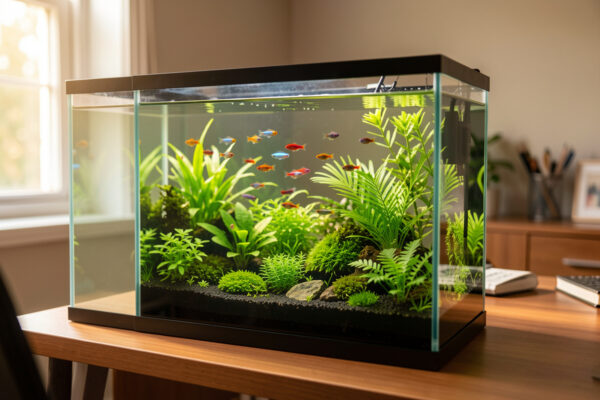
A 20 litre nano tank holds about 5 US gallons, and that is the volume where stocking finally gets interesting: it is the smallest tank that can sustainably hold one proper school of micro fish plus a shrimp colony. The winning formula is restraint — a single shoaling species of six to eight under 3 cm, plus inverts, and nothing else. This stocking 20 litre nano tank guide is built around doing one school well rather than two badly.
Twenty litres is where my own daily-reference tank lives: a planted low-tech setup that has run one micro-rasbora school and a Neocaridina colony for years. It is stable precisely because it is stocked the way I am about to describe — lightly, with one species, and heavily planted. The temptation at this size is to add a second school or a centrepiece fish. Resist it, and 20 litres rewards you with a tank that practically runs itself.
The one-school rule
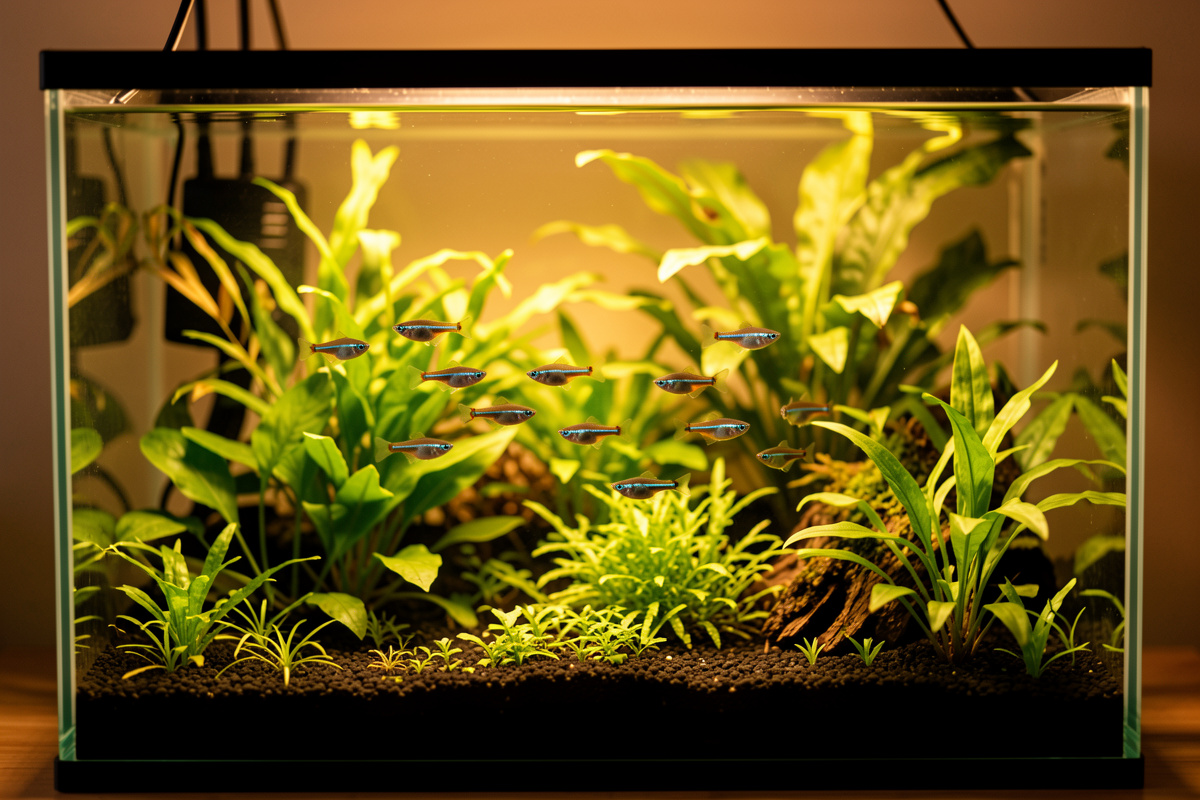
The core stocking rule for 20 litres is one shoaling species, kept as a group of six to eight, plus a shrimp colony or snails. A single species in a proper group looks better, behaves more naturally, and keeps the bioload inside what 5 gallons can clear with a weekly water change. Two species is the most common 20 litre overstocking mistake, and it is the one that turns a calm tank into a chemistry chase.
One species also schools properly. A group of eight chili rasboras moving together is a far better display than four chilis and four embers ignoring each other in a tank too small for either to feel secure. The bioload framework behind this is in the main stocking guide, and the per-animal waste math is in the bioload guide — both point to the same conclusion: in a nano, fewer species kept properly beats more species kept marginally.
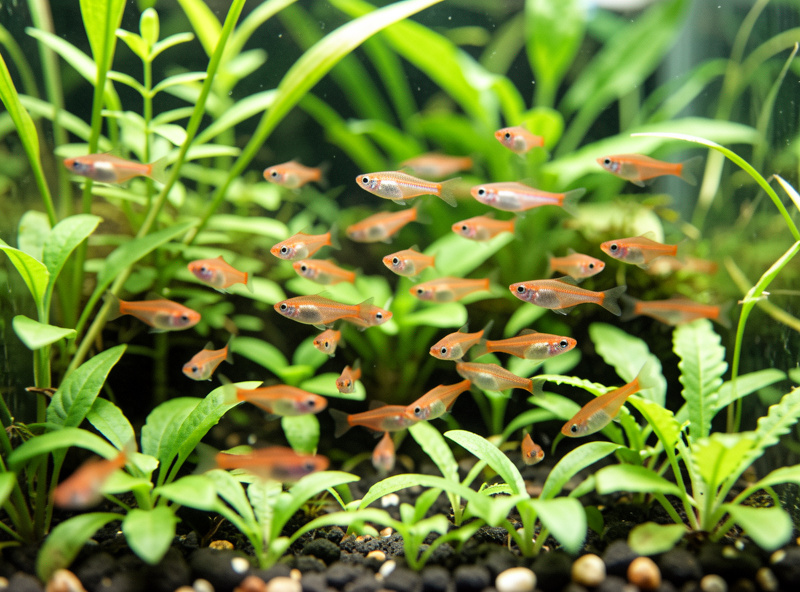
Species that suit a 20 litre school
The best 20 litre schooling fish are the true micro species: chili rasbora, phoenix rasbora, ember tetra, celestial pearl danio, and Endler guppies. All stay under about 3 cm, stay peaceful, and add a modest bioload that a planted 5 gallon can buffer. Pick one, keep a group of six to eight, and let that be the centrepiece rather than cramming in a second type.
Each has a slightly different temperament. Chili and phoenix rasboras are tiny and shy, best in a heavily planted tank where they gain confidence. Ember tetras are a touch bolder and show better in open mid-water. Celestial pearl danios are stunning but can squabble among males, so a group spreads the aggression. Endlers breed readily, which is its own bioload consideration over time. Whatever you choose, match it to your water — the parameter-overlap method is in the compatible tankmates guide.
| Species | Adult size | Group for 20 L | Note |
|---|---|---|---|
| Chili rasbora | ~2 cm | 8–10 | Shy, wants heavy planting |
| Ember tetra | ~2 cm | 8–10 | Bolder, shows in open water |
| Celestial pearl danio | ~2.5 cm | 6–8 | Males can squabble |
| Endler guppy | ~3 cm | 6 (skewed male) | Breeds; bioload grows |
| Pygmy corydoras | ~3 cm | 6–8 | Bottom group, gentle |
The other trap at this size is the “centrepiece” fish — a single larger, showier fish added on top of a school. In 20 litres there is rarely room for one. Most fish sold as nano centrepieces, like dwarf gouramis or small cichlids, either outgrow 5 gallons or bring a bioload and temperament the volume cannot absorb. If you want a single statement fish, build the whole tank around it the way the betta option below does, rather than bolting it onto a school.
The shrimp-and-school combination
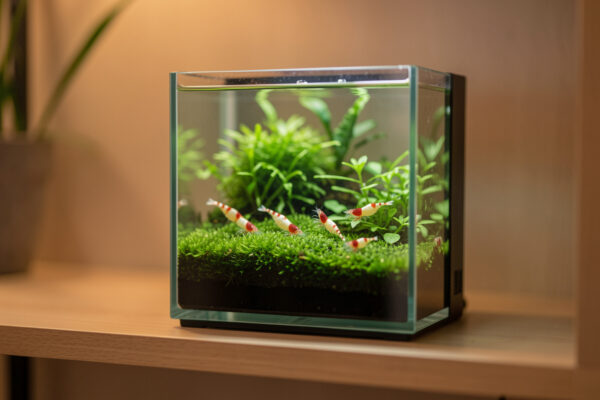
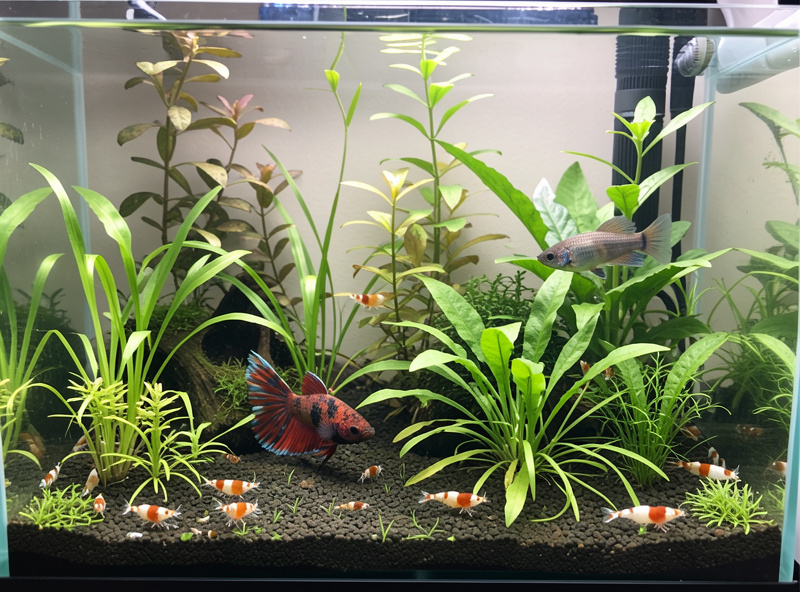
The reason a shrimp colony pairs so well with one fish school is that shrimp add almost no bioload while doing real cleanup. A Neocaridina colony in a 20 litre tank lives alongside a peaceful micro school without meaningfully changing the waste budget, which is exactly why my reference tank uses inverts as the “second species” instead of a second fish. It is the most stable way to get variety into 5 gallons.
The one honest caveat is shrimplets. Adult Neocaridina are too big for micro fish to bother, but newly hatched shrimp can become snacks, so a colony in a fish tank grows more slowly than a shrimp-only tank. If a booming colony is the goal, keep the shrimp separate; if you just want a stable mixed display, the school-plus-shrimp combination is hard to beat. The full risk picture is in my honest take on keeping shrimp with fish, and colony care is in the Neocaridina guide.
The betta-plus alternative
If a school is not your goal, a 20 litre tank also makes a roomy home for a single betta with a small invert crew and, optionally, a tiny peaceful dither group. Twenty litres gives a betta far more territory than the minimum, which often makes for a calmer, less fin-flaring fish. Keep flow gentle and planting dense so he has sightline breaks and resting spots.
Whether you add anything else to a betta tank depends entirely on the individual fish’s temperament — some tolerate a small shoal of fast dithers, many do not. Start with the betta and snails, observe for a few weeks, and only consider adding a group if he is settled. This is restraint again: a single happy betta beats a stressed betta sharing with fish he wants gone.
Cycle, stage, and maintain
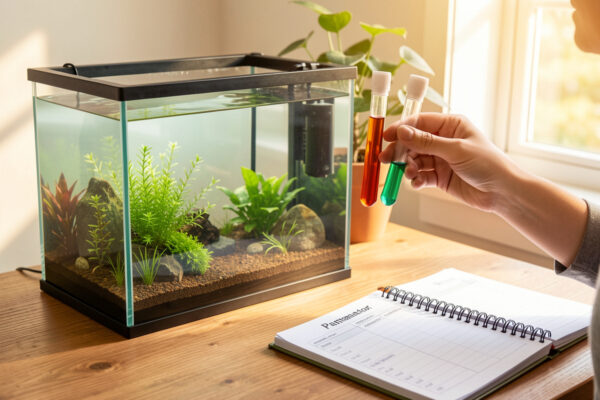
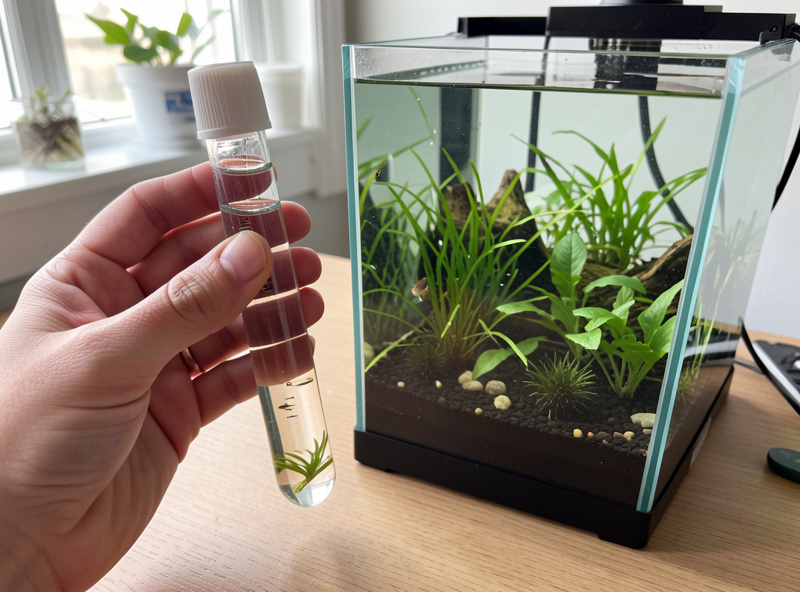
Twenty litres still demands a finished cycle and staged stocking. Confirm the biofilter with the double-zero test before any fish, then add livestock in waves — shrimp and snails first, then the fish school in one or two groups a week apart — so the bacteria grow alongside the load. Even at 5 gallons, dumping a full stock list in at once risks a mini-cycle ammonia spike.
Cycle it with a proper fishless cycle, and acclimate new arrivals slowly using the method in my introducing-fish guide. After that, the maintenance is simple: a small, regular, parameter-matched water change keeps nitrate flat and the school healthy. The cadence I use is in the water-change guide, and if you want to understand why even a well-stocked 20 litre still swings, that is in the parameter-swings write-up.
Frequently Asked Questions
How many fish can I keep in a 20 litre tank?
One shoaling species kept as a group of six to eight fish under 3 cm, plus a shrimp colony or snails. That single-school approach keeps the bioload inside what 5 gallons can clear with a weekly water change. Two fish species is the most common 20 litre overstocking mistake.
Can I keep two species of fish in a 20 litre nano tank?
It is better not to. Twenty litres holds one micro school properly, and a second species both raises the bioload and stops each group from schooling securely. Use a shrimp colony as your variety instead, since shrimp add almost no waste.
What are the best fish for a 20 litre planted tank?
True micro species: chili rasbora, ember tetra, celestial pearl danio, Endler guppies, or pygmy corydoras. All stay under about 3 cm and add a modest bioload a planted 20 litre can buffer. Keep one species as a group of six to eight.
Can shrimp live with fish in a 20 litre tank?
Yes. Adult Neocaridina shrimp are too large for peaceful micro fish to bother, so a colony lives happily alongside a small school. The trade-off is that newly hatched shrimplets can be eaten, so the colony grows more slowly than in a shrimp-only tank.
Is 20 litres enough for a betta?
It is generous. Twenty litres gives a single betta far more territory than the minimum, which often makes for a calmer fish. Keep flow gentle and planting dense, add a snail crew, and only consider other tankmates after observing his temperament for a few weeks.