An aquarium heater stuck on has welded its thermostat closed and is now heating continuously, with no off switch. On a nano tank the water can pass 90°F (32°C) within a few hours — lethal territory for tropical fish and shrimp. The only reliable early warning is an independent thermometer you actually look at every day.
This is the failure I fear most on small water, and I’ve watched it happen. Years of running four small tanks as logged experiments taught me that the heater is the one device that can go from silent to fatal faster than you can react — not because heaters are unreliable, but because 19 liters has almost no thermal buffer. A stuck heater on a 200-liter tank gives you a day. On a nano it gives you an afternoon.
So this walkthrough is built around time. First how to catch it early, then the emergency cooldown that won’t crack your glass, then why heaters stick and how to make sure the next one can’t take the whole tank with it. If your fish are at the surface right now and the glass feels warm, skip to the emergency section.
What Does It Mean When an Aquarium Heater Is Stuck On?
It means the thermostat contact inside the heater has fused shut, so the heating element runs whenever the heater has power, ignoring the temperature dial completely. The heater will keep pouring watts into the water past the set point, past the safe range, until you unplug it or the tank cooks. There is no self-correction.
Almost every aquarium heater works the same way: a bimetallic strip or a simple electronic thermostat opens a contact when the water reaches the set temperature, cutting power to the element. Over years of heating and cooling cycles, that contact can pit, arc, and eventually weld itself closed — the same failure mode that kills relays in any appliance. Once it’s welded, the indicator light stays lit permanently and the element never rests. On my spare-parts bench I’ve cracked open two dead heaters that failed this exact way; both had visibly burnt contacts. The dial becomes decoration. This is why I treat the number on a heater as a request, not a guarantee, and why I choose my heaters carefully in the first place — the reasons I never cheap out on this one component are in my guide to heater reliability on small tanks.
How Do You Know Your Heater Is Stuck On Before the Fish Do?
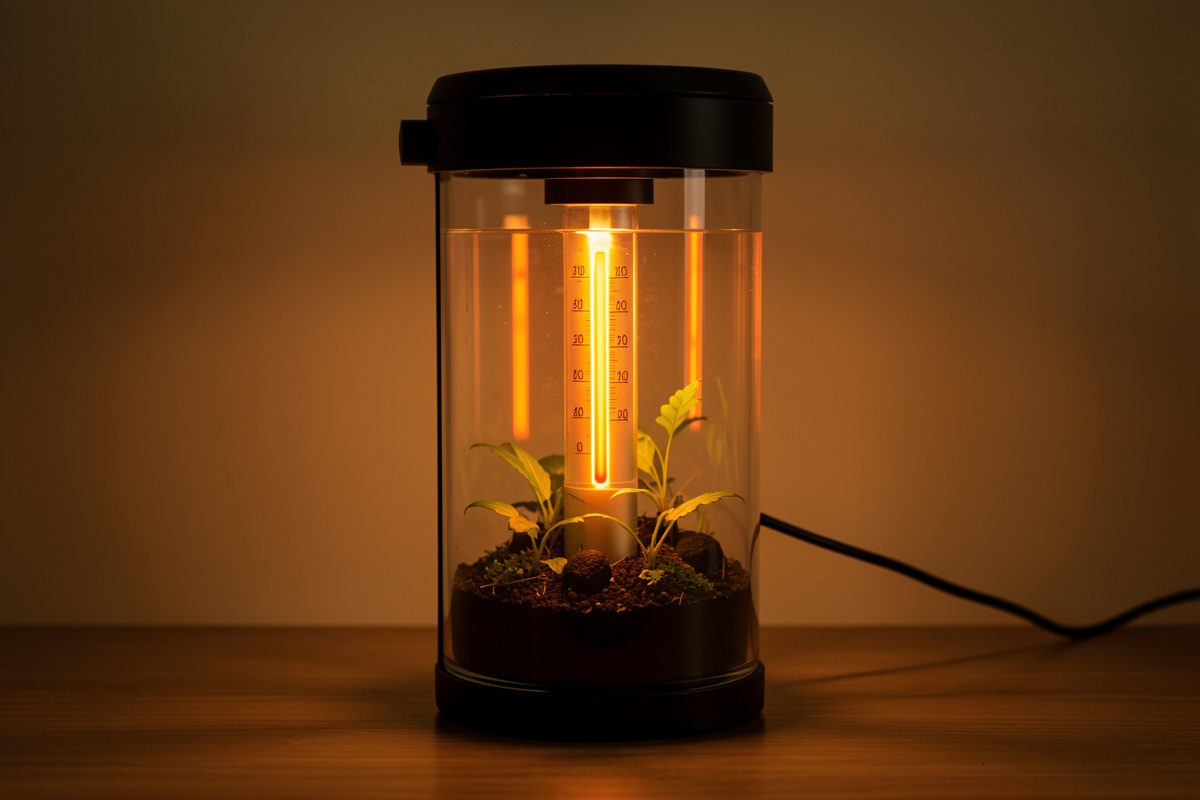
The earliest reliable signal is an independent thermometer reading above your set point — not the heater’s own light, which lies once the contact welds. Check a glass or digital thermometer daily, placed at the opposite end of the tank from the heater. A reading two or more degrees over target is your warning shot.
The fish will tell you too, but later and at a cost. As water warms, it holds less dissolved oxygen — a relationship the USGS water-science resources describe plainly: warmer water simply carries less O2. So the first behavioral sign of overheating is usually fish hanging near the surface, breathing hard, gasping at the film where oxygen is highest. Shrimp climb toward the top or, in my experience, pile into the coolest corner and stop moving. By the time you see that, you’re already deep into the danger zone. That’s the whole argument for the daily thermometer glance: it’s a five-second habit that catches the failure hours before the livestock does. I keep a cheap alcohol thermometer stuck to the far glass of every tank precisely so I never have to learn about a stuck heater from a dying shrimp. The dial glows on a healthy heater during a heating cycle; a dial-light that never goes dark is the tell.
What’s the Emergency Response When the Tank Is Overheating?
Unplug the heater first — that stops the input immediately. Then cool the water gradually: float a sealed bag of ice, aim a fan across the surface, and do a partial water change with slightly cooler (not cold) water. Never dump ice straight in or pour cold water fast; a rapid swing can shock or kill livestock as surely as the heat.
Here is the order I follow, and I keep it taped inside the stand door. One: pull the heater plug. Two: get oxygen and surface movement going — a fan blowing across the top drives evaporative cooling and gas exchange at once. Three: float a zip bag of ice cubes, which cools without diluting or shocking, and swap it as it melts. Four: begin a partial water change with water a few degrees below tank temperature, going slowly — I aim to bring a nano down no faster than about 1°F every five to ten minutes. The goal is a controlled descent back to the mid-70s°F, not a plunge. A crash from 92°F to 74°F in ten minutes will do its own damage. If you’re not practiced at emergency water changes on small tanks, my method for doing them safely is in water change cadence for nano tanks. Move deliberately. Panic is what turns a hot tank into a dead one.

Why Do Aquarium Heaters Stick On in the First Place?
Mechanical thermostats wear out. Each time the contact opens and closes it arcs slightly, and over thousands of cycles the metal pits and can weld shut. Cheap heaters with crude bimetal thermostats fail this way soonest; heat, mineral scale, and age all accelerate it. It is a wear-out failure, which means it is predictable and preventable.
The economics of the hobby work against you here. A no-name nano heater sells for the price of a coffee, and its thermostat is the simplest, cheapest component that will function — until it doesn’t. Reputable makers such as Eheim build more robust thermostats and publish honest wattage guidance, which is part of why they cost more and last longer. But any mechanical thermostat is a wear item. Mineral buildup on the element makes it run hotter for longer to hit the set point, which stresses the contact further; hard water tanks see this sooner. The lesson from my parameter log is blunt: heaters are consumables. I retire mine on a schedule rather than waiting for the failure, because a heater that owes me nothing is a heater that hasn’t killed anything yet.
How Do You Prevent a Stuck Heater From Cooking the Tank?
Three layers: undersize the heater so a stuck element heats slowly, add an independent thermostat controller as a hard cutoff, and keep a daily thermometer habit. Any one of them buys you detection time; together they make a stuck heater a non-event rather than a massacre.
Undersizing is my favorite because it’s free. A heater sized at roughly 3 to 5 watts per liter of tank is plenty in a normally heated room, and crucially, when it sticks on it heats the water slowly enough to give you a real detection window — hours, not minutes. An oversized 100-watt heater in a 19-liter nano is a bomb; a 25-watt heater in the same tank stuck on is a slow, catchable drift. The second layer is a separate inline thermostat controller with its own probe: you set it a couple of degrees above your target, and if the heater runs away, the controller cuts mains power to it regardless of what the heater’s own thermostat is doing. It’s the single best upgrade for anyone keeping sensitive livestock. This all rests on the broader truth that small volumes swing fast — the physics I lay out in why small water is the advanced class. If you want to add that controller layer, a quick search for an aquarium heater controller shows the plug-in models with an external probe worth owning.
As an Amazon Associate I earn from qualifying purchases.
Heater Stuck On vs Failed Off: Which Is Worse?
Stuck on is far more dangerous. A heater that fails off lets the tank drift toward room temperature over twelve to twenty-four hours — slow, survivable for most fish, and easily caught by the same daily thermometer check. A stuck-on heater can reach lethal temperatures in an afternoon. Both need the thermometer; only one is an emergency.
I’ve had both happen. The failed-off heater on my low-tech nano one winter dropped the tank to about 66°F over a night, and the shrimp barely noticed — Neocaridina tolerate cool water fine, and a slow drift down is within the range most tropicals shrug off for a day. Whether your fish even need the heater running that hard is worth questioning; I dig into that for one common case in do bettas need a heater. The stuck-on failure, by contrast, is the one that empties tanks. If you only defend against one, defend against heat. Keep a spare heater on the shelf for the failed-off case, keep a controller and an undersized heater against the stuck-on case, and glance at that thermometer every single day. The same afternoon-fast oxygen math shows up the moment a filter stops working, and heat turns into the enemy in reverse during a power outage on a nano tank — same failure map, same clock. That habit alone would prevent most heater deaths I’ve heard about.
How hot can a stuck aquarium heater make a nano tank?
On a small tank of around 19 liters, a stuck heater can push the water past 90 degrees Fahrenheit within a few hours, and higher if left overnight. That is lethal for tropical fish and Neocaridina shrimp. The small water volume is what makes it so fast, because there is little thermal mass to absorb the heat.
What should I do first if my aquarium is overheating?
Unplug the heater immediately to stop the heat input. Then cool the water gradually with a floating bag of ice, a fan across the surface, and a slow partial water change using slightly cooler water. Never add ice directly or pour in cold water fast, because a rapid temperature swing can kill livestock as surely as the heat.
Why did my heater indicator light stay on?
On a healthy heater the light glows only during a heating cycle and goes dark once the water reaches the set point. A light that never turns off usually means the thermostat contact has welded closed and the element is running continuously. Verify with an independent thermometer and unplug the heater if the temperature is above target.
Can I prevent an aquarium heater from sticking on?
You cannot make a mechanical thermostat immortal, but you can make its failure survivable. Undersize the heater so a stuck element heats slowly, add a separate inline thermostat controller as a hard cutoff, and check an independent thermometer daily. Together these turn a stuck heater into a catchable event rather than a disaster.