Lighting a nano planted tank decides whether you grow plants or algae. Match intensity and photoperiod to your plants and you win; over-light a 20-litre box and algae takes over in under two weeks. In small water, light is a dose, not a decoration.
I run my tanks the way I ran hydroponic reservoirs for years — test, do not guess, change one variable at a time. Light is the variable most keepers get wrong because the industry sells brightness as a feature. This guide is the whole system: how to choose a light, what PAR and PUR actually mean for a small tank, how long to run it, what plants survive on little, and how to read algae as the feedback signal it is. Every section links to a deeper guide so you can go as far down the rabbit hole as you want.
The One Thing That Matters: Light Is a Dose
Light drives photosynthesis, and photosynthesis drives the demand for everything else — CO2, nutrients, and the bacterial balance that keeps a tank stable. Push more light than your plants can use and the surplus energy feeds algae instead. In a nano tank that tipping point arrives fast because the volume is tiny and there is no buffer.
This is the same lesson the volume math of small tanks teaches everywhere: less water means faster swings. A 60-watt-equivalent light over 20 litres is a very different dose than the same fixture over 200 litres. I think in terms of light reaching the substrate, the photoperiod hours, and what the plants are telling me back — pearling and tight growth, or diatoms and stringy hair. The fixture wattage on the box is almost meaningless on its own.
How to Choose a Nano Light Without Overspending
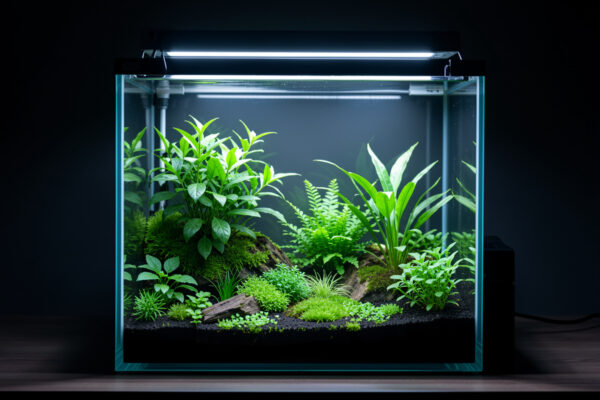
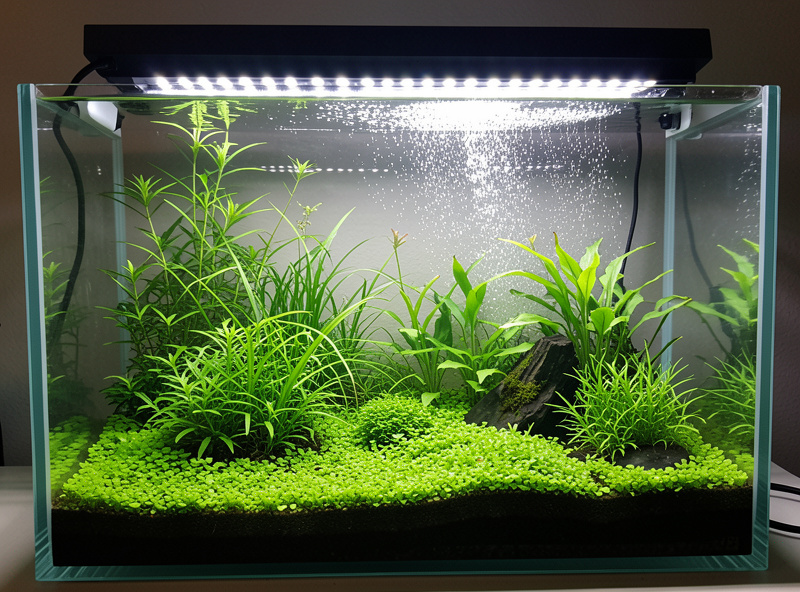
Choose your light to match your plant ambition, not your tank’s good looks under the showroom lights. Low-tech epiphytes and mosses need a modest light; a high-tech carpet under pressurised CO2 needs a strong, tunable fixture. Buying a high-PAR light for low-tech plants is the most common way beginners create an algae farm.
On my low-tech ~20-litre reference tank I run a modest LED and have kept it stable for years with Anubias, Bucephalandra, Java fern and a Neocaridina colony. On my high-tech ~60-litre rimless I run a strong, dimmable fixture over pressurised CO2 because the carpet demands it. Two tanks, two completely different light budgets. The full breakdown of which fixture suits which plant ambition lives in my best LED light for a nano planted tank guide, and if money is tight, the budget nano lighting guide shows where cheaping out is fine and where it is not.
The fixture tiers, honestly
There are three practical tiers for a nano. Budget LEDs (think NICREW ClassicLED, Hygger, AQUANEAT) grow low-tech plants and cost very little. Mid-tier fixtures (Fluval Plant 3.0 Nano, NICREW SkyLED, Finnex) add colour tuning and more output for medium plants. High-tech bars (Chihiros WRGB II, Twinstar, Week Aqua) deliver the PAR and spectrum a CO2 carpet needs — and the price to match.
| Light tier | Typical street price | Output class (PAR at substrate) | Plants it supports | CO2 needed? | Algae risk if mismatched |
|---|---|---|---|---|---|
| Budget LED (NICREW ClassicLED, Hygger) | $20–40 | Low | Anubias, Java fern, mosses, low-tech stems | No | Low |
| Mid-tier tunable (Fluval Plant 3.0 Nano, NICREW SkyLED) | $60–100 | Medium | Most stems, easier carpets, crypts | Optional / helpful | Medium |
| High-tech bar (Chihiros WRGB II, Twinstar, Week Aqua) | $120–250 | High | Demanding carpets, red stems, dense scapes | Yes (pressurised) | High without CO2 |
| Single small spotlight / clip lamp | $15–30 | Very low / uneven | Floating plants, a single Anubias | No | Low but patchy growth |
Notice the pattern: more light is not better, it is more demanding. A high-tech bar on a tank without CO2 and dosing is the classic algae machine. Match the tier to the plants you actually intend to keep, which brings us to the plants themselves.
Match the Plants to the Light, Not the Other Way Around
The cheapest, most reliable path to a green nano is choosing plants that thrive on the light you can afford. Low-light plants — Anubias, Java fern, Bucephalandra, mosses, many crypts — grow slowly and forgive a modest fixture, which is why they anchor almost every stable low-tech tank I have run.
If you want a carpet or red stems you are signing up for a higher light tier plus CO2 and ferts, and the honest failure rates climb. I keep a running record of which carpets survive without CO2 in my carpet plant failure rates piece, and the broader survivor list lives in low light plants for a nano tank and low-tech aquarium plants that actually survive. For shaded, light-hungry tanks, floating plants double as both a feature and a natural light diffuser. The whole low-tech planted approach — substrate, plants, ferts — is in my low-tech planted nano guide.
PAR vs PUR: What the Numbers Actually Mean
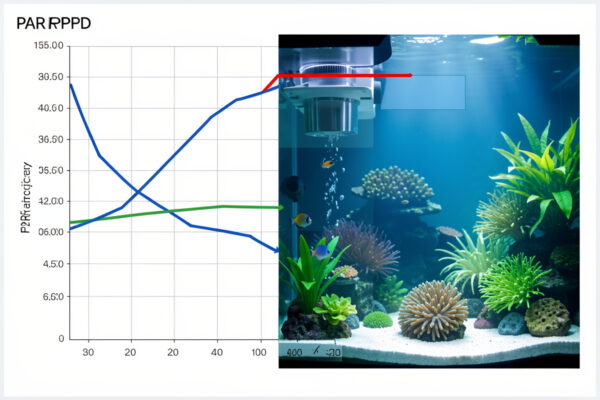
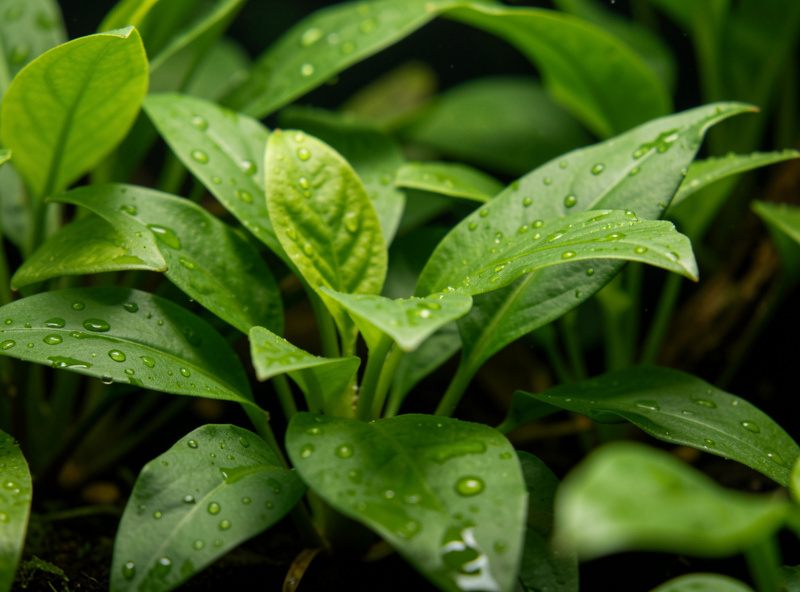
PAR (Photosynthetically Active Radiation) measures how much usable light energy reaches your plants; PUR (Photosynthetically Usable Radiation) is the slice of that light your plants can actually absorb. A fixture can post a big PAR number while wasting much of it on wavelengths plants barely use — which is why two lights with the same PAR can grow very differently.
For a nano keeper this matters because spectrum, not just raw brightness, decides growth and how much you stoke algae. A full-spectrum fixture with strong red and blue (good PUR) grows plants efficiently at lower intensity, so you can run less total light and starve algae. I do not own a $300 PAR meter, and most readers should not buy one either — I read light the budget way, by plant response and algae onset, the same practical approach Aquarium Co-Op favours over chasing headline PAR numbers. The full explainer, with how to read a manufacturer’s PAR chart honestly, is in PAR vs PUR in nano tank lighting.
Photoperiod: How Long to Run the Light
Most planted nano tanks do best on a 6 to 8 hour photoperiod, not the 10 to 12 hours people leave the light on to enjoy the tank. Plants do not need more hours; algae loves them. Shortening the photoperiod is the fastest, free lever you have to fight an algae outbreak in a small tank.
When I set up a new scape I start conservative — often six hours — and only lengthen it once the tank is mature and algae-free. After I moved one tank’s light schedule from nine hours down to six, the diatom film on the glass cleared within a fortnight without touching anything else. That is the parameter-log method applied to light: change one thing, watch, log the result. The full reasoning on hours, and why a midday “siesta” split is overrated for most nanos, is in light duration for nano tank plants.
Dimmers and Timers: Automate the Dose
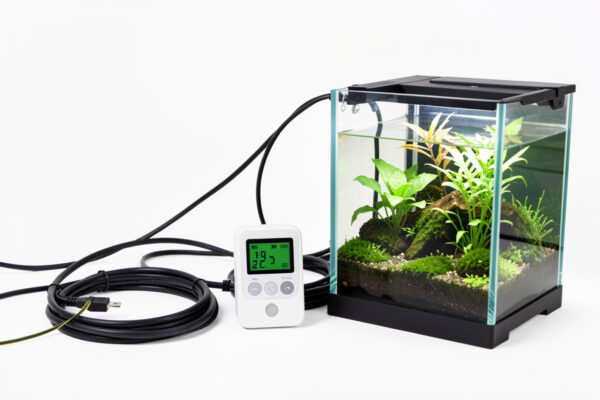
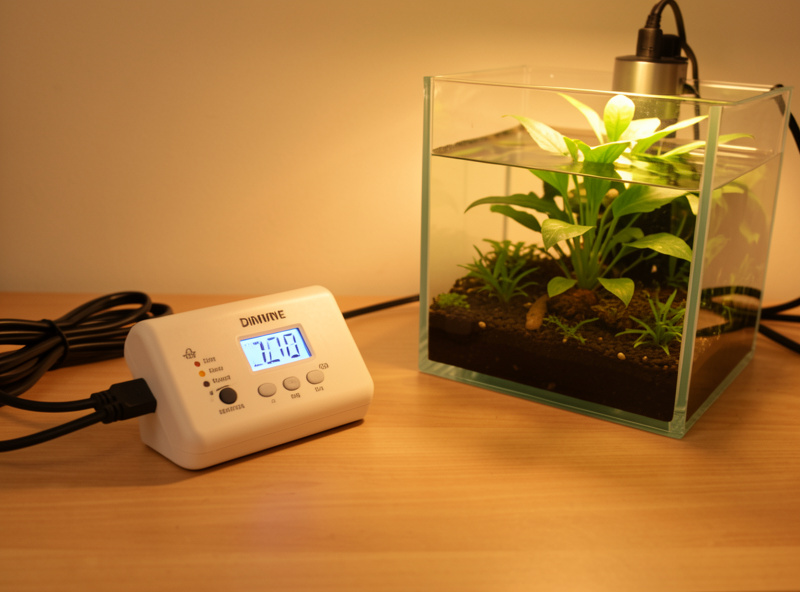
A timer is non-negotiable and a dimmer is the upgrade that quietly solves most algae problems. Consistency is what plants want — the same hours, the same intensity, every day — and a cheap mechanical or smart timer delivers that better than any human ever will. A dimmable light lets you turn intensity down instead of choosing between blinding and off.
On my high-tech tank the dimmer is how I ramp intensity up gradually as the scape matures, and how I dial it back the instant algae appears — without uprooting plants or rescaping. If your fixture has a controller, use the ramp feature; if it does not, a plug-in timer is a few dollars well spent. The exact schedules I run, ramp curves, and timer picks are in my dimmer and schedule guide for nano lighting.
Algae Is the Feedback Signal, Not the Enemy
Algae in a nano tank is almost never a mystery — it is the tank telling you the balance between light, CO2 and nutrients is off, and in small water the most common culprit is too much light — the imbalance the 2Hr Aquarist algae library traces case by case. Diatoms (brown dust) on a new tank are normal and pass; green spot, green dust, hair and the dreaded blackbeard usually trace back to light intensity or duration outrunning the plants.
Before you buy a bottle of algae killer, look at the dose. Cutting the photoperiod and dimming the light fixes more nano algae than any product, because it removes the energy driving it. The lighting-specific diagnosis — which algae means “too much light” and exactly what to change — is in algae from too much light in a nano. Light is only one input, though; nutrients and CO2 matter too, and getting the broader balance right depends on a stable, fully cycled tank, which is why I always point new keepers to the nitrogen cycle guide and the nano stability guide first.
Spectrum and Colour: White Light Is Not One Thing
The “white” light over your tank is a blend of red, green and blue diodes, and the mix changes both how plants grow and how the tank looks to you. A cool, blue-heavy light reads bright to the eye but can favour algae; a warmer light with strong red brings out plant colour and reds, while green light is mostly there to make the scape look natural to us. Tuneable fixtures let you set this blend; cheap fixtures fix it for you.
I keep my high-tech tank on a balanced full-spectrum setting that leans slightly warm, because that is where my plants colour up and the water looks like a window rather than a fish-shop display. A trap worth naming: the “RGB max” or “shimmer” presets on premium controllers crank intensity and blue to look spectacular in a video, and they are an algae invitation if you run them all day. Set the spectrum for the plants, not for the phone camera. This is really the practical face of the PAR vs PUR discussion — spectrum is how PUR shows up in daily life.
Coverage and Mounting: Spread Matters in a Small Footprint
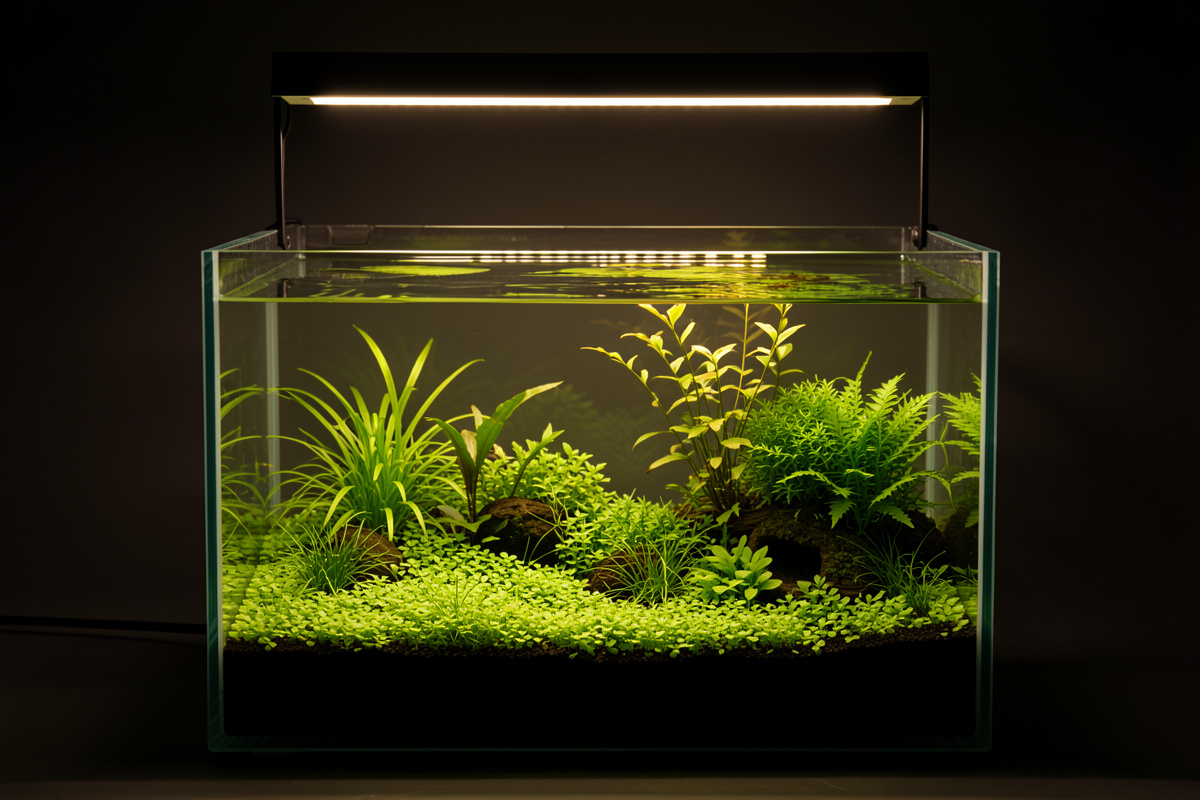
A nano’s small footprint makes light spread surprisingly tricky — a single spotlight throws a bright cone in the middle and leaves the corners dim, so plants grow unevenly and algae colonises the shaded glass. A bar-style light that spans the tank’s length gives even coverage; a clip spotlight suits a shallow bowl or a single specimen plant but not a planted rectangle.
Mounting height is the quiet adjustment nobody mentions. Raising a fixture on legs a few centimetres above an open-top rimless tank lowers the intensity at the substrate and widens the spread — effectively a free dimmer for an over-bright light. On my rimless 60-litre I have used height to tame intensity before I ever touched the controller. If your light sits directly on a lid, you are at maximum dose whether you want it or not, which is one more reason a dimmable open-top setup gives you control a fixed lid never will. Coverage also interacts with floating plants, which shade whatever grows beneath them — useful for low-light species, a problem for a carpet.
Light and Livestock: Bright Tanks Are for Plants, Not Animals
Fish and shrimp do not need bright light, and many actively prefer it dim. Strong lighting exists to grow plants; the animals tolerate it, and some skittish species are stressed by a sudden blaze with no shade. This is why a planted tank with cover, shadow and floating plants is kinder than an empty brightly-lit box.
On my Neocaridina shrimp tank the colony is most active and visibly grazing under moderate light with plenty of moss and plant cover to retreat into; a bare, over-lit tank makes shrimp hide and colours wash out. If you keep livestock, give them shade and never run a harsh light over a sparse scape. The husbandry that actually keeps animals healthy — stable parameters, a finished cycle, the right water values — sits alongside lighting, not under it; my cherry shrimp guide and the stability guide cover that side.
The Nano Lighting Mistakes I See Most Often
The same handful of mistakes account for the majority of “why is my nano full of algae” messages, and almost all of them come back to treating light as decoration rather than a dose. Naming them is the fastest way to skip the painful learning curve.
First: buying the brightest light “to be safe” and running a low-tech tank into an algae bloom. Second: leaving the light on 10 to 12 hours because the tank looks nice in the evening — covered in the duration guide. Third: no timer, so the photoperiod drifts day to day and the tank never settles. Fourth: chasing a high-tech carpet under a strong light with no CO2 and no dosing, then blaming the plant — the carpet failure rates piece is blunt about this. Fifth: reaching for an algaecide bottle instead of pulling the dose back, which is why the too-much-light algae guide exists. Every one of these is fixable for free by changing the light, not the wallet.
Putting the Lighting System Together
Here is the whole thing in order. Decide your plant ambition first. Buy the light tier that matches it — budget LED for low-tech, high-PAR bar only if you are committing to CO2. Put it on a timer at six to eight hours. Start low and short, then increase slowly. Watch the plants and the glass, and treat any algae as a signal to pull the dose back, not as a reason to dose chemicals.
Run that way and a nano becomes the most rewarding lit object in the house — especially through a dark Swedish winter. Keep the rest of the husbandry tight too: matched water change cadence, a stable cycle, and if you keep livestock, the right shrimp parameters. Light is powerful precisely because it is connected to everything else in the box.
Frequently Asked Questions
How many hours should I leave a nano tank light on?
Most planted nano tanks do best on a 6 to 8 hour photoperiod. Longer hours feed algae without helping plants. Start at six hours on a new tank and only lengthen once it is mature and algae-free.
Do I need an expensive high-PAR light for a nano planted tank?
Only if you plan to grow demanding carpets or red stems with pressurised CO2. Low-tech plants like Anubias, Java fern and mosses thrive under a budget LED, and a high-PAR light over a low-tech tank usually just grows algae.
What is the difference between PAR and PUR?
PAR is the total usable light energy reaching your plants; PUR is the portion of that light plants can actually absorb. A full-spectrum light with good PUR grows plants efficiently at lower intensity, letting you run less light and starve algae.
Why is my nano tank getting algae after I added a brighter light?
Because light is a dose and you increased it past what your plants can use. The surplus energy feeds algae. Dim the light or shorten the photoperiod first; in small water this fixes most algae before any chemical treatment.
Do I need a timer for a nano aquarium light?
Yes. Plants want the same hours every day, and a cheap timer delivers that consistency far better than manual switching. A dimmable light plus timer is the single best setup for preventing algae in a small tank.
Can low-light plants survive in a nano tank without CO2?
Yes. Anubias, Bucephalandra, Java fern, mosses and many crypts grow slowly and reliably under a modest light with no CO2. They anchor almost every stable low-tech nano and forgive beginner mistakes.