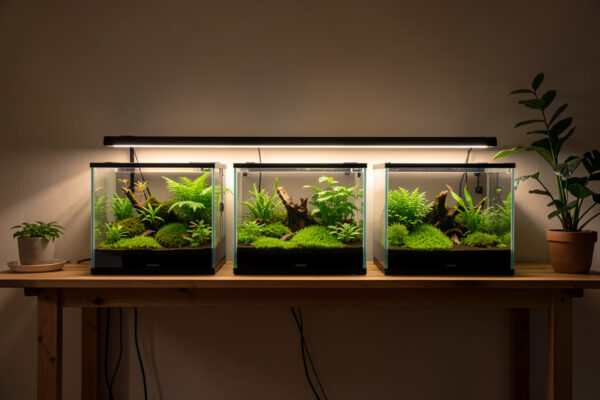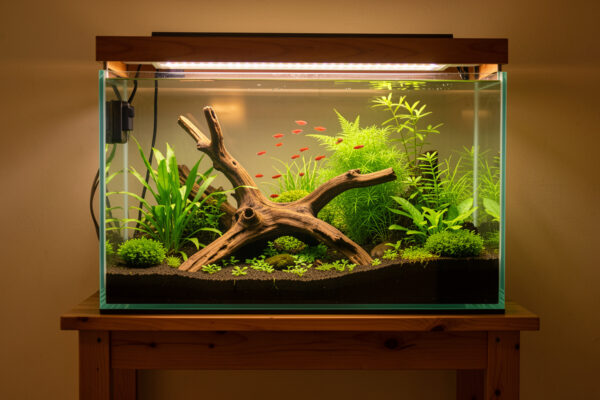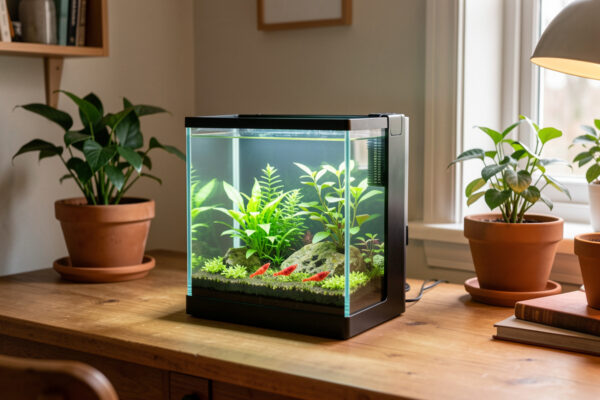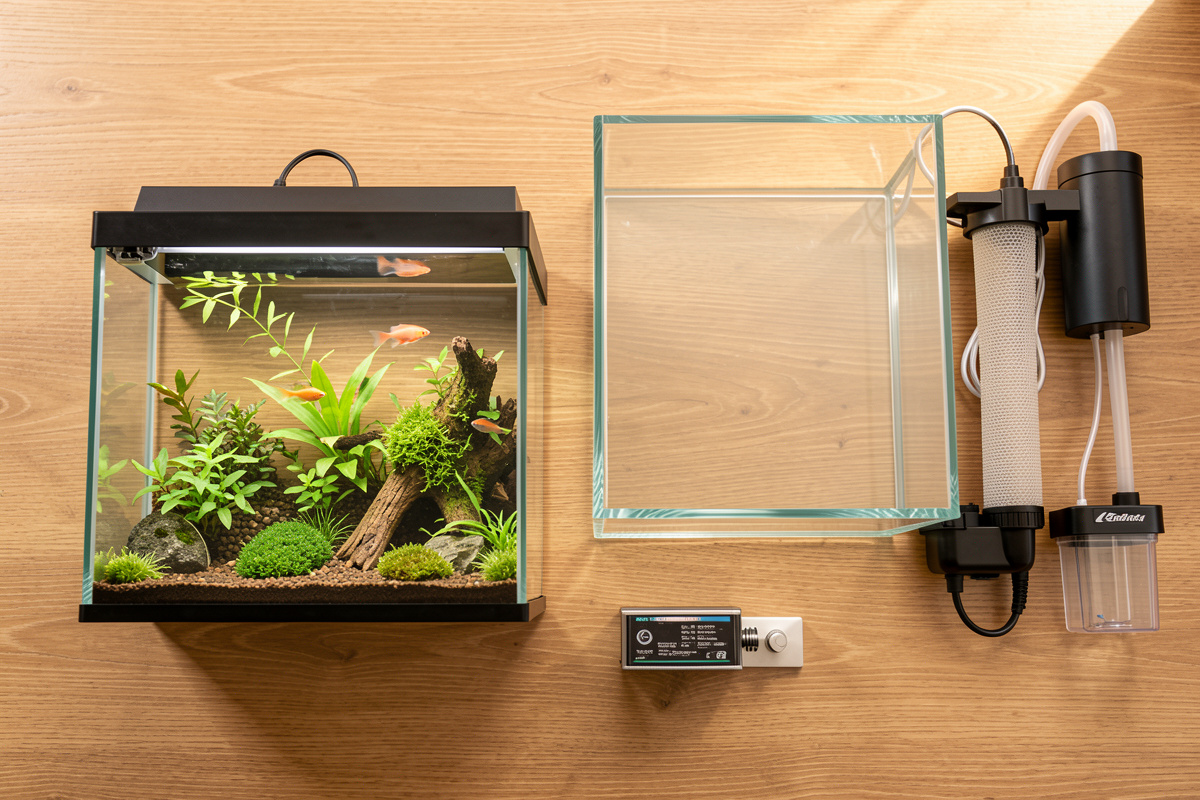
Buy an all-in-one nano tank if you want a tidy, forgiving setup and you are happy to pay roughly 30 to 50 percent more for the integration; buy separate components if you have a specific plan or you want to control every part. An all-in-one hides the filter, heater, and pump in a rear chamber. Separate parts cost less and repair cheaper, but they sprawl across the tank and demand more decisions from you. Neither is “better” — they solve different problems.
I run both approaches on my rack. My daily low-tech reference is an all-in-one that has been stable for years, and my shrimp tank is a bare box with nothing but an air-driven sponge filter. The choice comes down to three questions: how much does clean-looking matter, how handy are you, and what exactly is going to live in there. Get those answers straight and the decision makes itself.
What Does an All-in-One Actually Bundle?
An all-in-one aquarium integrates the life support into the tank itself, almost always as a rear or corner chamber that hides the filter media, the return pump, and often the heater. You fill the display, water flows over a weir into the chamber, through the media, and gets pumped back. The Fluval Spec and Flex I compare in Fluval Spec vs Flex are the archetypes — same idea, two sizes. If your “separate” plan is really an open aquascape, that is its own decision I split out in rimless tank vs an all-in-one kit.
What it bundles that matters: a filter you never see, a factory-matched light, and usually a lid. What it does not always bundle: a heater. Read the box. If your all-in-one ships without one and you keep anything tropical — which is almost everything in the hobby — that heater is a separate, non-negotiable purchase, and it is the one component I never buy on price alone, for reasons in heater reliability on small tanks.
The Real Cost Difference, Line by Line
The sticker gap looks bigger than the real gap, because a bare tank is not a working tank. Once you add the filter, light, and heater a bare tank needs, the separate route closes most of the distance — you just get more control and cheaper repairs for your money. Here is roughly how a 10-gallon build pencils out both ways in 2026 street prices — the finished-kit side of that same size sits in the best 10-gallon nano roundup.
| Item | All-in-one kit | Separate components |
|---|---|---|
| Tank | Included | $25 to $40 bare glass |
| Filter | Included (rear chamber) | $15 to $30 sponge or HOB |
| Light | Included (factory strip) | $25 to $60 clip or bar LED |
| Heater | Sometimes included | $15 to $25 nano heater |
| Lid | Usually included | $10 to $20 glass or mesh |
| Typical all-in total | $110 to $160 | $90 to $175 |
Notice the totals nearly overlap. The all-in-one is not wildly more expensive once the bare tank is fully equipped; what you pay the premium for is tidiness and a single, matched design. What the separate route buys you is the freedom to pick a genuinely good light instead of a factory strip, and the ability to replace a $4 sponge instead of a $6 proprietary cartridge forever.

When the All-in-One Is the Right Call
Choose the all-in-one when the tank sits somewhere people see it and you value calm over control — a living room, an office, a bedroom shelf. The hidden equipment is the whole point: fewer cables, no hang-on-back box breaking the sightline, and a stock light that at least works out of the box. For a first-timer especially, the integration removes decisions, and fewer decisions in week one means fewer panic changes in week three.
It is also the honest pick if you are not the tinkering type. My all-in-one reference tank asks almost nothing of me between water changes — the routine is the small, matched weekly change I describe in water change cadence for nano tanks, and an auto top-off handles evaporation so the parameters stay put. That “set a rhythm and leave it alone” quality is exactly what a good all-in-one delivers, and it is the backbone of the stability argument in why small water is the advanced class.
When Separate Components Win
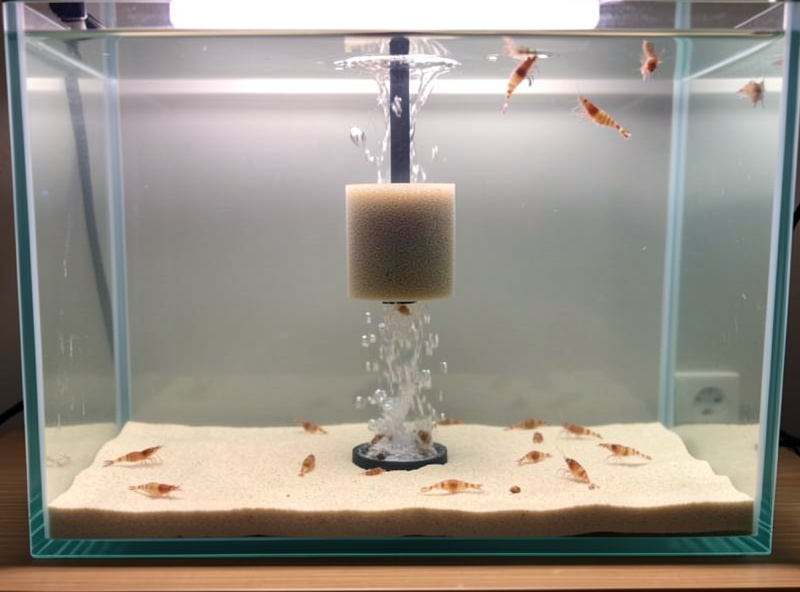
Go separate when you have a specific plan the kit can’t serve. A dedicated shrimp tank is the clearest case: a Neocaridina colony wants a gentle, enormous-surface-area sponge filter and nothing that can shred a shrimplet, so I run my colony on a bare bottom with a single air-driven sponge — the setup behind the Neocaridina care guide. No rear chamber to childproof, no pump to sponge over. Just clean, slow, biologically massive filtration.
Separate also wins for planted tanks where the stock light won’t cut it. Factory strips grow low-light epiphytes and little else; if you want stems or a carpet you are buying a real light anyway, so start there — the best LED light for a nano planted tank lays out the options. And it wins for anyone who likes to repair rather than replace: a separate heater, filter, and light each fail independently and each costs a few dollars to swap, instead of a proprietary part you hunt for online.
The Hidden Cost I Learned the Expensive Way
The trap in every all-in-one is the proprietary cartridge, and I fed that machine for a year before I did the math. The factory design wants you to slot in a branded foam-and-carbon cartridge every month. Each swap throws away an established bacteria colony and resets a slice of your filtration — I watched my nitrate creep and my tank get twitchy every time I “maintained” it that way. The smell still reminds me: the faintly swampy rinse water when I finally pulled the cartridge and found it was doing nothing the media below it wasn’t already doing better.
The fix costs almost nothing. I gutted the chamber, packed it with a coarse sponge for mechanical work and a good biomedia for the bacteria that actually run the nitrogen cycle — the colony DrTim’s Aquatics documents you establish by dosing ammonia to a 2 to 3 ppm target, then guard by never resetting it. The tank steadied within two weeks. That media has lasted years with only the occasional rinse in old tank water — never tap, which would kill the colony. A branded cartridge every month is roughly $70 a year; a sponge you rinse is a few dollars a year. Multiply that across the life of a tank and the “cheaper” all-in-one has quietly become the expensive one. Whichever tank you buy, own your media.
The Upgrade Path: Which One Grows With You?
Think about where the tank is going, not just where it starts. This is the argument people forget, and it is often the deciding one. An all-in-one is a finished system: its chamber size, its pump, and its light are what they are. If you fall in love with the hobby and want to go from low-tech to a pressurized planted showpiece, you will be fighting the fixed chamber the whole way — there is rarely room to hide a CO2 reactor or upgrade the return flow meaningfully.
Separate components grow with you a piece at a time. Want more light for stems? Swap the light. Ready for CO2? Add a diffuser and a bigger filter for the extra circulation, exactly the progression in the high-tech nano CO2 guide. Decide the shrimp colony needs a second sponge as it grows? Drop one in. My high-tech tank is a separate-components build precisely because I knew it would evolve, whereas my all-in-one has stayed a calm low-tech tank its whole life and never needed to change — the honest low-tech baseline is in the low-tech planted nano guide.
There is a flow angle here too. An all-in-one’s return is fixed, and if you keep a betta that fixed flow can be too strong for a fish that hates current — you end up baffling the outflow. With separate parts you simply choose a gentler filter from the start, matched to whatever will live there, which ties back to stocking the tank honestly in my nano tank stocking guide. The rule of thumb: if the tank will always be what it is today, an all-in-one is fine; if you suspect it is the first of many, separate components save you buying the tank twice.
My Rule for Choosing
Here is the rule I give people, and it has never steered anyone wrong: buy the all-in-one for a display tank in a room you live in, and buy separate components for a working tank with a job — a shrimp colony, a quarantine box, a heavily planted scape. If you are a total beginner who just wants one nice tank that works, the all-in-one wins on forgiveness, and the whole buying logic sits in my nano tank kit guide. Either way, spend the money you save on the water tools — a test kit and a good heater outlast any tank.
As an Amazon Associate I earn from qualifying purchases. The relevant aisles: all-in-one nano aquariums, sponge filters, and nano heaters. I run Seachem Prime — which per Seachem’s own description removes chlorine and chloramine and detoxifies ammonia — and a liquid API test kit on every tank regardless of which route I take.
Is an all-in-one aquarium worth the extra money?
For a display tank in a room you use, yes. You pay roughly 30 to 50 percent more for integration, and in return you get hidden equipment, a tidier look, and fewer decisions, which makes it more forgiving for beginners. For a working tank like a shrimp colony or quarantine box, separate components are the better value.
Do all-in-one tanks come with a heater?
Not always. Many all-in-one nano kits include the filter and light but not a heater. Check the box, and if it lacks one, budget for a reliable nano heater separately, since almost every aquarium fish and shrimp needs stable tropical temperature.
Are separate components cheaper than an all-in-one kit?
On sticker price yes, but once you add the filter, light, heater and lid a bare tank needs, the totals nearly overlap. The real savings from going separate come later: cheaper repairs and no proprietary cartridge to buy on a schedule.
What is wrong with the stock filter cartridge?
Nothing is dangerous about it, but the branded foam-and-carbon cartridge is designed to be replaced monthly, which throws away established beneficial bacteria and costs around 70 dollars a year. Most keepers gut the chamber and pack their own coarse sponge and biomedia, which lasts years and filters better.
Which is better for a shrimp tank, all-in-one or separate?
Separate components, specifically a bare-bottom tank with a single air-driven sponge filter. It gives gentle flow and huge biological surface area with nothing that can trap or injure shrimplets, which is exactly what a Neocaridina colony wants.