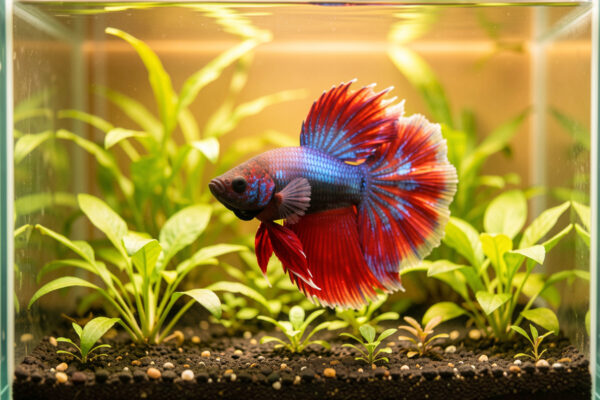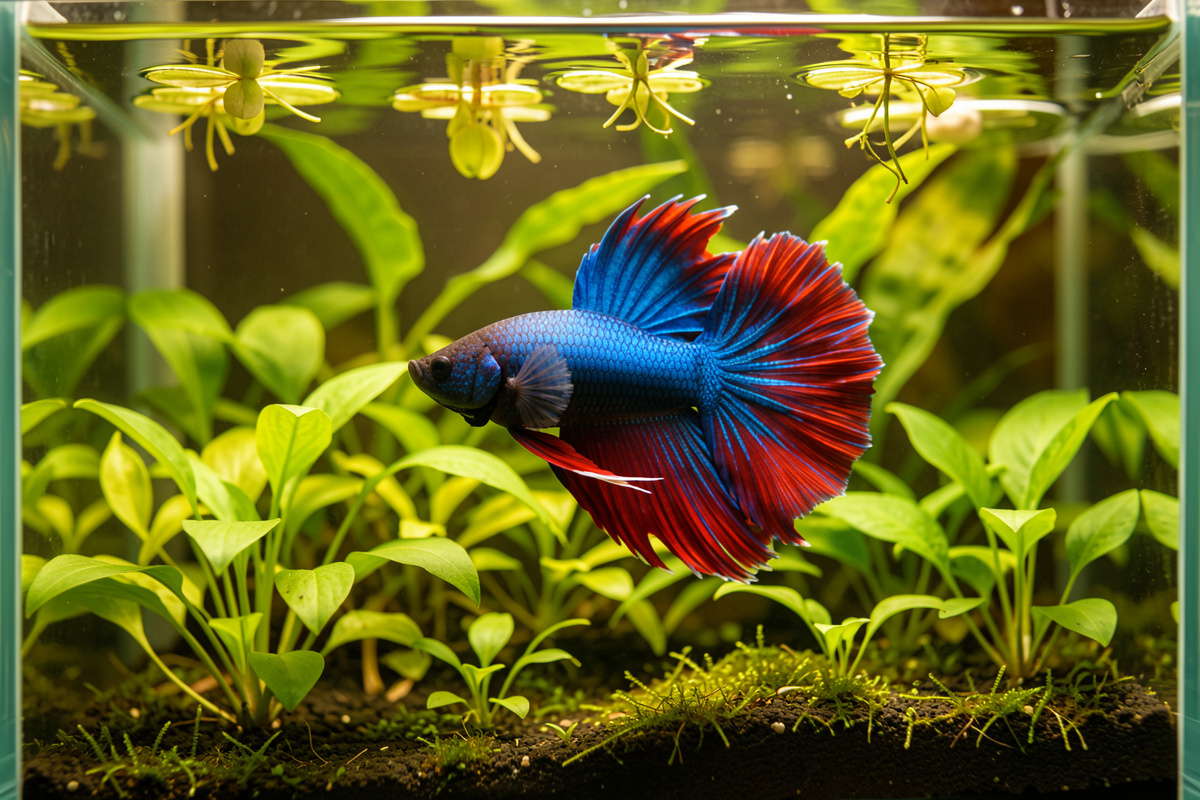
A betta in a nano tank thrives in a heated, filtered, cycled aquarium of at least 19 litres (5 US gallons) held at 25–27 C with gentle flow. The myth that a betta is a low-tech bowl fish kills more of them than any disease. Small water is not easier water — it swings faster, so it demands more discipline, not less.
I keep my tanks the way I ran hydroponic reservoirs for years: parameters logged, one change at a time, conclusions earned from numbers rather than hope. The betta is the species the pet trade has lied about the most, and almost every problem people bring me — clamped fins, refused food, a fish that just fades — traces back to husbandry physics, not bad luck. This guide is the whole system: the volume, the heat, the cycle, the flow, the plants, and the tankmates that actually work at nano scale. Each section links to a deeper walkthrough so you can drill down where you need to.
Why the Betta Is the Most Mis-Sold Fish in the Hobby
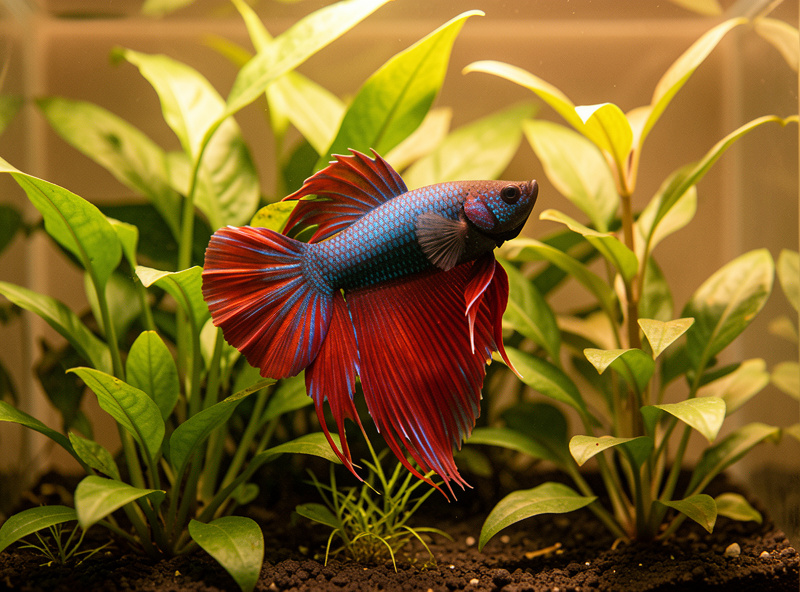
The betta is sold in a cup and pictured in a vase, so people assume it wants tiny, still, unheated water. It does not. Betta splendens evolved in warm, vegetated, slow-moving shallows in Southeast Asia — warm and planted, not cold and bare. A cup is a shipping container, not a habitat.
What makes the betta look bowl-proof is its labyrinth organ, which lets it gulp atmospheric air. That trait keeps a betta alive in oxygen-poor water for a while, and the trade has quietly turned “survives” into “thrives.” In my parameter log, the difference between those two words is measured in ammonia, temperature stability, and how fast the water chemistry moves when you are not watching. A labyrinth fish in a degrading bowl is not happy; it is enduring. The honest starting point for keeping one well is to throw out everything the cup implied and treat the betta as the warm-water, soft-current, cover-loving fish it actually is.
The Real Minimum: Volume, Heat, and the Cycle Come First
The non-negotiable trio for a betta is volume of at least 19 litres, a heater holding 25–27 C, and a completed nitrogen cycle. Miss any one and you are managing a slow decline, not keeping a fish. Everything else — plants, decor, tankmates — is optional comfort layered on top of those three.
Volume is the master variable because it buys you chemical stability. A larger body of water dilutes ammonia, holds temperature, and resists the parameter swings that small water produces by default. I argue the volume case in detail in my breakdown of the real minimum tank size for a betta, and the broader physics in why small aquariums are harder. The heat case — why tropical means tropical, and what a cold tank does to a betta’s immune system and appetite — gets its own guide on whether bettas need a heater. And none of it matters until the tank is biologically cycled: a betta in an uncycled tank is swimming in its own ammonia. If “cycling” is a new word, start with my honest nitrogen cycle guide and the fishless cycle walkthrough before the fish ever arrives.
Bowl, 10 Litre, 20 Litre, 60 Litre: An Honest Comparison
The most useful thing I can show you is what each common “betta home” actually delivers in stability terms. The table below is the verdict I give every time someone asks me what to buy. The short version: a 19–38 litre (5–10 gallon) tank is the sweet spot — small enough to stay a nano, large enough to forgive a mistake.
| Setup | Volume | Heatable? | Filterable? | Parameter Swing Risk | My Verdict |
|---|---|---|---|---|---|
| Betta bowl / vase | 0.5–3 L | No (no safe heater) | No | Extreme | Cruel by physics |
| 10 litre cube | ~10 L | Marginal | Yes (gentle) | High | Expert-only minimum |
| 20 litre nano | ~19–23 L | Yes | Yes | Moderate | The honest sweet spot |
| 60 litre planted | ~57–60 L | Yes | Yes | Low | Forgiving and beautiful |
Notice the bowl’s verdict is not “hard” — it is “cruel by physics,” because you cannot heat or filter it safely, full stop. I unpack exactly why in the volume and heat truth about betta bowls. If you only take one number from this guide, take 19 litres.
Filtration and Flow: A Betta Wants a Current It Can Win Against
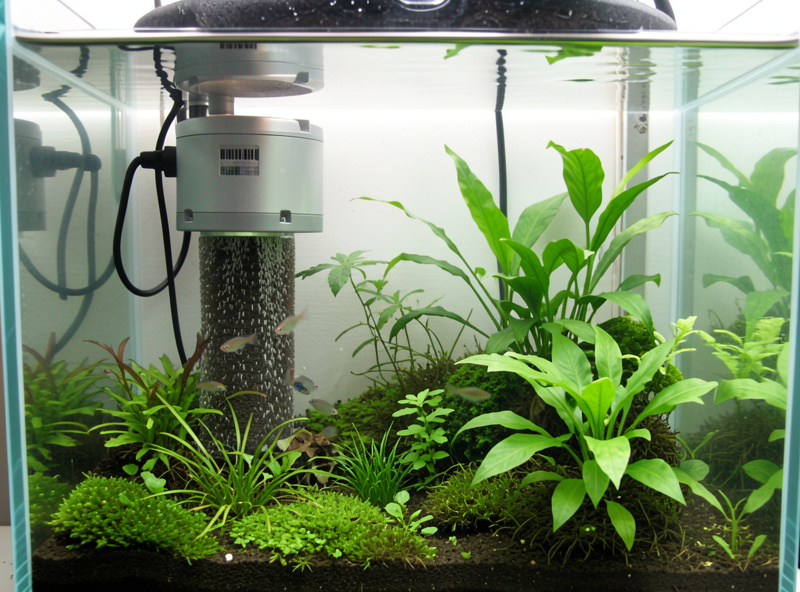
A betta needs filtration but hates strong flow. Those heavy, trailing fins act like a sail, and a current that would be nothing to a tetra exhausts a betta, pinning it in a corner or against the intake. Aim for gentle, broken flow — a sponge filter or a baffled output is ideal.
This is one of the most common husbandry mistakes I see: people add a filter rated for a much larger tank and then wonder why their betta looks ragged and stressed. The fish is not sick; it is fighting the weather. A sponge filter run off a small air pump gives you biological filtration and surface agitation without a torrent, which is why it is my default recommendation for any betta nano. If your tank came with a built-in pump that blasts the surface, you do not need new gear — you need to tame the one you have. I cover every fix, from filter floss baffles to spray bars, in betta and filter flow: when the current is too strong. A simple ATC sponge filter that pairs with a quiet air pump is the cheapest, most betta-appropriate filter you can buy: browse nano sponge filters on Amazon.
Heat: Tropical Means Tropical, and the Dial Lies
A betta is a tropical fish and needs a heater holding a stable 25–27 C (77–81 F). Room temperature in most homes — and certainly in a Swedish winter — sits well below that, and a cold betta eats less, moves less, and gets sick more easily. Cold is not a minor discomfort; it is a slow immune shutdown.
The trap at nano scale is that small water heats and cools fast, and cheap heaters overshoot. I never trust the dial on a nano heater — I verify with an external thermometer and watch for swing, exactly the way I verified nutrient temperatures on the hydro bench. A 25–50 watt adjustable heater suits most betta nanos; the reliability case for not cheaping out on this one component is in my nano heater reliability guide, and the species-specific version is do bettas need a heater. Always pair a heater with a separate thermometer you read daily: a cheap glass or digital aquarium thermometer is the difference between knowing and guessing.
The Cycle and the Test Kit: Where Most Betta Deaths Actually Start
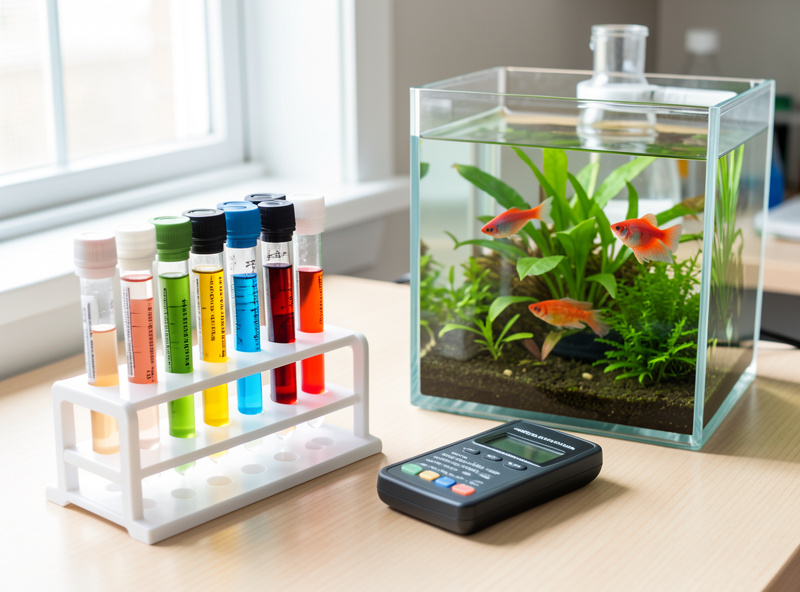
Most “mystery” betta deaths are ammonia poisoning in an uncycled tank, slow and invisible without testing. A betta needs a fully cycled tank reading zero ammonia and zero nitrite before it moves in, and a liquid test kit is the only honest way to confirm that. Test strips drift; liquid kits do not.
This is the part of betta keeping the cup never mentions and where my chemistry-first bias earns its keep. Ammonia from the fish’s waste and uneaten food has to be converted by bacteria into nitrite, then into far-less-toxic nitrate, and that bacterial colony takes weeks to establish. Until it does, every bit of waste is a toxin. I test, I do not guess — the same liquid ammonia/nitrite/nitrate kit lives in my aquarium drawer and once lived next to my nutrient reservoirs. If you are unsure whether your tank is ready, my double-zero test pattern tells you exactly what the numbers should read, and parameter swings in a small tank explains why nano water moves faster than you expect. A freshwater liquid master test kit is the single highest-value purchase in this hobby. As an Amazon Associate I earn from qualifying purchases.
Plants: A Planted Betta Tank Is Easier to Keep, Not Harder
Live plants make a betta nano more stable, not more work. They consume ammonia and nitrate directly, give the fish cover that lowers stress, and break up sightlines and flow. For a betta, the best plants are low-light, undemanding species like Anubias, Java fern, and floating plants that need no CO2 and no high-PAR lighting.
Bettas love to rest, and a broad Anubias leaf near the surface becomes a favourite perch — a planted tank is enrichment as much as filtration. The good news for beginners is that the betta-appropriate plant list is also the easy-care list: epiphytes you tie to wood or rock, hardy stems, and floaters that dim the light a betta prefers anyway. You do not need a high-tech setup; my low-tech planted nano guide covers the whole approach, and the species shortlist tuned specifically for bettas is in best plants for a planted betta nano tank. If your lighting question runs deeper, the nano lighting guide sorts out photoperiod without feeding algae. Anubias is the perfect starter epiphyte: Anubias nana for nano tanks.
Tankmates: Most Bettas Are Better Off Alone
The honest default is that a betta nano is a single-fish tank. In a 19–38 litre nano there is rarely room for the bioload and the temperament gamble that tankmates bring. The only reliable “tankmates” at nano scale are invertebrates — snails and, with caution, shrimp — not other fish.
People want a community tank because it looks lively, but a betta is a territorial, individually temperamental fish: one will ignore shrimp for a year, the next will hunt them to zero. I am honest about that risk rather than selling a tidy stocking list that gets animals killed. Nerite snails are the safest companions because they add no meaningful bioload and a betta ignores them. Shrimp are a real maybe — sometimes a thriving colony, sometimes lunch — and I lay out the odds in keeping shrimp with fish. The full, species-by-species reality for a nano is in betta tankmates that actually work in a nano, and the underlying math of who fits in small water is in my nano stocking guide and the volume math.
Fins and Appetite: The Two Early-Warning Systems
A betta’s fins and its appetite are the two gauges that tell you the husbandry is wrong before anything looks dramatic. Clamped or deteriorating fins almost always mean water quality or temperature, and a betta that stops eating in a new tank is usually reacting to husbandry, not illness. Read those gauges and you catch problems while they are still free to fix.
Fin rot is the classic example of a husbandry problem dressed up as a disease. Before anyone reaches for medication — which is squarely vet territory, not mine — the first question is always: what do the ammonia, temperature, and flow numbers read? My betta fin damage prevention checklist is a husbandry-first walkthrough, because clean, warm, stable water heals far more fins than any bottle. The same logic applies to a new betta that refuses food: stress, cold, and an uncycled tank come first on the list, long before you worry the fish is sick. I work through it in betta not eating in a new tank. For the maintenance rhythm that keeps both gauges in the green, my water change cadence guide and the broader nano stability guide are the routines I actually run.
Acclimating a New Betta Without Shocking It
The day the betta arrives is the day most beginners undo all their preparation. Never tip the cup straight into the tank. The water the fish travelled in differs from your tank in temperature, pH, and hardness, and dumping it across that gap shocks the animal. Drip acclimation over 30–45 minutes closes the gap gently.
My method is the same patience I learned moving plants between nutrient solutions: float the sealed cup for 15 minutes to match temperature, then start a slow drip from the tank into the cup — a knotted length of airline does it — until the cup volume has roughly tripled. Then net the fish into the tank and discard the cup water rather than pouring it in; that shipping water can carry ammonia and you do not want it in a freshly cycled nano. The first 24 hours, leave the betta alone: no feeding, dim light, no audience pressed against the glass. A fish that hides on day one is behaving normally, not failing. Stress at introduction is the hidden cause behind a surprising share of the “my new betta won’t eat” messages I get, which is why I treat the move itself as part of the husbandry, not an afterthought.
Feeding a Betta in a Nano: Small, Targeted, Logged
Overfeeding is the fastest way to wreck a nano’s water chemistry, because every uneaten pellet becomes ammonia in a small volume. Feed a betta only what it clears in about two minutes, once or twice a day, and remove anything left over. A betta’s stomach is roughly the size of its eye — it needs far less than the cup-feeding instructions imply.
A quality betta-specific pellet should be the staple, with the occasional frozen or freeze-dried treat such as daphnia or bloodworm for variety and to help with the occasional constipated, bloated fish. I keep one fast day a week, which is normal husbandry, not deprivation. The reason I am so strict about feeding is bioload arithmetic: in 19 litres there is no buffer for rotting food, so what looks like generosity is really a slow ammonia dose. This is the same discipline behind my water change cadence — small inputs, matched outputs, logged. Watch the fish’s body shape over a week rather than feeding to a schedule blindly, and you will dial in the right amount for your individual betta.
The Setup, Start to Finish
Put the system together in order and a betta nano is genuinely low-stress to run. The sequence is: tank (19 L+) → heater and thermometer → gentle filter → substrate and plants → fishless cycle → test to double-zero → then the betta. Skipping straight to the fish is the single decision that turns this hobby into a string of funerals.
Once it is running, the work is small and steady: weekly water changes matched to temperature, a daily glance at the thermometer, feeding little and removing what is not eaten in a couple of minutes, and a periodic test to confirm the numbers have not drifted. That is the whole job. A planted, cycled, heated nano with one betta is one of the most rewarding low-maintenance tanks you can keep — and in a dark Swedish winter, the best-lit window in the house. The trick was never to make it tiny and simple. It was to respect that small water is the advanced class, give it the three non-negotiables, and let the chemistry do the rest. Test, do not guess — whatever is living in the water.
Frequently Asked Questions
What is the minimum tank size for a betta?
At least 19 litres (5 US gallons). That volume lets you heat and filter the tank and gives the water enough mass to resist the rapid ammonia and temperature swings that kill bettas in smaller containers. Bigger is more forgiving; smaller is expert-only.
Do bettas really need a heater and filter?
Yes to both. A betta is a tropical fish needing a stable 25 to 27 C, which room temperature rarely provides, and it needs a cycled filter to process ammonia. The labyrinth organ lets a betta survive poor water briefly, but surviving is not thriving.
Can a betta live in a bowl?
No. A bowl cannot be safely heated or filtered, so the water swings in temperature and accumulates ammonia. A betta in a bowl is slowly declining, not thriving. The smallest responsible betta home is a heated, filtered, cycled tank of 19 litres or more.
Why is my betta’s filter flow a problem?
A betta’s long fins act like a sail, so a current sized for a normal tank exhausts it and pins it in corners. Use a sponge filter or baffle the output to create gentle, broken flow. Clamped fins and a betta hiding from the outflow are the warning signs.
What plants are best for a betta nano tank?
Low-light, undemanding plants: Anubias, Java fern, Bucephalandra, and floating plants. They need no CO2 or high lighting, consume ammonia and nitrate, and give the betta cover and resting perches. Floating plants also dim the light, which bettas prefer.
Can a betta have tankmates in a nano tank?
Usually it is safest alone. At nano scale the reliable companions are invertebrates like nerite snails, and sometimes shrimp, never other fish. Betta temperament is individual: some ignore shrimp, others hunt them. Cory cats and most community fish need far more volume than a nano provides.
Why has my new betta stopped eating?
Most often husbandry, not illness. A new betta reacts to stress, cold water, or an uncycled tank by refusing food. Check that the temperature holds 25 to 27 C and that ammonia and nitrite read zero before assuming the fish is sick. Settling in can take several days.
Related Guides
- What Is the Real Minimum Tank Size for a Betta?
- Is a Betta Bowl Cruel? The Volume and Heat Truth
- Betta Tank Mates That Actually Work in a Nano
- Betta and Filter Flow: When the Current Is Too Strong
- Do Bettas Need a Heater? The Tropical Reality
- Preventing Betta Fin Damage: A Husbandry Checklist
- Best Plants for a Planted Betta Nano Tank
- Betta Not Eating in a New Tank: Husbandry Causes First